

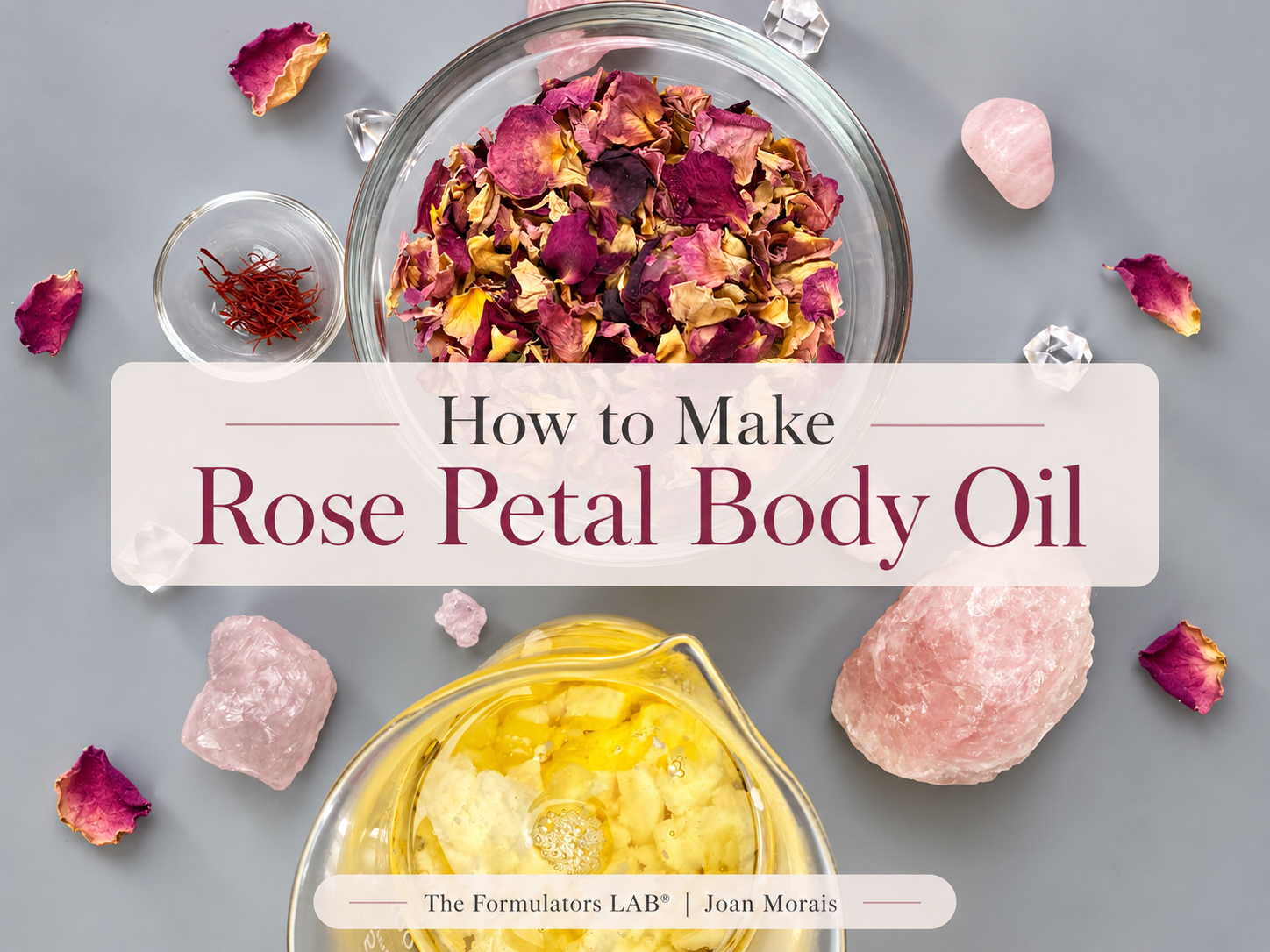
Free Formula Below: Rose Petal Body Oil infused with 6 varieties of organic rose petals and saffron.
How to Make Rose Petal Body Oil
Rose Petal Body Oil is a beautiful botanical oil created for massage, self-care, and everyday skin nourishment. It combines dried organic rose petals with coconut, sunflower, and sesame oils to leave the skin feeling soft, smooth, conditioned, and cared for.
Inspired by the traditions and wisdom of Ayurveda, this oil can become part of a simple self-nurturing ritual—an opportunity to slow down, massage the body, breathe in the delicate aroma of rose, and enjoy intentional touch.
For this infusion, I like to use a blend of several varieties of organic dried rose petals. Each brings its own subtle color, aroma, and character to the finished oil.
Rose
Rose has been treasured by cultures around the world for centuries and is often associated with love, beauty, comfort, and the heart.
The petals have a soft, sweet floral aroma and make a beautiful addition to botanical skin and body preparations. When infused into oil, dried rose petals add a sense of ritual and luxury while complementing nourishing plant oils.
Rose is especially lovely in formulations designed for dry, delicate, or mature-feeling skin.
The Essential Oils
Rose Essential Oil and Rose Absolute
For an even more luxurious rose aroma, a very small amount of rose essential oil or rose absolute can be added after the infusion is complete.
Although both come from rose flowers, they are produced using different extraction methods.
Rose Otto Essential Oil — Rosa damascena
Rose otto is produced through steam distillation of rose flowers.
Steam distillation captures many of the volatile aromatic compounds naturally present in the flower. Because an enormous quantity of rose petals is required to produce a very small amount of essential oil, true rose otto is one of the most precious essential oils used in aromatherapy and perfumery.
Its aroma is floral, fresh, complex, and unmistakably rosy.
Rose Absolute — Rosa damascena or Rosa centifolia
Rose absolute is produced using solvent extraction.
This extraction method captures a somewhat different range of aromatic compounds than steam distillation, resulting in a deeper, richer, and often more intense rose aroma.
Both rose otto and rose absolute smell beautiful, but each has its own distinctive character.
Because rose aromatics are extremely concentrated, only a very small amount is needed.
The Plant Oils
Saffron
Saffron comes from the dried stigmas of the Crocus sativus flower and is one of the world’s most precious spices.
It has been traditionally used in cooking, perfumery, botanical preparations, and Ayurvedic beauty rituals. Saffron contains naturally occurring antioxidant compounds and adds another special botanical element to this infusion.
Only a few threads are needed.
Coconut Oil
Coconut oil gives the body oil softness, richness, and glide.
It helps condition and soften both skin and hair and contributes to the smooth massage quality of the finished oil.
Refined coconut oil can be used when you want very little coconut aroma. Because coconut oil becomes solid at cooler temperatures, the finished body oil may also become thicker or partially solid depending on room temperature.
In Ayurvedic traditions, coconut oil is considered cooling and is often associated with Pitta.
Sunflower Oil
Sunflower oil is one of my favorite oils for body care.
It is rich in naturally occurring fatty acids and contains vitamin E. It is lightweight, nourishing, and helps soften and condition the skin without making the formula feel excessively heavy.
Its fatty-acid composition also makes sunflower oil a beautiful choice for formulations designed to support the skin barrier.
In Ayurveda, sunflower oil is generally considered a versatile oil suitable for many different constitutions.
Sesame Oil
Sesame oil has a long history of use in Ayurveda and traditional body massage.
It is a rich, nourishing oil with excellent slip and a characteristic warm, nutty aroma. It works beautifully in body and massage oils and creates a more substantial feel than sunflower oil.
In Ayurvedic tradition, sesame oil is considered warming and grounding and is especially associated with Vata.
One thing to consider when formulating with sesame oil is its aroma. Its natural scent can compete with delicate and expensive aromatics such as rose otto.
Formulators Note:
If you are adding rose essential oil or rose absolute, reduce the amount of sesame oil or omit it entirely. Sesame oil has a naturally strong, nutty aroma that can overpower the delicate scent of rose.
If you are adding rose essential oil or rose absolute, reduce the amount of sesame oil or omit it entirely. Sesame oil has a naturally strong, nutty aroma that can overpower the delicate scent of rose.
How to Make Rose Petal Body Oil
Rose Petal Body Oil Formulation🌹
🌹Rose Petal Body Oil Formula
Phase A — Plant Oils
150 grams (3/4 cup) organic refined coconut oil
150 grams (3/4 cup) organic sunflower oil
50 grams (4 tbsp) organic sesame oil*
Phase B — Botanical Infusion
4 grams (1/2 cup) dried organic rose petals
Approximately 7 saffron threads — optional
Phase C — Aroma
2–3 drops rose essential oil or rose absolute — optional
Procedure
- Combine the coconut, sunflower, and sesame oils in a clean, dry, heat-safe container.
- Gently warm until the coconut oil has melted. The oils should be only slightly warm rather than hot.
- Add the completely dried rose petals and optional saffron.
- Allow the oil to cool completely.
- Cover the container and allow the botanicals to infuse into the oils.
- After the infusion is complete, strain the oil thoroughly to remove the rose petals and saffron.
- Add the optional rose essential oil or rose absolute and mix well.
- Transfer into a clean, dry bottle and label.
Formulator’s Notes
Adjusting the Sesame Oil
Sesame oil is a beautiful choice when you want a richer, more traditional Ayurvedic massage oil but it has a strong scent that can overpower the scent of essential oils. If you are using precious rose aromatics, I prefer using less sesame oil so its nutty aroma does not overpower the rose.
If you are not adding rose essential oil or rose absolute, you can increase the sesame oil to approximately 50–100 grams, reducing the coconut or sunflower oil by the same amount.
Always Use Dried Rose Petals
When making an anhydrous herbal oil infusion, the rose petals should be completely dried.
Fresh flowers contain water, which is something we generally want to avoid introducing into an oil infusion intended for storage.
My Favorite Way to Infuse Rose Petals
There are many traditional and modern methods for infusing botanicals into oils.
For this particular body oil, I love using a very gentle warming method over several days.
I gently warm the rose petals and oils to approximately 77°F / 25°C for about 30 minutes each day for three days. The 30 minutes includes the time needed for the oils to gradually warm.
After the third day, I strain the botanicals from the oil.
I was taught this beautiful method by Miss Beatrice, a seventh-generation Maya healer, while staying at her home in a village in Belize. I have carried the method with me ever since.
You can also make a traditional room-temperature infusion by allowing the dried rose petals to steep in the oil for approximately 3–4 weeks before straining.
How to Use Rose Petal Body Oil
Apply Rose Petal Body Oil whenever your skin needs extra nourishment or whenever you want to create a quiet self-care ritual.
Massage a small amount into the body using slow, circular movements.
It is especially beautiful after a warm bath or shower while the skin is still slightly damp. Applying oil to damp skin helps create a soft, conditioned skin feel and helps slow moisture loss from the surface of the skin.
The oil can also be used as:
- A body massage oil
- A scalp and hair oil
- A bath oil
- A hand and foot treatment
- An oil for Ayurvedic-inspired Abhyanga massage
Take a few moments while applying it to notice the warmth of your hands, the aroma of the rose, and the feeling of caring for your skin.
Use caution after applying oil to the feet, as they may become slippery.
Rose Petal Body Oil and Ayurveda
Ayurveda is an ancient system of wellness originating in India. The word Ayurveda is often translated as “the science of life.”
Ayurvedic traditions consider the individual as a whole, including the body, mind, senses, lifestyle, environment, and personal constitution.
One of the beautiful practices associated with Ayurveda is the use of plant oils for regular body massage.
What Is a Tridoshic Oil?
Ayurveda describes three primary doshas:
Vata • Pitta • Kapha
A tridoshic oil is designed to create balance among all three.
This Rose Petal Body Oil combines three different plant oils—coconut, sunflower, and sesame—to create a versatile massage oil with a balance of lightness, richness, warmth, and cooling qualities.
What Is Abhyanga?
Abhyanga is the traditional Ayurvedic practice of massaging the body with oil.
It can be performed by another person, but it is also a wonderful self-care practice.
The oil is traditionally massaged from the scalp all the way to the feet using long strokes over the limbs and circular movements around the joints.
Beyond skin conditioning, the beauty of Abhyanga is the ritual itself: slowing down, intentionally touching and caring for the body, and allowing yourself a few quiet moments before beginning or ending the day.
A Simple Abhyanga Ritual
- Set aside approximately 15 minutes before your bath or shower.
- Place a towel underneath your feet to protect the floor from oil.
- Warm approximately 3–4 tablespoons of Rose Petal Body Oil until comfortably warm.
- Begin with your scalp. Apply a small amount of oil and slowly massage with your fingertips using circular movements.
- If desired, gently massage a small amount onto the face, neck, and ears.
- Massage the arms and legs using long, comfortable strokes. Use circular movements around the elbows and knees.
- Massage the shoulders and any areas of the back that you can comfortably reach.
- Gently massage the abdomen using slow clockwise circular movements.
- Finish with the feet, taking time to massage the heels, soles, and toes.
- Rest for a few minutes and allow the oil to remain on the skin.
- Follow with a warm bath or shower. Cleanse gently and pat the skin dry rather than rubbing.
Abhyanga can be practiced whenever it feels supportive to you, whether occasionally as a special ritual or several times throughout the week.
Most importantly, it does not need to be complicated.
A beautiful plant oil, a few quiet minutes, and intentional touch can transform everyday skin care into something much more meaningful.
Free Formulators Guide
How to Make Rose Petal Body Oil
Download this free guide for a clear, practical reference you can use at your formulator bench.
Want to Learn More About Botanical Infusions?
If you would like to go beyond simple herbal oil infusions and learn how to thoughtfully select, prepare, and use botanicals in professional cosmetic formulations, I invite you to study with me.
I’m Joan Morais, herbalist, aromatherapist, cosmetic formulator, and educator, and I have been formulating and teaching cosmetic formulation for more than 20 years.
In my Professional Natural Skin Care Formulation Course and Professional Natural Hair Care Formulation Course, you’ll learn step by step how to work with plant ingredients, understand ingredient functions, develop professional formulas, and create skin and hair care products with greater knowledge and confidence.
Continue your formulation education:
Professional Natural Skin Care Formulation Course
Professional Natural Hair Care Formulation Course
Whether you are formulating for yourself, developing products for clients, or creating your own skin or hair care line, these courses are designed to give you the science, practical skills, and formulation knowledge to move forward as a cosmetic formulator.
You might also like