
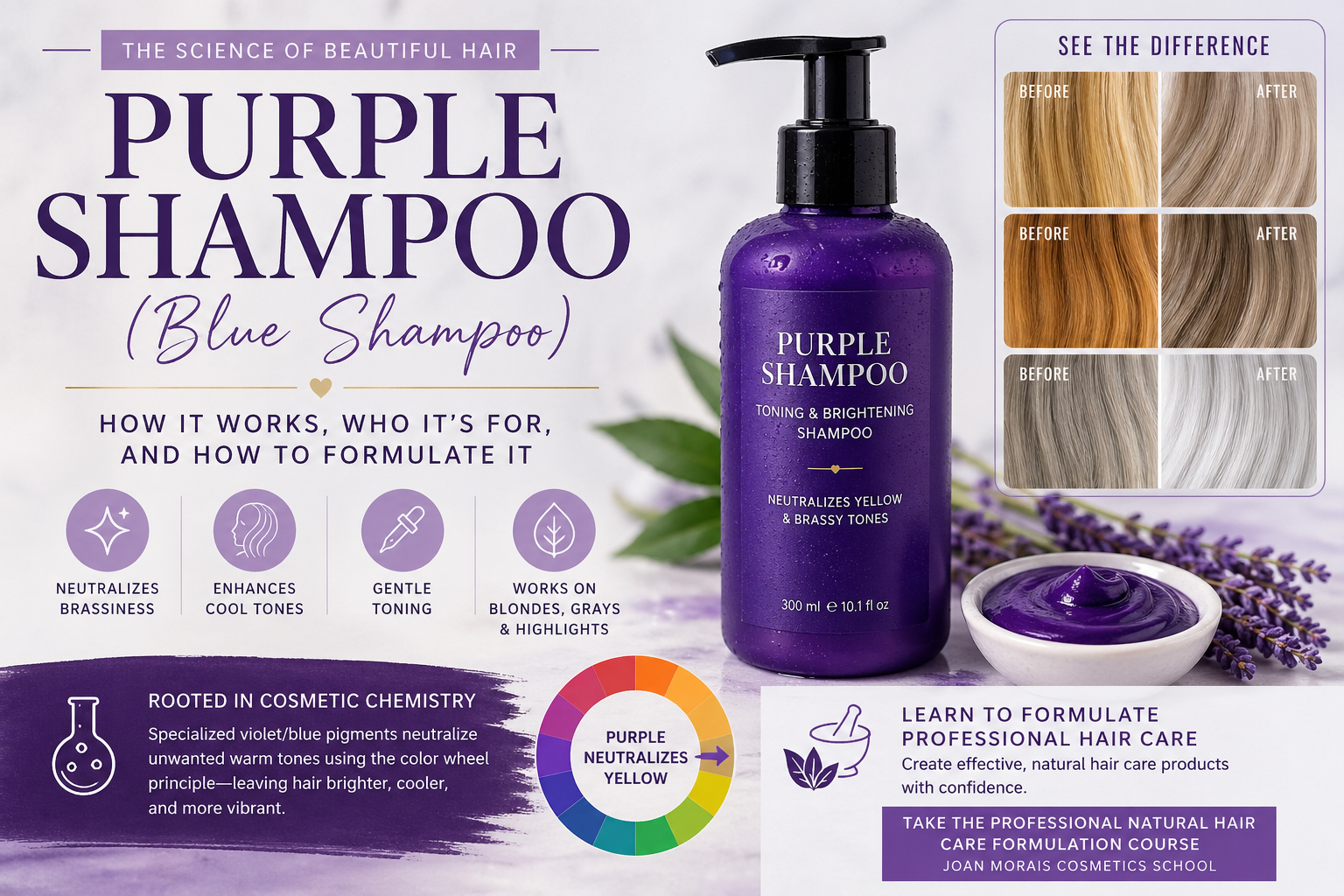
Purple Shampoo (Blue Shampoo)
Purple shampoo, also blue shampoo depending on the tone, is a specialized toning cleanser designed to neutralize unwanted warm tones in the hair. It’s one of the most widely used corrective maintenance products in both professional salons and at-home hair care routines.
If you’re formulating hair care products or building a line, understanding how toning shampoos work gives you a powerful, high-demand product category to offer.
What Is Purple (or Blue) Shampoo?
Purple and blue shampoos are color-depositing shampoos that use pigments to visually correct unwanted tones:
- Purple shampoo → neutralizes yellow tones
- Blue shampoo → neutralizes orange/brassy tones
This works based on color theory:
- Purple sits opposite yellow on the color wheel
- Blue sits opposite orange
So when applied to hair, these pigments visually cancel out warmth, leaving the hair looking:
- Brighter
- Cooler-toned
- More refined in color
The Purpose of Toning Shampoos
The primary function is color maintenance, especially for:
- Blonde hair (natural or lightened)
- Gray and silver hair
- Highlighted or balayaged hair
- Bleached or chemically lightened hair
What it does:
- Reduces brassiness
- Enhances cool tones (ash, platinum, silver)
- Brightens dull or yellowed hair
- Extends time between salon visits
How It Works (Cosmetic Chemistry Perspective)
From a formulation standpoint, purple shampoo is a surface-deposit system.
Key Mechanism:
- Water-soluble or dispersible direct dyes (basic dyes) deposit onto the hair shaft
- Hair, especially porous or damaged hair, has a negatively charged surface
- Many toning dyes are cationic (positively charged), allowing them to lightly adhere to the hair
This is not permanent color, it is:
- Temporary, does not color the hair purple if formulated correctly
- Surface-level deposition
- Gradually removed with washing
Key Functional Components in a Purple Shampoo
A toning shampoo is not just about adding pigment, it must balance cleansing, deposition, and hair feel.
1. Surfactant System
- Mild cleansers are preferred:
- Decyl Glucoside
- Cocamidopropyl Hydroxysultaine
- Sodium Lauroyl Sarcosinate
Harsh surfactants can strip both natural oils and deposited pigment too quickly.
2. Color Pigments (Critical Phase)
- Violet No. 2 dye
- Used at very low percentages
- Bleached hair: 0.02-0.12%
- White and Silver hair: 0.05-0.25%
- Must be:
- Stable in the formula
- Compatible with pH and surfactants
3. Conditioning Agents
To improve feel and deposition:
- Guar Hydroxypropyltrimonium Chloride
- Polyquaterniums (e.g., Polyquaternium-7, -10)
These help:
- Improve slip
- Enhance pigment adherence
- Reduce dryness
4. pH Control
- Ideal range: ~5.0–5.5
- Supports:
- Cuticle smoothing
- Better pigment adherence
- Scalp compatibility
5. Viscosity Modifiers
- Xanthan gum or other gums
- Ensures even distribution during application
How Purple Shampoo Works on Different Hair Types
Type 1–2 (Straight to Wavy)
- Less porous → lighter pigment deposit
- Needs:
- Shorter processing time
- Lower pigment intensity
Type 3–4 (Curly to Coily)
- More porous → stronger pigment uptake
- Benefits:
- More noticeable toning effect
- Caution:
- Can over-tone if too strong
Gray / Silver Hair
- Highly receptive to pigment
- Can easily take on a slight purple hue if overused
Chemically Treated / Bleached Hair
- Very porous
- Absorbs pigment quickly
- Most responsive to toning shampoos
How to Use Purple or Blue Shampoo
Basic Instructions:
- Apply to wet hair
- Distribute evenly
- Leave on for 1–5 minutes (depending on intensity needed)
- Rinse thoroughly
- Follow with conditioner or mask
Frequency:
- 1–2 times per week (typically)
- Overuse can lead to:
- Dullness
- Slight purple/blue cast
Formulation Insight: Turning Our Shampoo Formulations into a Toning Shampoo
One of the most powerful formulation advantages is this:
Our well-balanced shampoo formulation bases can be converted into a purple or blue shampoo with a simple adjustment. We teach you how and the amounts of violet to use for hair color.
The Adjustment:
- Add a controlled percentage of violet dye
- Ensure:
- Proper dispersion
- Stability in the system
- Even distribution
Important Formulation Considerations:
- Start with very low dye levels
- Test on different hair swatches
- Evaluate:
- Deposit intensity
- Wash-out behavior
- Staining risk (skin, nails, surfaces)
Practical Takeaway for Formulators
Instead of creating entirely new systems, you can:
- Use our existing shampoo formulations
- Customize them into:
- Purple shampoo (anti-yellow)
- Blue shampoo (anti-orange)
This makes it:
- Easier to customize our shampoo formulations
- Cost-effective
- Scalable
- Easy to expand a product line
Learn to Formulate Professional Hair Care Products
If you want to go deeper into:
- Purple shampoo formulation
- Shampoo systems for all hair types
- Color-safe formulations
- Conditioning systems
- Styling and treatment products
- Creating a full sellable hair care line
Download the Purple Shampoo Handout
You’ll learn all of this inside the
Professional Natural Hair Care Formulation Course
Inside the course:
- You receive complete, professional formulations
- Learn how to customize and modify them
- And are authorized to make and sell your products
You might also like