
Lamellar Liquid Crystal Structures: What They Do in Cosmetic Formulations, Skin and Hair
When formulating a moisturizer or hair conditioner, it is easy to focus primarily on the ingredient list. However, ingredients are only part of the story. The way those ingredients organize themselves inside the finished product can have a major influence on stability, texture, application and performance.
One important type of internal organization is known as a lamellar liquid crystal structure.
Lamellar liquid crystal emulsions can create elegant textures, hold water within the formulation, support emulsion stability and improve the delivery of conditioning ingredients to the skin or hair. Although the term may sound complicated, the basic concept is surprisingly simple. Learn about two emulsifiers that create lamellar liquid crystal structure here.
What Is a Lamellar Liquid Crystal Structure?
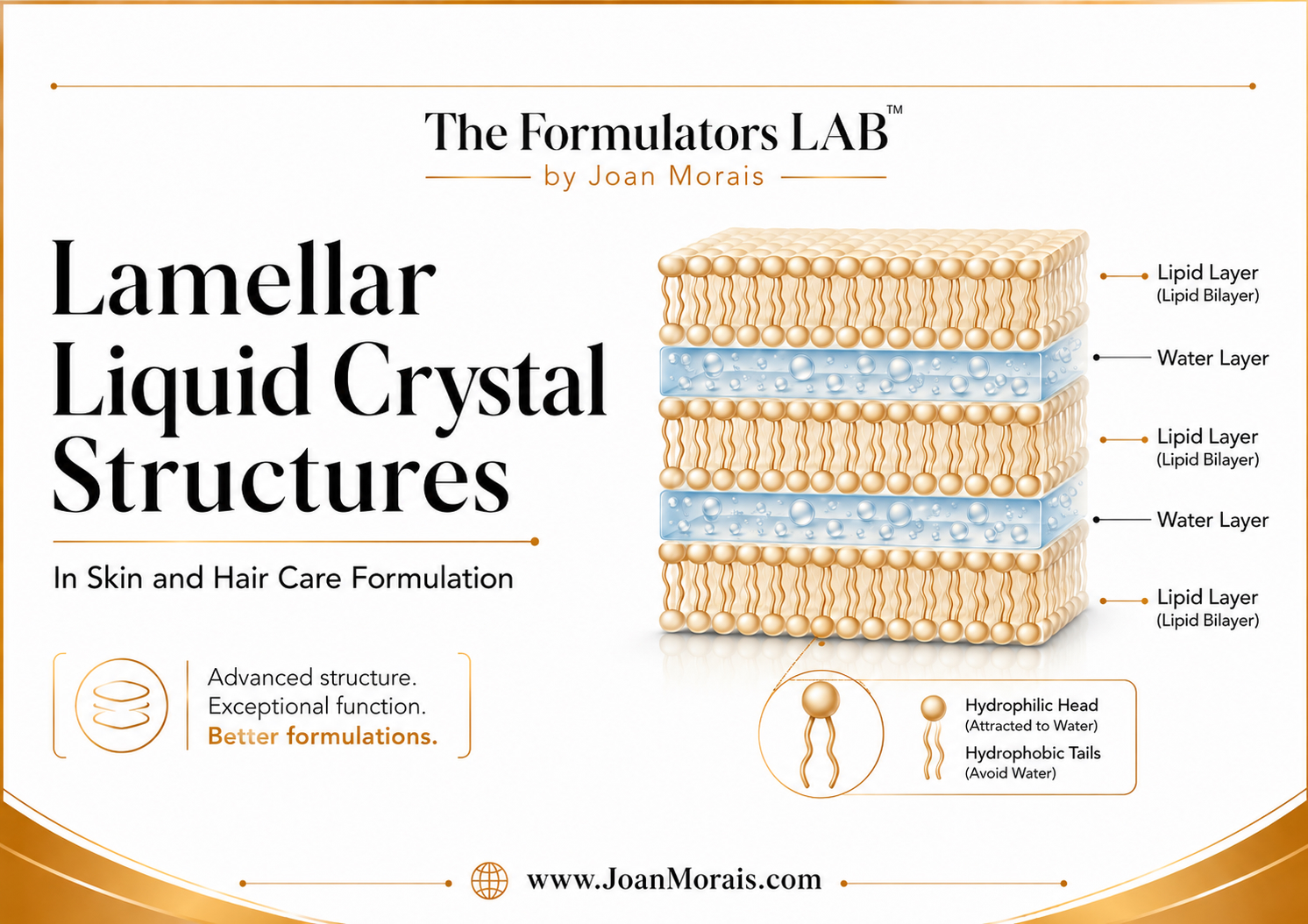
The word lamellar means arranged in thin layers.
In a lamellar structure, emulsifiers, fatty alcohols, lipids and water organize into repeating layers. The oil-loving portions of the emulsifier molecules face toward other oil-loving portions, while their water-loving portions face the surrounding water.
This creates alternating layers of:
Lipid layer → water layer → lipid layer → water layer
The arrangement is similar to a stack of extremely thin sheets with water held between them.
The term liquid crystal describes a state that is more organized than a regular liquid but still has some movement and flexibility. It is not a hard crystal like salt or sugar, and it has nothing to do with visible decorative crystals. The molecules are arranged in an orderly pattern while the product remains soft, spreadable and fluid under pressure.
Depending on the formulation, lamellar structures may form around oil droplets, exist as multilayered vesicles or connect throughout the water phase as a lamellar gel network. Researchers have confirmed these structures using techniques such as polarized microscopy, small-angle X-ray scattering and small-angle neutron scattering.
How Is a Lamellar Emulsion Different from an Ordinary Emulsion?
A conventional oil-in-water emulsion contains oil droplets dispersed throughout water. Emulsifier molecules sit primarily at the surface of each oil droplet and help prevent the droplets from joining together.
A lamellar emulsion has an additional level of organization. Instead of forming only a single emulsifier layer around the droplets, some of the emulsifier, fatty alcohol and lipid molecules organize into multiple layers within the formula.
This structured network can influence:
- Emulsion stability
- Viscosity and flow
- Water retention
- Product texture
- Skin or hair deposition
- Release of active ingredients
- After-feel and conditioning
Not every thick cream is a lamellar emulsion. A product may be thickened with gums, polymers, waxes or fatty alcohols without developing a true lamellar liquid crystal structure.
What Does a Lamellar Structure Do in a Formulation?
It Supports Emulsion Stability
The layered structure can create a stronger physical barrier between oil droplets. It may also form a network throughout the continuous phase that limits droplet movement.
This can help reduce:
- Oil droplet coalescence
- Creaming
- Separation
- Rapid changes in viscosity
- Uneven distribution of ingredients
The lamellar structure does not replace proper emulsifier selection, preservation or stability testing. It is one part of the complete emulsion system.
It Creates Body and Structure
Lamellar gel networks can give creams and conditioners a rich, substantial body. The product may appear firm in the container but spread easily when pressure is applied.
This is known as yield stress and shear-thinning behavior. The structure helps the product remain stable at rest, but the network temporarily breaks down during pumping, rubbing or spreading.
When the pressure is removed, the product regains much of its structure. This contributes to the creamy, cushioned texture associated with many high-quality moisturizers and conditioners. Research on conditioner-type lamellar gel networks has connected their microscopic organization with their rheology, dilution behavior and sensory properties.
It Holds Water Within the Formula
Water can become positioned between the lipid layers. This gives the lamellar network the ability to act as a type of microscopic water reservoir.
The water is not permanently trapped, but its movement and evaporation may be slowed. This can contribute to a more hydrated skin feel and a less watery or fleeting application.
It Influences Product Sensory
A lamellar structure can produce a texture that feels:
- Cushioned
- Silky
- Creamy
- Moisturizing
- Substantial without necessarily feeling waxy
- Less greasy than expected from the oil-phase percentage
The sensory result is not created by the lamellar structure alone. The emollients, fatty alcohols, emulsifier concentration and processing method all affect the final feel. Studies have shown that changing the chemical structure of the emollient can alter the molecular organization of the liquid crystals and, in turn, change the sensory properties of the emulsion.
It Can Influence Active-Ingredient Delivery
Lamellar structures contain both water-associated and lipid-associated regions. This allows them to accommodate certain water-soluble and oil-soluble ingredients within different parts of the structure.
The network may help protect some ingredients, control their release or increase their contact with the skin. However, it should not automatically be assumed that every lamellar emulsion delivers every active more deeply.
Release and penetration still depend on:
- The active ingredient
- Its solubility
- Molecular size
- Concentration
- The oil phase
- The emulsifier system
- The condition of the skin
- The complete finished formula
A lamellar structure is a delivery environment, not a guarantee of enhanced skin penetration.
Free Formulators Guide
Lamellar Liquid Crystal Structures
Download this free guide for a clear, practical reference you can use at your formulator bench.
What Does a Lamellar Structure Do on the Skin?
The outermost layer of the skin, the stratum corneum, is often described using a brick-and-mortar analogy. The corneocytes are the bricks, and the intercellular lipids surrounding them are the mortar.
Those natural skin lipids, including ceramides, cholesterol and free fatty acids, are themselves organized into lamellar layers.
Because a lamellar cosmetic emulsion has a layered organization similar to the organization of stratum corneum lipids, it may have a strong affinity for the skin surface. This is why lamellar emulsions are sometimes described as biomimetic or skin compatible systems.
In comparative research, a lamellar gel demonstrated improved skin hydration and occlusion compared with regular emulsions. The researchers attributed this performance partly to the similarity between the formulation structure and the organization of the skin’s natural lipids.
Potential Skin Benefits
A properly formulated lamellar emulsion may help:
- Reduce the rate of water evaporation
- Improve immediate and longer-lasting hydration
- Support a smoother skin surface
- Deliver emollients more evenly
- Replenish compatible surface lipids
- Improve the feel of dry or compromised skin
- Provide a protective yet breathable-feeling layer
Clinical research involving a self-assembled lamellar lipid formulation has also demonstrated benefits for dry skin and skin-barrier measurements.
It is important to understand that the structure alone does not “repair” the skin. The composition of the lipid layers matters. A lamellar cream containing appropriate ceramides, fatty acids, sterols and emollients will not perform identically to one made from emulsifier and fatty alcohol alone.
The finished formula must supply ingredients that are useful to the intended skin type.
Does a Lamellar Emulsion Become Part of the Skin Barrier?
Not exactly.
The formula does not simply turn into new skin or permanently replace the skin’s natural lipid matrix. Instead, it may interact closely with the skin surface, form a protective deposit and supply lipids that support the barrier environment.
The degree of interaction depends on the formula’s lipid composition, molecular organization and application conditions.
For this reason, it is more accurate to say that a lamellar emulsion can support the skin barrier rather than claim that it completely rebuilds or duplicates it.
What Does a Lamellar Structure Do in Hair Care?
Lamellar structures are also extremely important in hair conditioners, masks and intensive treatments.
In many conditioners, a positively charged cationic surfactant is combined with long-chain fatty alcohols and water. During heating and controlled cooling, these ingredients organize into a lamellar gel network.
The network gives the conditioner:
- Creamy viscosity
- Stability in the container
- A rich, substantial texture
- Easy spreading through wet hair
- Controlled distribution of conditioning ingredients
- Good rinse behavior
The ratio of cationic surfactant to fatty alcohol, the fatty alcohol chain length, mixing time and cooling rate can all change the structure of the conditioner. Researchers have shown that processing conditions can affect the formation of multilamellar vesicles, the uniformity of the network and its final mechanical properties.
How It Helps the Hair Fiber
The visible hair shaft is a nonliving keratin fiber. It cannot heal itself in the same way that living skin can.
Hair conditioning therefore works primarily by modifying and protecting the surface of the fiber.
Cationic conditioning ingredients have an affinity for the hair surface and can adsorb through electrostatic and hydrophobic interactions. Research has demonstrated that cationic surfactants may form monolayer or bilayer associations on hair, depending on the surfactant and its concentration.
Once deposited, conditioning ingredients can help:
- Reduce friction between hair fibers
- Improve wet and dry combing
- Reduce static
- Smooth the cuticle surface
- Increase softness and flexibility
- Improve manageability
- Reduce the rough feel associated with damaged hair
- Help distribute oils and emollients more evenly
The lamellar network serves as the structured vehicle that holds and distributes these ingredients. It does not permanently reconstruct the cortex or fuse damaged hair back together.
Lamellar Structures and Textured Hair
Curly, coily, chemically treated and highly porous hair can benefit from conditioners that spread evenly and provide substantial surface lubrication.
A well-designed lamellar conditioner can provide a cushioned application and help distribute conditioning ingredients through the bends and curves of the hair fiber. The final performance, however, still depends on the type and concentration of the cationic conditioner, fatty alcohols, oils, polymers and humectants.
A lamellar structure is not automatically lightweight or heavy. The complete formula determines whether the conditioner is appropriate for fine hair, wavy hair, curly hair, tightly coiled hair or damaged hair.
Lamellar Skin Emulsions and Hair Conditioners Are Not Identical
The term lamellar describes the layered organization, but skin creams and hair conditioners may create that organization with very different ingredients.
A facial moisturizer may use nonionic emulsifiers, phospholipids, fatty alcohols, glyceryl esters, ceramides or plant-derived lipids.
A traditional conditioner commonly uses a cationic surfactant with cetyl alcohol, cetearyl alcohol, stearyl alcohol or another long-chain fatty material.
The skin formulation is generally designed to support hydration, emolliency and barrier comfort.
The hair formulation is generally designed to create deposition, lubrication, detangling and manageability.
The internal structures may be related, but their intended performance is different.
How Are Lamellar Structures Created?
Lamellar structures form through a process of self-assembly.
The emulsifier or surfactant molecules contain both a water-compatible portion and an oil-compatible portion. Under the appropriate conditions, these molecules align with one another and organize into layers.
The process is affected by:
- Emulsifier structure
- Fatty alcohol type and concentration
- Ratio of emulsifier to fatty alcohol
- Oil-phase composition
- Water content
- Electrolytes
- Polymers and gums
- Heating temperature
- Mixing method
- Homogenization
- Cooling rate
- Agitation during cooling
- Final pH
The processing method is especially important. Controlled studies have found that mixing time and cooling rate can alter the microscopic structure and homogeneity of lamellar gel networks.
General Processing Method
The exact procedure must always follow the emulsifier supplier’s recommendations, but a typical process includes:
Phase A: Prepare the Water Phase
Combine the water and compatible water-soluble ingredients. Heat the phase to the recommended emulsification temperature.
Phase B: Prepare the Oil Phase
Combine the oils, emulsifier, fatty alcohols and other heat-stable oil-soluble ingredients. Heat until everything is completely melted and uniform.
Combine the Phases
Add one phase to the other according to the requirements of the emulsifier. Mix or homogenize sufficiently to create the emulsion.
Begin Controlled Cooling
After the emulsion has formed, switch to moderate sweep or propeller mixing when appropriate.
This cooling stage is critical. The lamellar structure frequently develops as the emulsifier and fatty materials pass through their phase-transition and crystallization ranges.
Excessive high shear during the entire cooling process can sometimes disrupt the developing structure, while inadequate mixing may create an uneven product. The correct balance depends on the emulsifier system and batch size.
Add Cool-Down Ingredients
Add the preservative, fragrance, essential oils and heat-sensitive active ingredients at their appropriate temperatures.
Continue mixing until the product is uniform and has reached the required filling temperature.
How Can a Formulator Confirm a Lamellar Structure?
A product’s appearance alone cannot confirm that a lamellar liquid crystal structure has formed.
Under polarized light microscopy, some liquid crystalline systems display birefringence and characteristic patterns sometimes described as Maltese crosses. This can be a useful screening tool, but it does not always identify the exact structure.
More advanced analytical methods include:
- Small-angle X-ray scattering
- Small-angle neutron scattering
- Differential scanning calorimetry
- Cryogenic or transmission electron microscopy
- Rheological analysis
- Polarized light microscopy
Researchers frequently use a combination of these techniques because no single visual observation tells the complete structural story.
Common Formulation Mistakes
Assuming Every Fatty-Alcohol Cream Is Lamellar
Fatty alcohols can increase viscosity without necessarily forming the desired organized structure.
Changing the Oil Phase Without Retesting
The emollient type can change the arrangement of the liquid crystals, viscosity and sensory profile.
Ignoring the Cooling Process
The structure continues developing after the initial emulsion forms. Cooling rate and agitation can be just as important as homogenization.
Using the Emulsifier Percentage Alone
A higher emulsifier concentration does not automatically produce a better lamellar network. The ratios among emulsifier, fatty alcohol, oil and water must be balanced.
Treating the Structure as a Marketing Claim
A lamellar structure should be supported by supplier information, microscopy or appropriate testing. It should not be claimed solely because the product contains a particular emulsifier.
Are Lamellar Liquid Crystals the Same as Liposomes?
No.
A liposome is a closed vesicle made from one or more lipid bilayers surrounding an internal water compartment.
A lamellar liquid crystal phase may consist of extended layered sheets, multilamellar vesicles, layers around oil droplets or an interconnected gel network.
Liposomes have lamellar bilayers, but not every lamellar emulsion should be described as a liposomal product.
Are Lamellar Structures Natural?
Lamellar describes the organization of the ingredients—not whether they are natural or synthetic.
A lamellar emulsion can be created with natural-origin emulsifiers and plant-derived lipids, synthetic ingredients or a combination of both.
For a natural or vegan formulation, the formulator must still verify:
- Ingredient origin
- Processing aids
- Animal-derived components
- Certification status
- Supplier documentation
- Natural-origin calculations
The presence of a lamellar structure does not, by itself, establish that the formula is natural, organic or vegan.
The Formulator’s Takeaway
Lamellar liquid crystal structures are more than a cosmetic formulation trend. They represent an organized internal architecture that can influence how a cream or conditioner is stabilized, how it spreads and how it interacts with skin or hair.
In skin care, a lamellar structure can help retain water, improve hydration, support barrier comfort and distribute emollients and active ingredients.
In hair care, a lamellar gel network can create the creamy structure of a conditioner while helping conditioning ingredients spread and deposit more effectively on the hair fiber.
The greatest benefits are achieved when the formulator considers the entire system:
Ingredient selection + ingredient ratios + processing + cooling + stability testing + intended performance
A lamellar emulsifier cannot create an exceptional product by itself. However, when the formulation and manufacturing process are designed correctly, lamellar organization can help transform an ordinary cream or conditioner into a more stable, elegant and high-performing product.
Continue Your Formulation Education
Learn how to select emulsifiers, design stable systems and create professional natural and vegan skin and hair care products with The Formulators LAB by Joan Morais.
Professional training in natural, vegan cosmetic formulation
REFERENCES
1. Šindelka K, Kowalski A, Cooke M, Mendoza C, Lísal M. Interactions of cationic surfactant-fatty alcohol monolayers with natural human hair surface: Insights from dissipative particle dynamics. Journal of Molecular Liquids. 2023;375:121385. doi:10.1016/j.molliq.2023.121385.
2. Davies AR, Amin S. Microstructure design of CTAC and BTAC lamellar gels for optimized rheological performance utilizing an automated formulation platform. International Journal of Cosmetic Science. 2020;42:259–269. doi:10.1111/ics.12609.
3. Fameau AL, Veronico L, Le Coeur C, Mahmoudi N, Gentile L. Shear and cooling effects on lamellar gel network structure: Insights from Rheo-SANS. Journal of Molecular Liquids. 2024;414:126283. doi:10.1016/j.molliq.2024.126283.
4. Colafemmina G, Palazzo G, Mateos H, Amin S, Fameau AL, Olsson U, Gentile L. The cooling process effect on the bilayer phase state of the CTAC/cetearyl alcohol/water surfactant gel. Colloids and Surfaces A: Physicochemical and Engineering Aspects. 2020;597:124821. doi:10.1016/j.colsurfa.2020.124821.
5. Terescenco D, Savary G, Picard C, Clemenceau F, Merat E, Grisel M. Influence of the emollient on emulsions containing lamellar liquid crystals: From molecular organization towards applicative properties. International Journal of Cosmetic Science. 2018;40(6):565–574. doi:10.1111/ics.12498.
6. Nisbet S, Mahalingam H, Gfeller CF, et al. Cosmetic benefit of a biomimetic lamellar cream formulation on barrier function or the appearance of fine lines and wrinkles in randomized proof-of-concept clinical studies. International Journal of Cosmetic Science. 2019;41(1):1–11. doi:10.1111/ics.12499.
7. Fluhr JW, Darlenski R, Daehnhardt-Pfeiffer S, Albrecht M. Clinical efficacy of a multilamellar cream on skin physiology and microbiome in an epidermal stress model: A controlled double-blinded study. International Journal of Cosmetic Science. 2024;46(4):566–577. doi:10.1111/ics.12950.
8. Fluhr JW, Darlenski R, Daehnhardt-Pfeiffer S, Albrecht M. Impact of multilamellar formulations on stratum corneum lipid organization and epidermal lipid barrier enhancement, Part II. International Journal of Cosmetic Science. 2024;46(4):578–589. doi:10.1111/ics.12971.
9. Danby SG, Andrew PV, Kay LJ, et al. Enhancement of stratum corneum lipid structure improves skin barrier function and protects against irritation in adults with dry, eczema-prone skin. British Journal of Dermatology. 2022;186(5):875–886. doi:10.1111/bjd.20955.
10. Yang Y, Yan S, Yu B, Gao C, Chang K, Wang J. Lamellar gel containing emulsions as an effective carrier for stabilization and transdermal delivery of retinyl propionate. Colloids and Surfaces A: Physicochemical and Engineering Aspects. 2023;674:131834. doi:10.1016/j.colsurfa.2023.131834.
You might also like