
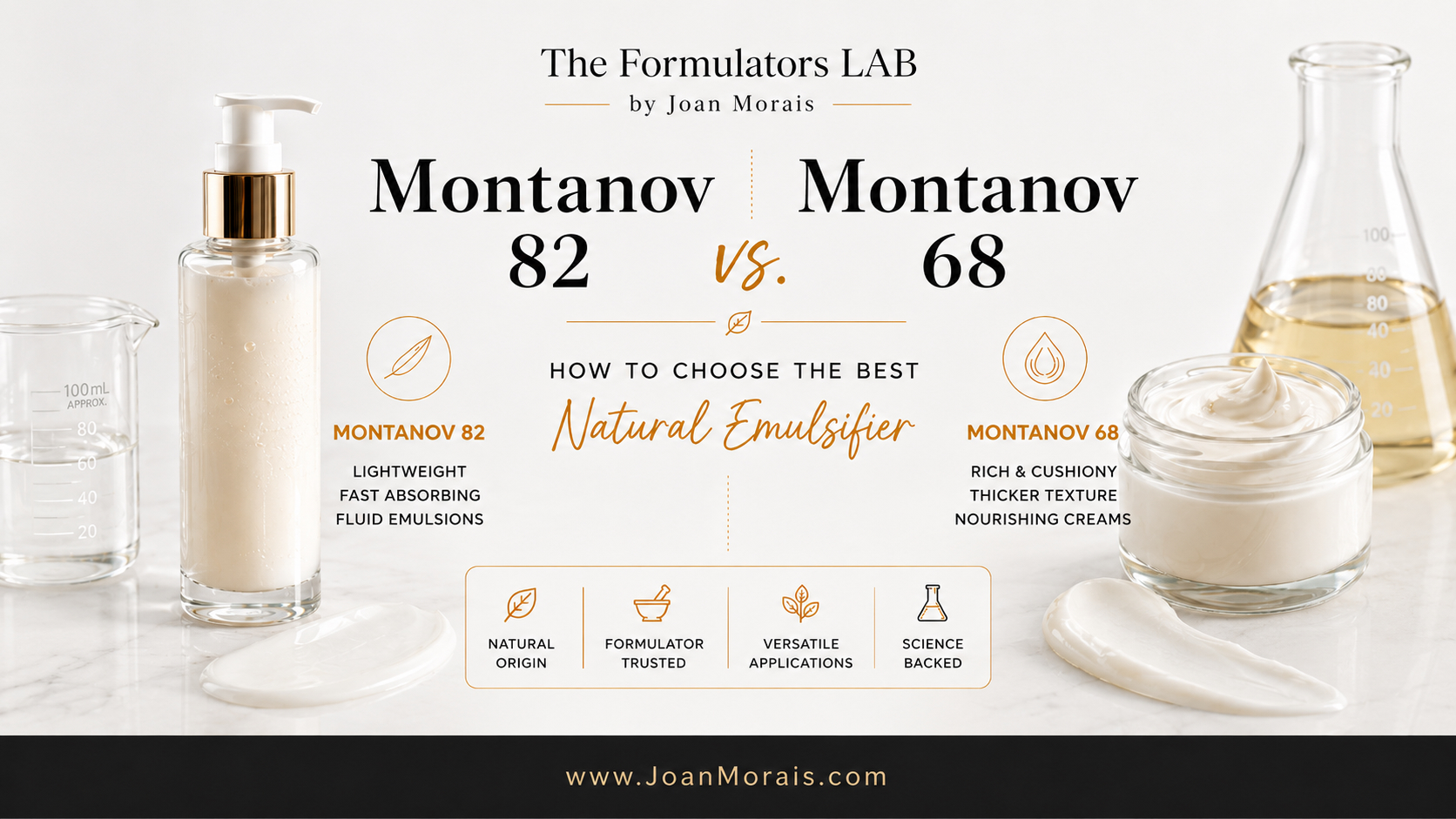
Montanov® 82 vs. Montanov® 68: Which Natural Emulsifier Should You Choose?
What Are Montanov® Emulsifiers?
Montanov emulsifiers are derived from plant-based fatty alcohols and sugars. They form lamellar liquid crystal structures that closely resemble the organization of lipids in the skin’s stratum corneum. Learn about lamellar liquid crystal structures here. This type of emulsion helps improve moisturization, enhances skin feel, and contributes to excellent long-term stability.
Both emulsifiers are:
- PEG-free
- Non-ionic
- Biodegradable
- Suitable for natural and organic formulations
- Compatible with most cosmetic ingredients
The main difference lies in the texture and viscosity they produce.
Montanov® 82
INCI: Cetearyl Alcohol (and) Coco-Glucoside
Montanov 82 creates elegant, lightweight emulsions with excellent spreadability and a fast-absorbing finish.
Best Applications
Montanov 82 is ideal for:
- Facial lotions
- Lightweight facial moisturizers
- Body lotions
- Facial milks
- Gel-creams
- Hand lotions
- After-sun lotions
- Daily moisturizers
- Lightweight men’s skin care
- Products designed for oily, combination, or normal skin
It is particularly useful when you want a lotion that feels silky rather than rich or heavy.
Recommended Usage Level
Typical usage:
2–5%
Typical oil phase:
8–20%
For most lotions:
- 3–4% Montanov 82
- 10–18% total oil phase
Characteristics
Produces:
- Fluid emulsions
- Fast absorption
- Light, silky skin feel
- Minimal waxiness
- Elegant slip
- Low tack
Because it produces lighter structures, formulas containing high levels of butters may require additional viscosity support.
Montanov® 68
INCI: Cetearyl Alcohol (and) Cetearyl Glucoside
Montanov 68 produces richer emulsions with greater body and viscosity while maintaining an elegant skin feel.
Best Applications
Montanov 68 works exceptionally well in:
- Facial creams
- Rich moisturizers
- Barrier creams
- Night creams
- Hand creams
- Body creams
- Baby creams
- Mature skin formulations
- Ceramide creams
- Products containing butters
It excels when a more luxurious cream texture is desired.
Recommended Usage Level
Typical usage:
3–6%
Typical oil phase:
15–30%
For many facial creams:
- 4–5% Montanov 68
- 18–25% oil phase
Characteristics
Produces:
- Thick creams
- Rich texture
- Excellent cushion
- Strong emulsion stability
- Creamy, moisturizing finish
- Excellent compatibility with butters and richer oils
Side-by-Side Comparison
| Feature | Montanov® 82 | Montanov® 68 |
|---|---|---|
| INCI | Cetearyl Alcohol & Coco-Glucoside | Cetearyl Alcohol & Cetearyl Glucoside |
| Emulsion Type | Oil-in-water | Oil-in-water |
| Texture | Light, fluid | Rich, creamy |
| Skin Feel | Fast-absorbing | Cushioned, moisturizing |
| Oil Phase | 8–20% | 15–30% |
| Usage Level | 2–5% | 3–6% |
| Best For | Lotions, milks, gel-creams | Creams, body creams, barrier products |
| Ideal Skin Types | Oily, combination, normal | Dry, mature, sensitive |
Choosing Between Them
Choose Montanov 82 if you want:
- A lightweight daily moisturizer
- A lotion that absorbs quickly
- An elegant facial milk
- A non-greasy body lotion
- Products designed for warmer climates
Choose Montanov 68 if you want:
- A luxurious facial cream
- A rich body moisturizer
- Barrier repair formulations
- Creams with butters
- More structure and viscosity
Free Formulators Guide
Montanov 82 vs. Montanov 68
Download this free guide for a clear, practical reference you can use at your formulator bench.
Basic Procedure for Using Montanov® 82 and Montanov® 68
Both emulsifiers are used similarly and require heating.
Step 1 – Prepare the Water Phase
Combine the water-phase ingredients in a heat-resistant vessel.
Examples include:
- Distilled water
- Hydrosols
- Glycerin
- Water-soluble humectants
Step 2 – Prepare the Oil Phase
In a separate vessel combine:
- Carrier oils
- Butters (if used)
- Fatty alcohols (if desired)
- Esters
- Montanov 82 or Montanov 68
The emulsifier is included as part of the total oil phase.
Step 3 – Heat Both Phases
Heat both phases to approximately:
158–167°F (70–75°C)
Ensure the emulsifier is completely melted before combining.
Step 4 – Emulsify
Slowly add the oil phase to the water phase (or follow your preferred validated manufacturing procedure) while mixing with moderate to high shear until a smooth emulsion forms.
Mix for several minutes until the emulsion is uniform.
Step 5 – Cool
Continue gentle mixing while the emulsion cools.
As the temperature decreases, viscosity will gradually increase.
Step 6 – Add Cool-Down Ingredients
Below approximately 104°F (40°C) add ingredients such as:
- Preservative
- Heat-sensitive botanical extracts
- Vitamins
- Fragrance or essential oils
- pH adjusters, if needed
Mix thoroughly.
Step 7 – Check Final Product
Evaluate:
- pH
- Viscosity
- Appearance
- Stability
- Skin feel
Allow the emulsion to mature for 24–48 hours before making final viscosity and stability assessments.
Professional Formulation Tips
- Count Montanov 82 and Montanov 68 as part of the oil phase when calculating your formula.
- For lighter emulsions, reduce the oil phase and choose lighter esters and carrier oils.
- For richer creams, increase the oil phase and incorporate butters such as shea, mango, or kokum.
- Both emulsifiers develop their final viscosity over several hours, so avoid judging the finished texture immediately after emulsification.
- Always perform stability testing when developing a new formulation, particularly when working with high oil phases or unusual ingredient combinations.
Continue Learning
Whether your goal is to formulate for yourself, launch a brand, or pursue a career in cosmetic formulation, our Professional Skin Care and Professional Hair Care Formulation Courses provide the knowledge, hands-on formulas, and guidance to help you succeed.
You might also like