
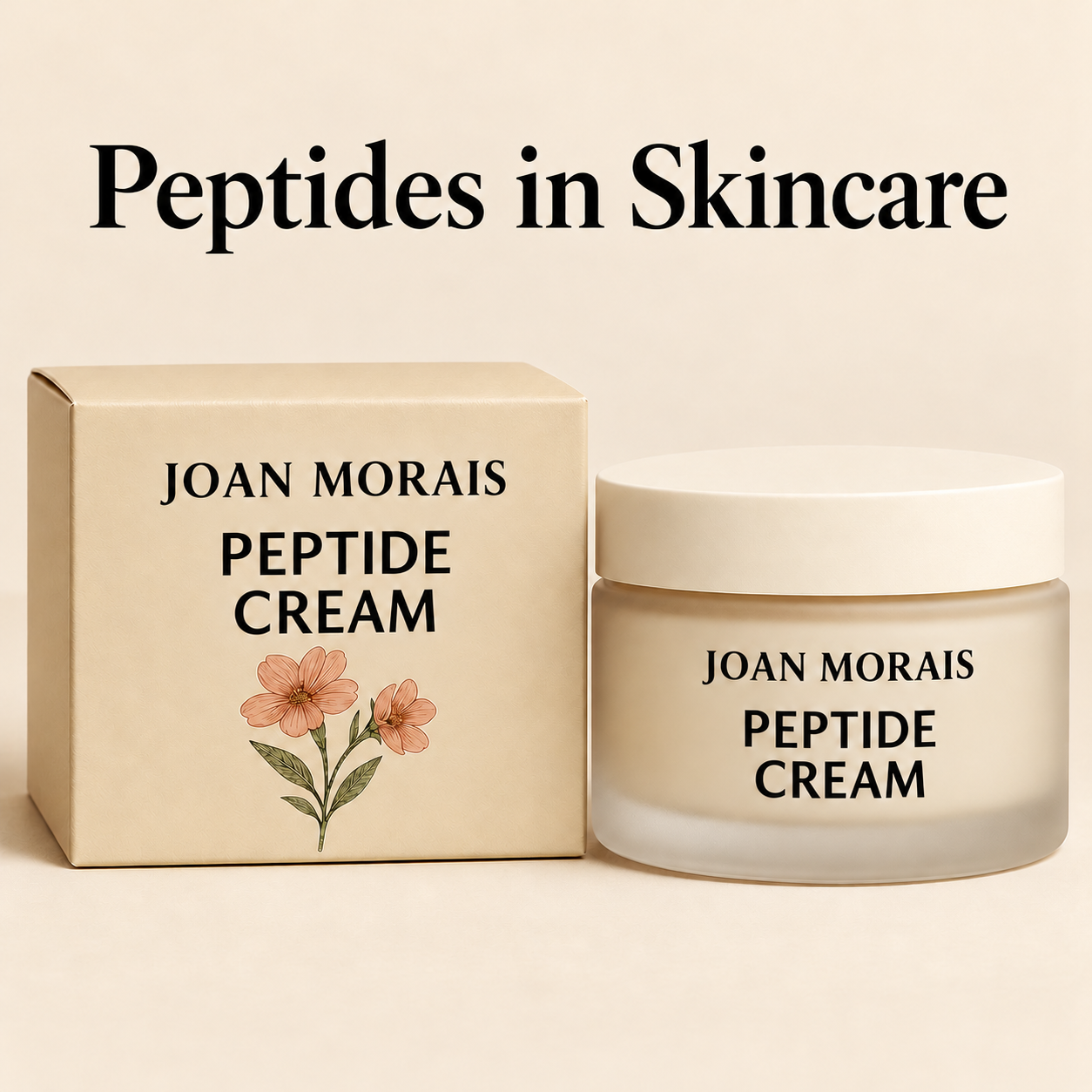
Peptides in Skincare
Part 1 of 3 • Peptides and Ceramides Educational Series
by Joan Morais
A practical guide for cosmetic formulators and skincare enthusiasts
Peptides can be useful ingredients for improving the appearance of aging skin. Choosing one starts with understanding its purpose and the quality of its research. This guide explains the main peptide types, what their studies can tell you, and how to choose a material for your formulation.
What peptides are
Peptides are short chains of amino acids connected by peptide bonds. Amino acids also make up larger proteins, including collagen and elastin. A peptide applied in a serum does not simply become collagen. Certain peptides are studied for their ability to influence cell signals, condition the skin, or improve the appearance of fine lines and wrinkles. Their effects depend on molecular structure, delivery, dose, and the complete formulation.
Learn about delivery using skin penetration enhancers in the Skin Penetration Enhancer LAB Class.
How peptide research developed
Peptide science developed alongside nineteenth- and twentieth-century protein chemistry. Emil Fischer helped establish peptide-bond chemistry and synthesize early peptides. Frederick Sanger’s work on insulin sequencing and Bruce Merrifield’s solid-phase synthesis method helped researchers identify and manufacture defined amino-acid sequences. Modern cosmetic peptides grew from decades of this research, followed by studies of topical ingredients. There was no single discovery of skincare peptides.
Why there are so many peptides
A change in one amino acid can create a different molecule. Manufacturers can also attach lipid chains, bind metals, blend sequences, or use different carriers. A trade name may describe a single peptide, several peptides, or a solution containing water, humectants, and preservatives. Check the INCI ingredient names and the exact commercial grade before comparing materials.
The numbers in peptide names help identify the molecule; they do not rank its effectiveness. A longer peptide is not automatically more effective. Also distinguish original Matrixyl, associated with Palmitoyl Pentapeptide-4, from Matrixyl 3000, a blend of Palmitoyl Tripeptide-1 and Palmitoyl Tetrapeptide-7. Evidence for one does not automatically apply to the other.
The main families of cosmetic peptides
Some peptides are studied for their potential effects on nerve signaling involved in muscle contraction. These laboratory findings do not prove that a peptide cream or serum relaxes facial muscles or produces results comparable to Botox injections.
Carrier peptides, such as the copper-binding complex GHK-Cu, bind metals and are studied for skin-conditioning and repair-related mechanisms. Enzyme-interacting and other specialized peptides target additional pathways. These categories overlap, and the category alone does not tell you how well a finished product will work.
What peptides can realistically do
Some peptide formulations have shown improvements in the appearance of fine lines, wrinkles, or elasticity over several weeks. The result belongs to the tested product and conditions. Hydration, emollients, and film-forming ingredients in the base can also improve how skin looks, so a suitable comparison formula matters. Cell findings about collagen do not prove that a serum rebuilds collagen or lifts sagging facial tissue. Sunscreen and daily sun protection remain foundational for limiting visible photoaging.
How to read peptide ingredient information
First identify the exact INCI name, the standardized ingredient name used in cosmetic ingredient lists. Then check whether you are buying a powder or a diluted solution. For example, adding 2% of a solution containing 0.05% active peptide gives 0.001% active peptide, or 10 parts per million (ppm), in the finished formulation. This example assumes percentages by weight; it is not a general use rate.
Ask for the full technical data sheet, active concentration when disclosed, suggested use level, compatibility guidance, and safety documentation. A long peptide list or a high percentage of commercial solution does not establish a more effective product.
Supplier studies and independent studies
Supplier studies often provide the first evidence for a new ingredient. They can be useful, but the supplier has a commercial interest in favorable results. Look for randomized, blinded human trials using the same formula without the peptide as a control. Check participant number, duration, dose, measurements, and statistical results. Cell studies suggest mechanisms; consumer surveys describe perceptions. Neither proves collagen production in a person’s skin.
Peer review and independence are different. In a published 2005 trial, 93 women used a moisturizer with 3 ppm palmitoyl pentapeptide and its vehicle on opposite sides of the face for 12 weeks. The peptide formula improved fine lines and wrinkles compared with the vehicle. The authors were affiliated with Procter & Gamble, so this is industry-authored research.
Argireline research also shows why one positive study is not the whole picture. A 2013 trial in 60 participants reported improvement after four weeks. A small 2023 split-face study in 19 women found no significant added wrinkle benefit over the hyaluronic acid serum base after four weeks. Differences in formulations and measurements limit comparisons. Check funding, author affiliations, and material supply when judging independence.
Uplevity and Argireline Amplified
Uplevity, in the original supplier brochure, contains Acetyl Tetrapeptide-2. Its two human studies are separate: 19 women took part in a 55-day split-cheek imaging study with placebo, while 20 women used a 2% commercial-solution cream for 56 days in a firmness study. The brochure does not describe a placebo group for the latter. The “nine years younger” language is an age estimate calculated from imaging, not a literal reversal of aging. Its reported collagen increase comes from cell experiments.
Argireline Amplified contains Water (Aqua), Acetyl Hexapeptide-8, Sodium Benzoate. It is marketed for expression wrinkles and broader signs of skin aging, and has its own supplier studies. Evaluate those studies separately from original Argireline research. These materials cannot be ranked from the largest percentage improvement in separate studies, because their outcomes, formulas, and methods differ.
Using peptides and ceramides together
Yes. You can include both in a compatible formulation or skincare routine. Ceramides are lipids important to the outer skin barrier; peptides are amino-acid sequences selected for particular functions. A moisturizing formulation can combine peptides with ceramides, cholesterol, and fatty acids. Peptides do not replace the barrier support provided by these lipids.
Read Part 2 of 3 Peptides for Skincare coming soon.
Practical formulation guidance
Select a peptide after defining your main product goal. Follow the exact grade’s use level, pH range, heat tolerance, solubility, and processing instructions. Many aqueous solutions go into cool-down, but there is no universal processing rule. An aqueous peptide solution is not a direct addition to an anhydrous facial oil or balm; choose a suitable documented delivery form.
Preservatives in a peptide raw material do not automatically preserve the finished product. Account for the complete formulation and verify preservative efficacy, stability, packaging compatibility, and skin tolerance. Support performance claims with appropriate finished-product evidence.
Joan’s Formulation Tip
When selecting peptides, look beyond the ingredient name and supplier claims. Check the actual peptide concentration, recommended usage level, pH compatibility, and clinical evidence for the specific commercial ingredient.
A peptide with strong laboratory results does not necessarily provide the same benefits in a finished skincare product. Human studies using the actual ingredient and an appropriate control formula provide more useful evidence when selecting actives for your formulations.
Choosing a peptide for your formulation
Begin with one clear skin goal and a moisturizing base that feels good on the skin. Choose a peptide whose research, specifications, and cost fit that goal, then test the finished formulation. Understanding why you select an ingredient is more useful than adding several peptides because they are fashionable.
Peptide Selection Chart
Use this chart to compare peptides based on their intended skin benefits, supporting evidence, vegan status, and how they are produced.
| Skin goal | Peptides to investigate | What the evidence needs to show | Vegan status | How it is derived |
|---|---|---|---|---|
| Fine lines and wrinkles | Palmitoyl Pentapeptide-4; Matrixyl® 3000 | Human improvement compared with the same base formula; evidence for the exact commercial ingredient. [1, 6] | Commonly vegan | Chemically synthesized peptides; palmitoyl groups are added during manufacturing. Verify fatty acid origin. |
| Expression wrinkles | Acetyl Hexapeptide-8; Acetyl Octapeptide-3 | Human wrinkle measurements for the specific commercial grade. Original Argireline® and Argireline® Amplified should be evaluated separately. [2, 3, 5, 10] | Commonly vegan | Chemically synthesized amino acid chains modified with acetyl groups. |
| Firmness and elasticity | Acetyl Tetrapeptide-2; Palmitoyl Tripeptide-5 | Controlled human studies demonstrating improvements in firmness, elasticity, or visible skin appearance. [4] | Commonly vegan | Chemically synthesized peptides. Palmitoyl Tripeptide-5 includes an attached fatty acid group. |
| General skin conditioning | Copper Tripeptide-1 | Demonstrated benefits in finished topical products; laboratory findings alone are insufficient. | Commonly vegan | Synthetic tripeptide (GHK) complexed with copper ions. |
Questions to ask a peptide supplier
What is the complete INCI? How much active peptide is in the supplied material? Has it been diluted by a reseller? What formula was tested, at what dose, and for how long? Did the human trial use a matched base without peptide, blinding, and randomization? Who funded or supplied the study? Is there independent replication? What pH, processing, storage, and packaging limits apply?
Free Formulator’s Guide
Peptides in Skincare
Download this free guide for a clear, practical reference you can use at your formulator bench.
Explore the Peptide Cream and Ceramide Serum and in the Professional Natural Skin Care Formulation Course.
Make the Radiant Aging Peptide Serum in the LAB Class.
References
[1] Robinson LR et al. International Journal of Cosmetic Science. 2005;27(3):155–160. Controlled study of palmitoyl pentapeptide. Source
[2] Wang Y et al. American Journal of Clinical Dermatology. 2013;14(2):147–153. Randomized placebo-controlled Argireline study. Source
[3] Henseler H. GMS Interdisciplinary Plastic and Reconstructive Surgery DGPW. 2023;12:Doc09. Split-face Argireline serum study. Source
[4] Lubrizol/Lipotec. Uplevity peptide solution. Supplier brochure, edition 17A, © 2013–2017; material and studies on pages 1 and 2. Product information: Source
[5] Lubrizol/Lipotec. Argireline Amplified peptide solution. Supplier product information and Amplifying Beauty Simplifying Routines brochure, © 2020. Source
[6] Croda Beauty. Matrixyl 3000. Supplier information identifying peptide components and commercial grades. Source
[7] Sanger F, Tuppy H. Biochemical Journal. 1951;49(4):463–481. Insulin peptide sequencing research. Source
[8] Merrifield RB. Journal of the American Chemical Society. 1963;85(14):2149–2154. Solid phase synthesis of a tetrapeptide. Source
[9] The Rockefeller University. R Bruce Merrifield and the Nobel Prize in Chemistry. Historical background on Fischer and peptide synthesis. Source
[10] Lubrizol/Lipotec. SNAP-8 peptide solution C. Supplier product information. Source
Supplier publications describe the supplier’s materials and tests. They do not establish results for a different finished formulation.