
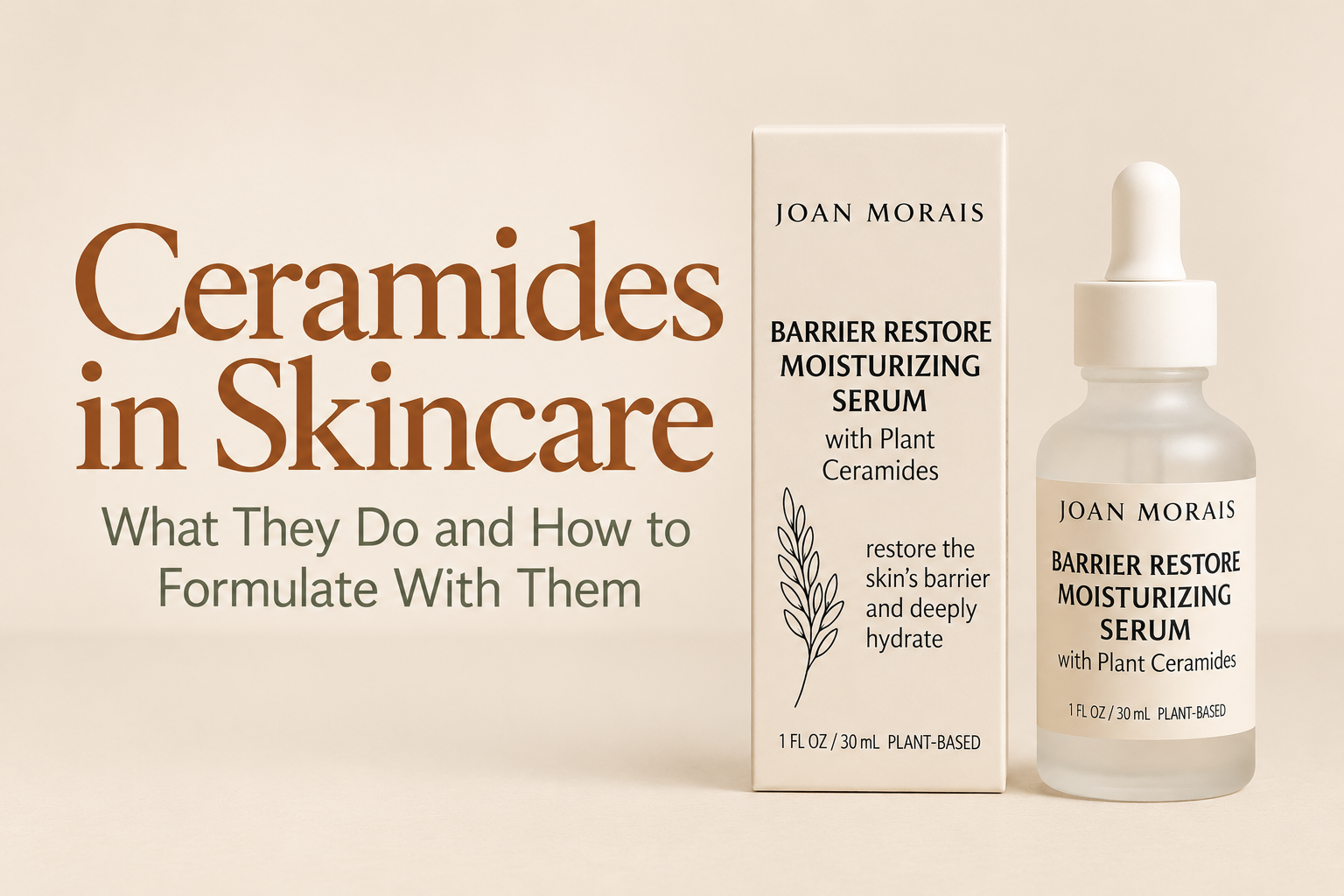
Ceramides in Skincare: What They Do and How to Formulate With Them
Part 2 of 3 • Peptides and Ceramides Educational Series
Part 1: Peptides in Skincare is here.
by Joan Morais
What are ceramides?
Ceramides are a family of sphingolipids naturally present in the stratum corneum, the outermost layer of skin. Along with cholesterol and free fatty acids, they help organize the intercellular lipid matrix that limits excessive water loss and supports barrier function. Ceramides are not proteins, peptides, or exfoliating acids.
How were ceramides discovered?
The term ceramide comes from early studies of waxy lipids, particularly cerebrosides. In the twentieth century, advances in lipid chemistry and chromatography helped researchers identify ceramides as components of sphingolipids. Later work on the stratum corneum established the importance of ceramide subclasses and their organization in skin barrier function. The modern cosmetic story developed as researchers linked altered skin lipid profiles with dryness and impaired barrier performance.
Why does skin need ceramides?
The outer skin barrier is often compared with bricks and mortar: corneocytes are the bricks and intercellular lipids are part of the mortar. Ceramides contribute to ordered lipid lamellae. When the barrier is compromised, skin may feel dry, rough, tight, or more reactive.
Formulator’s Note:
A well-designed moisturizer can reduce water loss and improve comfort; a ceramide-containing product may help replenish relevant lipids, but the finished formulation determines results.
A well-designed moisturizer can reduce water loss and improve comfort; a ceramide-containing product may help replenish relevant lipids, but the finished formulation determines results.
Why are there so many ceramide names?
Ceramides differ in the sphingoid base and fatty-acid components. The INCI names NP, AP, EOP, NS, and others denote different molecular classes. They are not simply different strengths of one ingredient. EOP is an acylceramide important to specialized skin lipid structures, while NP is commonly encountered in commercial barrier formulations. Pseudo-ceramides are synthetic analogues and should not be labeled as identical molecules.
Ceramides at a Glance
| Ingredient | Primary role | Best fit | Vegan status |
|---|---|---|---|
| Ceramide NP | Skin-identical barrier lipid; useful in lipid replenishment | Barrier-support moisturizers, creams | Commonly vegan; verify supplier documentation |
| Ceramide AP | Barrier lipid with different molecular structure | Moisturizers and barrier serums | Commonly vegan; verify supplier documentation |
| Ceramide EOP | Specialized acylceramide important to skin lipid architecture | Multi-ceramide barrier systems | Commonly vegan; verify supplier documentation |
| Ceramide NS / AS | Additional ceramide subclasses; grade-specific | Multi-lipid creams | Commonly vegan; verify supplier documentation |
| Phytosphingosine | Ceramide-related sphingoid base, not itself a ceramide | Barrier-oriented emulsions | Commonly vegan and produced through microbial fermentation. Confirm with the supplier. |
| Cholesterol + free fatty acids | Complementary barrier lipids, not ceramides | Barrier-support creams | Commonly vegan; verify supplier documentation; cholesterol requires particular verification |
Ceramides vs. peptides: different jobs
Ceramides are structural barrier lipids. Cosmetic peptides are diverse amino-acid sequences investigated for signaling, appearance of wrinkles, or other specific effects. A moisturizer may contain both, but their mechanisms and evidence are distinct. Peptides do not replace ceramides, and ceramides should not be expected to deliver a facial lifting effect.
What do studies actually show?
Research strongly establishes the biological importance of ceramides in skin barrier organization. Studies of ceramide-containing moisturizers also report improvements in hydration and barrier-related outcomes in some populations. However, a clinical result for a finished cream containing ceramides, humectants, occlusives, and other lipids does not prove that the added ceramide alone caused the improvement. Some studies compare complete formulas rather than isolated ingredients.
Supplier studies versus independent studies
Supplier data may include instrumental transepidermal water loss (TEWL), corneometry, clinical grading, or consumer assessments. These can be useful, but check the control, sample size, study duration, ingredient concentration, funding, and whether results were statistically significant. Independent, peer-reviewed research can help establish biological plausibility and reproduce findings, but independence does not automatically guarantee quality. Prefer studies of the exact commercial grade or finished formula, especially for marketing claims.
What formulators should know about ceramide delivery
Pure ceramides can be difficult to dissolve and process. Many cosmetic suppliers offer pre-dispersed complexes, lamellar concentrates, or blends with cholesterol, fatty acids, emulsifiers, and solvents. Follow the exact technical data sheet for heating, phase of addition, pH, shear, and usage level. The percentage of a commercial ceramide blend is not the same as the percentage of pure ceramide in the finished product.
Do ceramides work better with cholesterol and fatty acids?
Skin barrier lipids naturally include ceramides, cholesterol, and free fatty acids. This provides a scientific rationale for multi-lipid formulations, but there is no universal ratio that is optimal for every product or skin condition. The ratio, lipid structure, delivery system, and full emulsion all matter. Test the actual formulation rather than assuming a marketing ratio guarantees better performance.
Where should you use ceramides?
Leave-on moisturizers, creams, lotions, and barrier serums are especially logical formats. Ceramides may also appear in cleansers, but short contact time and rinsing make durable barrier benefits harder to establish. For sensitive-skin positioning, minimize unnecessary fragrance and prioritize a comfortable, well-preserved, stable base.
Joan’s Formulation Tip
When selecting ceramides, look beyond the ingredient name and supplier claims. Check the type and actual concentration of ceramides, recommended usage level, solubility, processing requirements, and compatibility with other ingredients. Consider combining ceramides with cholesterol and free fatty acids to support the skin’s moisture barrier.
A ceramide complex with promising laboratory results does not necessarily provide the same benefits in a finished skincare product. Human studies measuring skin hydration, transepidermal water loss (TEWL), and barrier function provide more useful evidence when selecting ceramides for your formulations.
A practical selection framework
First identify the intended outcome: reducing dryness, supporting barrier comfort, or building a premium multi-lipid moisturizer. Next choose a commercial grade with disclosed INCI, active concentration, solubility, process instructions, and efficacy documentation. Compare its cost per amount of active, not only its price per kilogram. Validate hydration, TEWL if feasible, stability, microbial preservation, and packaging compatibility in the finished formula.
What Formulators Should Know
Ceramides are scientifically relevant barrier lipids, but the word “ceramide” on a label is not proof of superior performance. Choose a documented grade, formulate for delivery and stability, and substantiate the benefits of the finished product.
Part 3 explores when ceramides or peptides are worthwhile in hair care.
Ready to formulate your own peptide cream and ceramide serum?
Learn to create these tried-and-tested skincare formulations including a Peptide Cream and Ceramide Serum in the Professional Natural Skin Care Formulation Course. Discover how to work with cosmetic actives and develop effective skincare products with confidence.
Free Formulator’s Guide
Ceramides in Skincare
Download this free guide for a clear, practical reference you can use at your formulator bench.
Series links: Part 1—Peptides in Skincare; Part 2—Ceramides in Skincare; Part 3—Peptides and Ceramides in Haircare (coming soon)
References
- Bouwstra JA, Ponec M. The skin barrier in healthy and diseased state. Biochim Biophys Acta. 2006;1758:2080–2095.
- van Smeden J, Bouwstra JA. Stratum corneum lipids: their role for the skin barrier function in healthy subjects and atopic dermatitis patients. Curr Probl Dermatol. 2016;49:8–26.
- Meckfessel MH, Brandt S. The structure, function, and importance of ceramides in skin and their use as therapeutic agents in skin-care products. J Am Acad Dermatol. 2014;71:177–184.
You might also like