How to Price Cosmetic Products for Profit
By Joan Morais
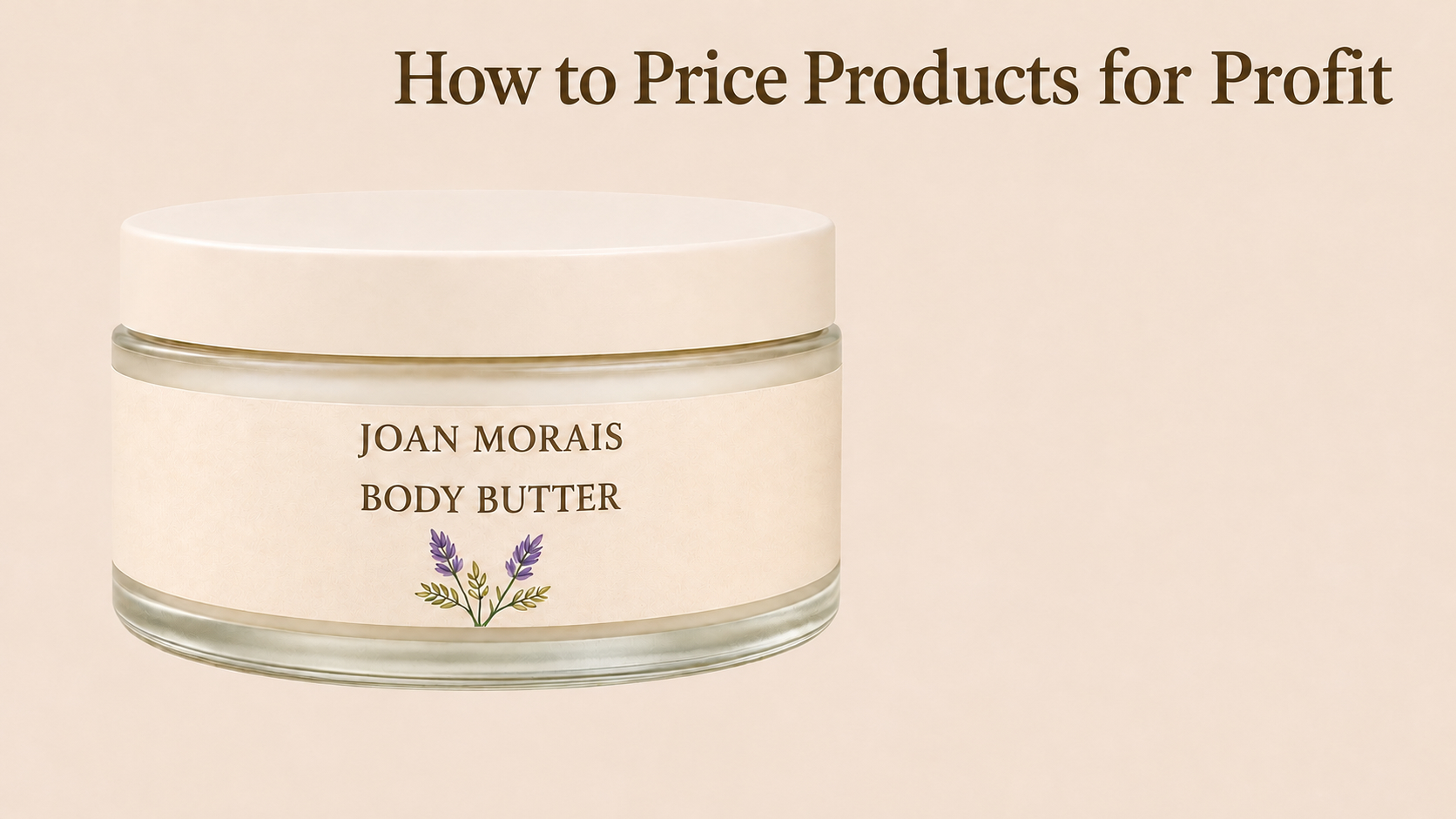
A sold-out batch can still lose money. Imagine you sell a jar of body butter for $20 and the ingredients in that jar cost $1.50. Before you know what you earned, you still have to account for the jar, label, time to make and fill it, and expenses such as payment fees and shipping.
Accurate pricing gives you room to pay for your work, replace inventory, and earn a profit you can put back into your business. It also helps you decide whether you can afford to offer wholesale pricing, run a sale, or cover shipping for your customers. All of those decisions start with one question. What does it cost me to make one finished product I can sell?
What is cost of goods?
Cost of goods (COG) is what it costs you to make a batch or a finished unit. For a cosmetic product, it starts with the ingredients and includes the packaging, labor, and other resources you use to make it.
| Production cost | What to include |
|---|---|
| Ingredients | The quantity of each ingredient used in the batch, including its share of incoming freight. Include ingredients you use in small amounts, such as preservatives, antioxidants, and fragrance. |
| Product packaging | Jars, bottles, caps, pumps, seals, labels, and cartons sold with the product. |
| Production labor | Time spent weighing, mixing, filling, labeling, and cleaning up. If you make the products yourself, assign your production time an hourly rate for pricing purposes. |
| Production supplies | Consumable items used to make and fill the batch, such as gloves, pipettes, and sanitizing supplies. |
| Manufacturing overhead | The share of production space, utilities, or equipment costs you allocate to the batch. |
Batch COG is the total cost to make the batch. Unit COG is that total divided by the number of finished, saleable units. Use a realistic yield when planning, then check it against what you actually fill and can sell. Product left in the mixing vessel, filling losses, and damaged packaging can all affect how much each finished unit costs.
You’ll also hear the term cost of goods sold (COGS). In bookkeeping, it’s the cost assigned to the products you sold during a period. If you make 28 jars with a recorded inventory cost of $5 each and sell 20, the cost of the jars sold is $100. The remaining eight jars account for $40 in inventory.
Start with what you paid for each ingredient
To cost an ingredient, find out what you paid per gram and multiply that by the number of grams used in your batch. Say you paid $24 for 1 kilogram of shea butter and allocated $6 of the supplier’s shipping charge to that purchase. Your total is $30 for 1,000 grams. If you use 300 grams in the batch, the shea butter costs $9.00.
Some suppliers sell oils by volume while your formula uses weight. Use the supplier’s density or the measured weight of the contents to convert that purchase to grams. When you scale your formula, you can use the same cost per gram to find the cost at your new batch size.
What does one jar of body butter cost to make?
Let’s say you make a 1,500-gram batch of body butter. After normal transfer and filling losses, you have 28 saleable jars, each filled to 50 grams. Here are the sample costs in USD.
| Cost for the batch | Amount |
|---|---|
| Ingredients | $42.00 |
| Jars, lids, and labels at $1.25 per set | $35.00 |
| Production labor at $28 per hour for 1.5 hours | $42.00 |
| Production supplies | $7.00 |
| Allocated manufacturing overhead | $14.00 |
| Batch COG | $140.00 |
$140 ÷ 28 saleable jars = $5.00 Unit COG.
The ingredients account for $1.50 per jar. That number tells you what goes into the jar. The $5.00 finished cost gives you a starting point for pricing it.
Compare retail, wholesale, and promotional prices
At a $20 selling price, the body butter earns $15.00 in gross profit per jar. Divide that $15 by the $20 selling price and you get a 75% gross margin. Divide the same $15 by the $5 cost and you get a 300% markup. Gross margin uses selling price as its starting point. Markup uses cost.
The next step is to enter the expenses that come with each sale. These can include card processing, marketplace commissions, order packing, and the portion of shipping you pay. A discount lowers the price you receive, so calculate the sale using the discounted price.
| Per jar | Direct retail | Wholesale | Retail with 20% off |
|---|---|---|---|
| Selling price | $20.00 | $10.00 | $16.00 |
| Cost to make one jar | $5.00 | $5.00 | $5.00 |
| Gross profit | $15.00 | $5.00 | $11.00 |
| Gross margin | 75% | 50% | 68.75% |
| Selling expenses in this example | $3.00 | $0.75 | $2.88 |
| Amount left after production and selling costs shown | $12.00 | $4.25 | $8.12 |
The retail examples assume one jar per order, a payment fee of 3% of the product price plus $0.30, and $2.10 in shipping paid by the maker. The wholesale example assumes $0.75 per jar in freight. The amounts left still need to help cover business expenses such as your website, marketing, insurance, and accounting, along with any other costs you haven’t already included.
A promotion can lift sales and leave you with less money per jar. Before you run one, look at how many extra units you would have to sell to make up the difference. Do the same when a retailer or distributor asks for a lower price. Factor in the full terms, including freight, testers, commissions, or volume discounts.
Choose a price your business can sustain
Look at comparable products your customer would consider buying. Compare their size, quality, packaging, and where they’re sold. Then see whether the price range makes sense with your costs and the number of units you realistically expect to sell.
If a retailer wants a 50% gross margin on a product that will sell for $20 on its shelves, its buy price is $10. Work through what your business earns at $10 before agreeing to the order. If the numbers are too tight, price out a different jar, a different purchase quantity, or a direct-to-customer sales plan. This is easier to work through while you’re developing a product and can still change how you make or sell it.
When it makes sense to pay for a pricing tool
Costing a product takes several calculations. You convert purchase quantities, work out the amount used in a batch, account for packaging and labor, and divide by your finished yield. Then a supplier raises a price, you change your batch size, or a store asks for wholesale terms, and you need to run the numbers again.
I created Formulate & Price™ to do that math for you. Enter your formula percentages, batch size, and ingredient purchase details. The tool calculates the weights, converts grams to ounces or ounces to grams, and ingredient costs. In Cost & Pricing, add your production costs and finished unit count to see what it costs to make a batch and one finished unit. Then enter the selling prices and expenses you want to evaluate. You can compare retail, wholesale, distributor, and promotional scenarios using your own numbers.
Think about what the time is worth to you. If you value your time at $30 an hour and a pricing tool saves you 3 hours a month, that’s 36 hours a year, worth $1080 in your time. The introductory annual subscription for Formulate & Price™ is $99 USD. If you regularly cost new formulas, update supplier prices, or review promotions, paying for a tool can make sense for your business. Plus, it relieves a lot of frustrations with instant calculations.
Use the Formulator’s Guide to Pricing Cosmetic Products to gather the numbers for one product. Then put those numbers into Formulate & Price™ and see what your next batch could earn at the prices you’re considering.
Free Formulator’s Guide
Pricing Products
Download this free guide for a clear, practical reference you can use at your formulator bench.
You might also like