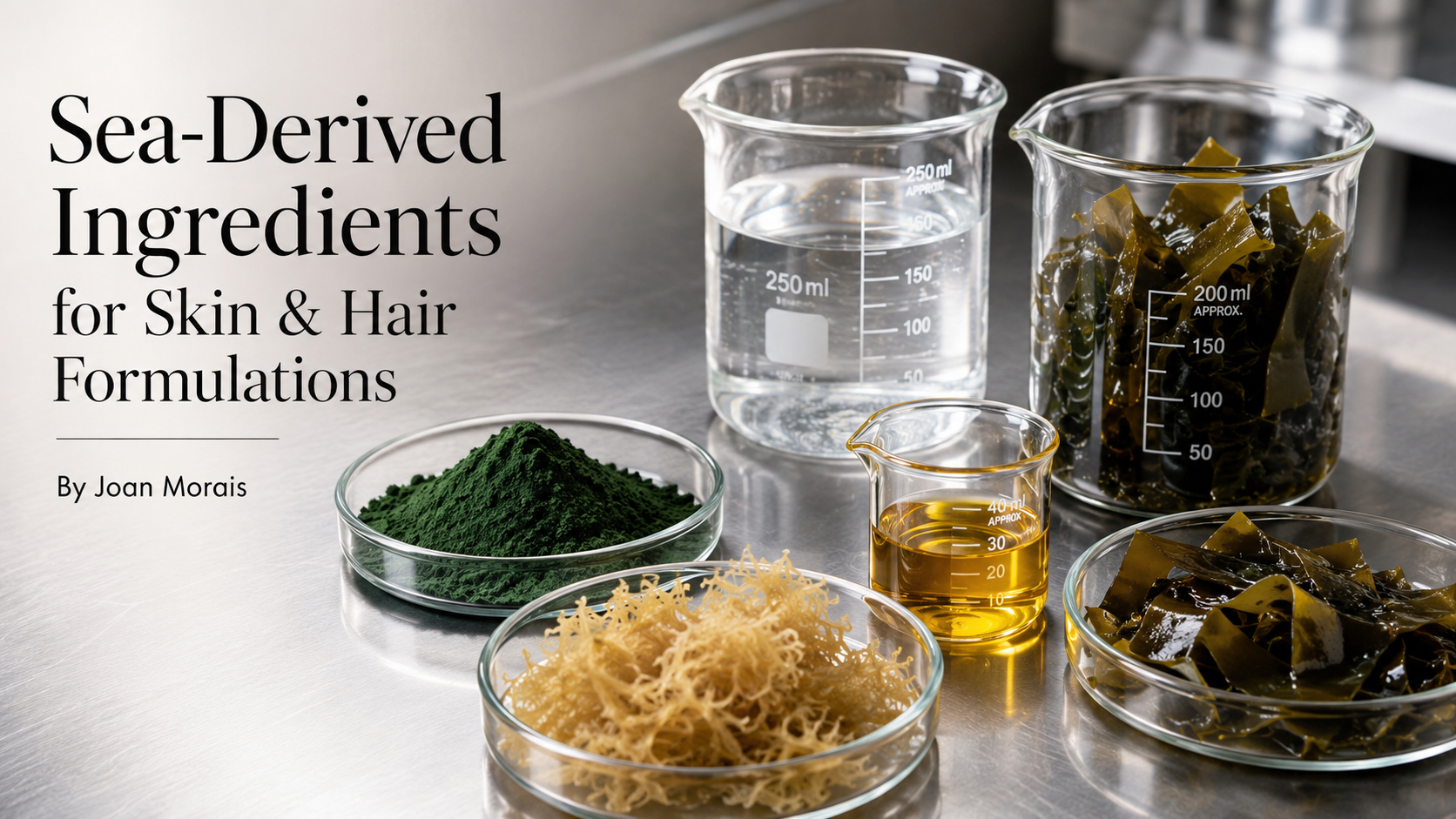
Sea-Derived Ingredients for Skin & Hair Formulations:
Sea Moss, Spirulina, Seaweed, Algae Oil, Kelp + Marine Actives
The sea is an extraordinary source of ingredients for cosmetic formulation. Marine plants, macroalgae, microalgae and mineral-rich seawater contain polysaccharides, minerals, amino acids, lipids, carotenoids, antioxidants and other compounds that can be useful in both skin care and hair care formulations.
Have you ever thought about developing products with ingredients from the sea, or even creating an entire collection inspired by marine ingredients? Sea-derived ingredients can bring unique textures, colors, sensory qualities and functional benefits to a formulation, while offering formulators an exciting way to explore ingredients beyond traditional land-based botanicals.
But one of the most important things to understand when formulating with marine ingredients is that “algae,” “seaweed,” and “sea moss” are not interchangeable terms.
Different marine species contain very different compounds. Their benefits also depend on how the material is extracted, purified and standardized.
A whole seaweed powder, for example, behaves very differently in a formulation from a purified fucoidan extract obtained from brown seaweed.
For formulators, this distinction matters.
Marine ingredients can be incorporated into facial serums, moisturizers, creams, lotions, masks, scalp serums, shampoos, conditioners, leave-in conditioners and hair serums, but the correct ingredient form needs to be selected for the product being formulated.
Why Marine Ingredients Are So Interesting for Cosmetic Formulation
Seaweeds and microalgae live in environments that expose them to intense sunlight, salt, temperature changes, microorganisms and other environmental stresses.
To survive, many produce protective compounds including:
- sulfated polysaccharides such as fucoidan, carrageenan and ulvan
- polyphenols
- carotenoids
- amino acids
- peptides and proteins
- fatty acids
- sterols
- minerals and trace elements
- natural moisturizing compounds
These compounds are being studied for hydrating, antioxidant, soothing, barrier-supporting, protective and skin-aging benefits. Reviews of clinical research on topical macroalgae have found human evidence particularly for moisturization, pigmentation-related effects and some measures associated with skin aging, although the amount and quality of evidence varies considerably among individual seaweed species.
Hair research is less extensive than skin research, but marine ingredients can still be very useful for the scalp, hair fiber, conditioning, film formation, hydration and cosmetic appearance of the hair.
Formulator’s Note:
Understanding how an ingredient functions within a complete formula is an important part of learning professional cosmetic formulation.
Understanding how an ingredient functions within a complete formula is an important part of learning professional cosmetic formulation.
Sea-derived ingredients I have formulated with in skin and hair care products:
Sea Moss | Chondrus crispus (vegan)
Sea moss has become one of the most recognizable marine ingredients in beauty products.
True Irish moss or sea moss is generally associated with Chondrus crispus, a red macroalga found in cooler Atlantic coastal waters.
How Sea Moss Is Derived
After harvesting, the seaweed is cleaned and can be dried and milled into powder or extracted with water to obtain its water-soluble components.
One of its most important constituents is a group of sulfated polysaccharides collectively known as carrageenans.
These large polysaccharide molecules have excellent water-binding, film-forming and rheological properties.
A cosmetic-grade Chondrus crispus extract should not be confused with homemade “sea moss gel.” A professionally manufactured cosmetic ingredient has been processed and standardized and should have specifications for microbiological quality, contaminants and composition.
Benefits for Skin
Chondrus crispus is particularly interesting for formulations designed to provide:
hydration, water retention, a soft protective film, improved skin feel and support for dry or environmentally stressed skin.
Its polysaccharides can create a lightweight film over the skin that reduces the sensation of dryness while giving serums and gels a soft, hydrated finish.
There is substantial laboratory and compositional research surrounding red-algae polysaccharides, but robust human clinical trials specifically demonstrating the cosmetic effects of ordinary Chondrus crispus extract remain limited. It is therefore better to position sea moss primarily as a hydrating, conditioning and film-forming marine botanical rather than make aggressive anti-aging claims.
Benefits for Hair
This film-forming ability can also be useful on hair.
Sea moss extracts can contribute to slip, softness and moisture retention and may help leave the hair feeling smoother.
I particularly like this type of ingredient conceptually for curly, coily and dry hair formulations because polysaccharide-rich extracts can complement conditioning ingredients without requiring a heavy oil load.
We have a tried-and-tested Sea Moss Hair Mask formulation in the Professional Natural Hair Care Formulation Course, where students can learn how to incorporate sea moss into a complete conditioning hair formulation.
Best Formulations
Sea moss works especially well in facial gel serums, hydrating masks, lightweight lotions, moisturizers, scalp gels, shampoos, conditioners, hair masks, curl products and leave-in conditioners.
The exact usage level should be based on the supplier’s recommended range because liquid extracts, powders, hydrolyzed extracts and carrageenan-rich materials can have very different concentrations.
Spirulina | Arthrospira platensis (vegan)
Spirulina is commonly called a microalga, although scientifically it is a photosynthetic cyanobacterium. In cosmetics, it is commonly found under names associated with Spirulina platensis or Arthrospira platensis.
Its distinctive blue-green color comes partly from pigments including phycocyanin and chlorophyll.
Spirulina also naturally contains proteins, amino acids, carotenoids, minerals and other antioxidant compounds.
How Spirulina Is Derived
Spirulina is cultivated in water, harvested and concentrated. It may then be dried into a powder or processed using water or other extraction systems to isolate selected water-soluble components.
The resulting cosmetic ingredient might therefore be a whole spirulina powder, aqueous extract, concentrated extract or purified fraction.
These forms should not automatically be treated as equivalent.
Benefits for Skin
Spirulina has generated interest for its antioxidant and soothing potential.
Laboratory research has demonstrated antioxidant activity and effects on keratinocyte behavior. A more recent double-blind study evaluated a proprietary defined Spirulina platensis extract in 20 people with atopic dermatitis. After four weeks, the active-containing gel increased skin microbiome diversity on treated areas compared with baseline, although this was a specialized extract and should not be interpreted as evidence that every spirulina powder or extract will produce the same result.
Another laboratory study found that Spirulina platensis extract incorporated into a cream supported keratinocyte proliferation and wound-closure activity in vitro. Again, this is laboratory rather than human clinical evidence, but it helps explain why spirulina continues to be investigated as a skin-active botanical.
Benefits for Hair and Scalp
Spirulina is especially interesting in scalp and hair formulations because it provides amino acids, pigments and antioxidant compounds.
It can be incorporated into products intended to support a healthy-looking scalp and conditioned hair. I would be more cautious about describing spirulina itself as a proven “hair-growth ingredient,” because strong clinical evidence for topical spirulina and hair growth is not currently established.
In the Shampoo Bar LAB Class, we use spirulina in the Shampoo Bar formulation, where it adds a naturally derived botanical element along with its characteristic blue-green color and nutrient-rich profile.
Formulation Considerations
Spirulina can contribute significant natural color and sometimes a noticeable marine or vegetal odor.
Phycocyanin and other pigments may also be sensitive to heat, light and formulation conditions.
For this reason, spirulina extracts are often easier to work with in cool-down phases or lower-temperature formulations.
Higher concentrations may be better suited to rinse-off masks and conditioners than elegant white facial creams.
Best Formulations
Spirulina can work well in facial masks, antioxidant gel serums, scalp serums, shampoos, conditioners, hair masks and treatment products.
Brown, Red and Green Seaweeds (vegan)
“Seaweed extract” on its own does not tell a formulator very much.
Marine macroalgae are broadly divided into brown algae, red algae and green algae, and these groups produce different bioactive compounds.
Brown algae are particularly known for fucoidan, alginates, laminarin, phlorotannins and fucoxanthin.
Red algae contain sulfated polysaccharides including carrageenans and agar-type polysaccharides, along with pigments and minerals.
Green algae can contain ulvans, chlorophyll, polyphenols and other polysaccharides.
This is one reason I prefer knowing the actual species and extraction method rather than simply purchasing something described as “seaweed extract.”
Undaria pinnatifida Extract | Wakame (vegan)
Undaria pinnatifida is a brown seaweed commonly known as wakame.
It is one of the more interesting marine cosmetic ingredients because certain extracts can be standardized for a particularly valuable brown-seaweed polysaccharide: fucoidan.
How Undaria Extract Is Derived
The seaweed is harvested, cleaned and dried before extraction. Water-based extraction and purification processes can be used to concentrate fucoidan and remove unwanted components.
The resulting ingredient can be very different from an ordinary whole-seaweed extract.
A standardized fucoidan-rich Undaria extract therefore offers a formulator much more predictable activity than simply adding powdered wakame to a product.
What Is Fucoidan?
Fucoidan is a family of sulfated fucose-rich polysaccharides found primarily in brown seaweeds.
It is one of the most researched classes of marine cosmetic actives.
Research has examined fucoidan for antioxidant, soothing, skin-protective and extracellular-matrix-related activity.
Clinical Data
One study tested a standardized Undaria pinnatifida extract containing approximately 85% fucoidan.
A 0.3% gel containing the extract was evaluated in a placebo-controlled study involving 25 subjects exposed to UV. The Undaria extract significantly reduced erythema and transepidermal water loss compared with placebo and control treatments, supporting a skin-soothing and protective effect.
This is a good example of why the exact raw material matters. The research involved a highly characterized fucoidan-rich extract, not culinary wakame powder.
Benefits for Skin
Undaria is particularly interesting for formulations targeting skin comfort, environmental stress, barrier support and visible signs of skin aging.
Its polysaccharides also make it a good fit for hydrating formulations.
I like adding undaria to the Ultra Rich Moisturizing Body Lotion formulation in the Professional Natural Skin Care Formulation Course.
Formulator’s Note:
If you are formulating for sensitive or dehydrated skin, you may also want to explore how beta-glucan compares with other soothing and film-forming ingredients.
If you are formulating for sensitive or dehydrated skin, you may also want to explore how beta-glucan compares with other soothing and film-forming ingredients.
Benefits for Hair and Scalp
Research on topical Undaria for human hair growth is much less established.
There is promising preclinical research involving mixtures of Undaria and Saccharina species and hair follicles, but this should not be converted into a human hair-growth claim.
From a cosmetic formulation perspective, I would use Undaria more confidently for scalp conditioning, antioxidant support, hydration and hair feel.
Best Formulations
Undaria extract is especially suitable for facial serums, hydrating serums, barrier-support creams, moisturizers, eye products, scalp serums, hair conditioners and hair masks.
Laminaria saccharina Extract | Sugar Kelp (vegan)
Laminaria saccharina is a name still encountered in cosmetic ingredient information, although the currently accepted botanical classification of this brown seaweed is Saccharina latissima, commonly called sugar kelp.
Brown kelps such as Saccharina contain polysaccharides, minerals, polyphenols and other compounds of interest to cosmetic formulation.
How It Is Derived
Sugar kelp can be processed through water extraction, hydroalcoholic extraction, enzymatic processing, ultrasound-assisted extraction and other techniques depending on which compounds the manufacturer wants to obtain.
Recent research has also examined ultrasound extraction as a way to obtain antioxidant-rich fractions of Saccharina latissima for incorporation into cosmetic creams.
Skin Benefits
Depending on the extract, sugar kelp can contribute hydrating, antioxidant, soothing and skin-conditioning properties.
Human moisturizing data are also available for closely related Laminaria/Saccharina species.
In one human study, a cream containing a 10% water/propylene-glycol extract of Laminaria japonica increased skin hydration by approximately 14% compared with placebo at the two-hour measurement and reduced TEWL during the observation period.
The exact species and extract in that study are not the same as every commercial Laminaria saccharina extract, so this should be interpreted as evidence supporting the broader potential of kelp-derived extracts rather than as proof for every kelp raw material.
I customize and use sugar kelp in the Hyaluronic Acid B5 Gel Serum formulation found in the Professional Natural Skin Care Formulation Course.
Hair and Scalp Benefits
Kelp extracts are also interesting for conditioners and scalp products.
A 2024 study followed 30 people using shampoo and essence containing Laminaria japonica water extract for three months. Researchers reported conditioning effects and improvements in the appearance and cleanliness of the scalp and hair. The study is useful preliminary evidence, although it is not the same level of evidence as a large randomized, placebo-controlled clinical trial.
Best Formulations
Laminaria/Saccharina extracts are excellent candidates for hydrating serums, creams, lotions, facial masks, scalp serums, shampoos, hair conditioners, leave-in conditioners and hair masks.
Fucus vesiculosus Extract | Bladderwrack (vegan)
Another brown seaweed worth knowing is Fucus vesiculosus, commonly called bladderwrack.
Fucus can provide both fucoidan and marine polyphenols called phlorotannins.
This combination makes certain standardized Fucus extracts particularly interesting for formulations focused on antioxidant protection and the visible signs of skin aging.
Clinical Data
A standardized Fucus vesiculosus extract containing approximately 60% fucoidan and 30% polyphenol was studied in a double-blind, placebo-controlled split-face trial.
A cream containing 0.3% of the extract was used twice daily for 60 days by 20 subjects.
At the end of the study, dermatologist assessments found improvement in brightness in 50% of subjects, improvement in the appearance of skin spots in 65% and improvement in wrinkle appearance in 45%. Instrumental measurements were also used to evaluate brightness, wrinkle depth and melanin index.
Again, these results apply to the specific standardized extract tested, rather than every bladderwrack extract on the market.
Best Formulations
I particularly like the concept of Fucus extract for antioxidant facial serums, brightening formulations, moisturizers, eye products and mature-skin formulations. I incorporate bladderwrack in the Regenerating and Brightening Gel Serum formulation in the Professional Natural Skin Care Formulation Course and the Fortifying Hair + Scalp Serum formulation in the Professional Natural Hair Care Formulation Course,
It can also be incorporated into scalp serums and conditioning products when antioxidant and soothing positioning is desired.
Ulva lactuca | Sea Lettuce (vegan)
Ulva lactuca is a green macroalga commonly known as sea lettuce.
One of the characteristic groups of polysaccharides associated with Ulva species is ulvan.
Ulva extracts can also contain minerals, phenolic compounds and other antioxidant components.
Clinical Data
Ulva was included in an interesting split-face clinical study of a marine serum spray containing Fucus vesiculosus extract, hydrolyzed Ulva lactuca extract, sea water, ectoin and additional moisturizing ingredients.
Thirty-three people entered the study and 29 completed the protocol.
The side receiving the marine serum plus moisturizer showed approximately 17% greater hydration than moisturizer alone after 20 minutes and 5% greater hydration after 28 days. Average skin roughness on the serum-treated side decreased approximately 17% from baseline after 28 days.
Because several actives were combined in the formula, the results cannot be attributed to Ulva alone. However, the study demonstrates how marine polysaccharides can work effectively as part of a well-designed multi-active hydrating serum.
I like using sea lettuce in the Daily Moisturizer formulation found in the Professional Natural Skin Care Formulation Course.
Best Formulations
Ulva is especially interesting for facial mists, gel serums, hydrating serums, light lotions, creams and scalp hydration products.
Algae Oil (vegan)
Algae oil is very different from a water-soluble seaweed extract.
The term can describe oils obtained from different microalgae species, and their fatty-acid profiles can vary considerably.
Some microalgal oils are particularly rich in omega-3 fatty acids such as DHA and EPA, while other oils contain different combinations of fatty acids, sterols, carotenoids and lipid-soluble compounds.
How Algae Oil Is Made
Microalgae can be cultivated in controlled systems and harvested before the intracellular oils are released and separated.
Extraction methods can include solvent extraction, mechanical processes, enzymatic methods and newer technologies such as supercritical CO₂ extraction.
A 2026 review of algae oil for cosmetic use describes microalgae as a promising sustainable source of cosmetic lipids but also points out that human topical clinical evidence is still limited.
Benefits for Skin
Algae oils can provide emollience, fatty acids and lipid replenishment, making them particularly interesting for dry, mature or barrier-focused skin formulations.
They also offer a compelling plant-based alternative when a formulator wants omega-rich lipids without fish-derived ingredients.
However, “algae oil” by itself is not enough information to formulate with.
I would always look at the supplier’s INCI name, algae species, fatty-acid profile, extraction process, peroxide specification and antioxidant system.
Benefits for Hair
Algae oil can be beautiful in hair formulations.
It can provide lubrication, shine, softness and a smoother hair feel and can be incorporated into both the lipid phase of conditioners and anhydrous hair serums.
For dry, curly or coily hair, a small amount of algae oil can contribute conditioning without needing to be the dominant oil in the formulation.
At this point, I would describe algae oil as a conditioning and lipid-support ingredient rather than a clinically proven topical hair-growth active.
I’ve used algae oil in a custom scalp formulation.
Oxidation Matters
Omega-3-rich algae oils can be considerably more oxidation-sensitive than highly stable oils such as jojoba or meadowfoam.
The formulation may therefore benefit from antioxidants such as tocopherol, low oxygen exposure and protective packaging.
Best Formulations
Algae oil is particularly suited to oil serums, facial oils, barrier creams, rich lotions, eye products, hair serums, hair oils, conditioners and hair masks.
Sea Water and Marine Minerals (vegan)
Sea water is another intriguing cosmetic ingredient, but it needs to be approached differently from ordinary purified water.
Natural sea water contains dissolved minerals and electrolytes including magnesium, sodium, calcium, potassium and chloride ions, although concentrations differ depending on the source.
Some cosmetic raw materials use filtered or purified seawater, while others provide concentrated marine-mineral solutions.
Clinical Evidence
Some of the best-known research involves mineral-rich Dead Sea water.
In a controlled study of people with atopic dry skin, bathing one forearm for 15 minutes in a solution containing 5% magnesium-rich Dead Sea salt improved hydration and, in subjects with elevated baseline TEWL, improved barrier measurements compared with tap water. Skin roughness and redness were also reduced.
More recent reviews suggest marine mineral and seawater therapies can have positive effects on hydration and barrier parameters, although therapeutic bathing studies should not be interpreted as being equivalent to adding a small amount of Sea Water INCI to a cosmetic serum.
That distinction is important when making cosmetic claims.
Formulating With Sea Water
Sea water contains electrolytes, and electrolytes can dramatically affect cosmetic formulation.
They may reduce the viscosity of some polymer gels, interfere with certain thickeners or destabilize emulsions that do not tolerate high electrolyte concentrations.
This is why I would never simply substitute seawater for the entire purified-water phase of an existing formulation and assume it will remain stable.
The formulation should be developed specifically around the mineral content of the raw material.
Hair Considerations
Mineral sprays can be useful for scalp products and texturizing hair products, but more salt is not necessarily better for the hair fiber.
High levels of salts can increase a dry or rough feel in some hair types.
For moisturizing or conditioning hair products, marine minerals are often best balanced with humectants, cationic conditioning ingredients and emollients.
Best Formulations
Sea water works well in mineral facial mists, hydrating serums, scalp tonics, body lotions, creams and texturizing hair products when the complete formulation has been designed to tolerate its electrolyte content. I’ve used cosmetic sea water in facial and hair mists.
Astaxanthin from Haematococcus pluvialis (vegan)
One of the most interesting microalgae-derived cosmetic actives is astaxanthin.
Astaxanthin is a red-orange carotenoid produced in particularly high concentrations by the microalga Haematococcus pluvialis when the organism is exposed to environmental stress.
It is strongly antioxidant and has received considerably more human research than many other algae-derived cosmetic actives.
Skin Research
A systematic review identified 11 human clinical studies evaluating astaxanthin and skin aging. Most investigated oral supplementation, while a smaller number included topical treatment. Overall, the evidence suggested potential improvements in parameters such as moisture and elasticity, although the topical evidence base remains much smaller than the oral evidence base.
One study involving topical astaxanthin together with oral supplementation reported improvements in crow’s-feet wrinkles, elasticity, skin texture, moisture and age-spot appearance after eight weeks. Because oral and topical astaxanthin were used together, the results cannot be attributed entirely to the topical product.
Formulation Considerations
Astaxanthin is intensely colored.
Very small amounts can turn a formulation yellow, orange or red, depending on concentration and the raw material.
It is therefore especially well suited to formulations in which a naturally golden or orange color is acceptable.
It is also lipophilic, making it more appropriate for an oil phase, anhydrous serum or properly solubilized/emulsified system than a simple water-based gel.
Best Formulations
Astaxanthin can work beautifully in antioxidant oil serums, facial oils, eye products, moisturizers, night creams, barrier creams and oil-based scalp or hair serums. Astaxanthin is an ingredient tried and tested in the Beauty Balm formulation and available in the Beauty Balm Class.
Marine Ingredients for Hair Care: What We Know and What We Don’t
Marine ingredients have tremendous potential in hair care, but formulators should separate hair conditioning evidence from hair-growth evidence.
Seaweed polysaccharides can form lightweight films around the hair fiber. Marine extracts may contribute hydration, antioxidant compounds and conditioning. Algae oils can improve lubrication, softness and shine.
There is also interesting preliminary hair research.
For example, laboratory and animal studies have found hair-growth-related activity from mixtures of Saccharina japonica and Undaria pinnatifida, including effects on follicle dimensions and pathways associated with the hair cycle.
Human evidence is much more limited.
A three-month study involving shampoo and essence containing Laminaria japonica extract in 30 participants reported conditioning and scalp benefits.
For now, I would confidently formulate marine ingredients for scalp condition, hydration, hair softness, slip, shine, antioxidant support and improved cosmetic feel, while being conservative about making hair-growth claims unless the exact commercial active being used has appropriate human clinical substantiation.
Free Formulator’s Guide
Sea-Derived Ingredients for Skin & Hair
Download this free guide for a clear, practical reference you can use at your formulator bench.
At-a-Glance Formulation Guide
| Marine Ingredient | Primary Cosmetic Benefits | Particularly Good For |
|---|---|---|
| Sea Moss / Chondrus crispus | Hydration, film formation, conditioning, texture | Gel serums, masks, conditioners, curl products |
| Spirulina | Antioxidant, soothing, nutrient-rich botanical | Masks, scalp serums, shampoos, conditioners |
| Undaria pinnatifida | Fucoidan, soothing, barrier support, environmental protection | Facial serums, creams, scalp serums |
| Laminaria/Saccharina | Hydration, antioxidant activity, conditioning | Serums, lotions, conditioners, scalp products |
| Fucus vesiculosus | Fucoidan + polyphenols, antioxidant, brightening/aging support | Anti-aging serums, creams, eye products |
| Ulva lactuca | Polysaccharides, hydration, antioxidant support | Mists, gel serums, lightweight moisturizers |
| Algae Oil | Emollience, omega-rich lipids, conditioning | Oil serums, creams, hair serums, conditioners |
| Sea Water | Marine minerals and electrolytes | Mists, mineral serums, scalp products |
| Astaxanthin | Strong antioxidant carotenoid | Oil serums, facial oils, creams, scalp oils |
| Fucoidan | Soothing, antioxidant and skin-protective activity | Active serums, moisturizers, eye products, scalp serums |
Important Formulation Considerations With Marine Ingredients
Marine ingredients are natural, but natural does not mean they can simply be added to a formulation without technical evaluation.
Know the actual INCI and species. “Algae extract” tells you very little. I want to know whether I am working with Chondrus crispus, Undaria pinnatifida, Fucus vesiculosus, Ulva lactuca, Saccharina or a microalgae species and if it is vegan.
Know how the ingredient was extracted. A water extract will have a very different chemical profile from a supercritical CO₂ oil extract or a purified fucoidan fraction.
Use cosmetic-grade ingredients. Marine plants can accumulate substances from their environment. Reviews of seaweed safety emphasize the importance of testing for contaminants such as arsenic, cadmium, lead, mercury and excessive iodine.
Do not assume seaweed extracts preserve a product. Water-based marine extracts still require an appropriately designed preservation system.
Watch electrolyte tolerance. Seawater and mineral-rich seaweed extracts can alter viscosity and emulsion stability.
Consider color and odor. Spirulina, brown seaweeds and astaxanthin can dramatically change the appearance of a finished product.
Protect sensitive oils. Omega-rich algae oils require greater attention to oxidation, antioxidants and packaging than many highly stable plant oils.
Choosing the Right Marine Ingredient
When I select a marine ingredient for a formulation, I start with the function I want from it rather than choosing it simply because it comes from the sea.
For a hydrating gel serum, I might look toward sea moss polysaccharides, Ulva or a kelp extract.
For a barrier-supporting or environmentally stressed skin serum, a standardized fucoidan-rich Undaria extract would be particularly interesting.
For a brightening and mature-skin formulation, a standardized Fucus vesiculosus extract with both fucoidan and marine polyphenols offers stronger clinical support than a generic seaweed extract.
For an antioxidant oil serum, astaxanthin or an appropriate algae oil may make more sense.
For a hair conditioner or mask, kelp, sea moss and other polysaccharide-rich seaweed extracts can complement cationic conditioning ingredients and emollients.
For a hair serum, algae oil can provide shine and lipid conditioning while a water-based seaweed extract is generally better suited to a scalp serum or leave-in emulsion.
The most exciting thing about marine ingredients is not simply that they are natural or that they come from the ocean. It is the remarkable diversity of their chemistry.
Fucoidan, ulvan, carrageenan, marine polyphenols, carotenoids, minerals and microalgal lipids all give formulators very different tools.
Understanding those differences allows us to formulate marine-based skin and hair products with purpose, better performance and scientifically responsible claims.
Research Note
The amount of human clinical research differs considerably between marine ingredients. Standardized fucoidan-rich extracts, certain kelp extracts, marine mineral systems and astaxanthin have meaningful human data, while ingredients such as sea moss and general algae oils currently rely more heavily on compositional, laboratory and emerging research. Results obtained with one proprietary standardized extract should not automatically be applied to every raw material derived from the same species.
Frequently Asked Questions About Sea-Derived Cosmetic Ingredients
What are sea-derived ingredients in cosmetics?
Sea-derived cosmetic ingredients are raw materials obtained from marine organisms or marine environments. They can include seaweeds, microalgae, marine oils, seawater, minerals, polysaccharides, proteins, carotenoids and ingredients produced through marine biotechnology. Examples include sea moss, spirulina, kelp extracts, algae oil, fucoidan and astaxanthin.
What is the difference between seaweed and algae?
Algae is a broad term that includes many different photosynthetic organisms. Seaweeds are large marine algae, also called macroalgae, and are generally classified as brown, red or green seaweeds. Microalgae are microscopic organisms and include species used to produce ingredients such as algae oil and astaxanthin.
Because different species contain different compounds, formulators should look at the specific species, INCI name and extraction method rather than treating all algae or seaweed extracts as interchangeable.
Is sea moss good for skin care formulations?
Sea moss, particularly Chondrus crispus, contains polysaccharides including carrageenans that can bind water and form a lightweight film on the skin. Cosmetic-grade sea moss extracts can be useful in hydrating serums, masks, creams and lotions where moisture retention and skin conditioning are desired.
Can sea moss be used in hair care products?
Sea moss extracts can be incorporated into shampoos, conditioners, hair masks, leave-in products and scalp formulations. Their polysaccharide content can contribute hydration, film formation and conditioning, although the finished performance depends on the type and concentration of the extract and the complete formulation.
What are the benefits of spirulina in cosmetic formulations?
Spirulina contains proteins, amino acids, pigments and antioxidant compounds, including phycocyanin and carotenoids. Cosmetic spirulina extracts are most commonly used for their antioxidant, skin-conditioning and botanical benefits. They can be incorporated into facial masks, serums, scalp products, shampoos and conditioners.
What does seaweed extract do for the skin?
The benefits depend on the species and extraction method. Different seaweed extracts may provide polysaccharides, polyphenols, minerals, antioxidants and other compounds associated with hydration, soothing, antioxidant activity, skin conditioning and support for the skin barrier.
Brown seaweeds such as Undaria, Fucus and Saccharina are especially interesting because they can contain compounds including fucoidan, alginates, laminarin, phlorotannins and fucoxanthin.
What is fucoidan?
Fucoidan is a group of sulfated, fucose-rich polysaccharides found primarily in brown seaweeds. Standardized fucoidan-rich extracts are being studied for soothing, antioxidant, skin-protective and skin-aging applications and are used in serums, moisturizers, creams and specialty skin treatments.
What is algae oil used for in cosmetics?
Algae oil is a lipid derived from certain microalgae. Depending on the species, it may contain omega fatty acids, sterols, carotenoids and other lipid-soluble compounds.
In skin care, algae oils can provide emollience and lipid conditioning. In hair care, they can contribute softness, shine and lubrication. They work particularly well in facial oils, oil serums, creams, hair serums, conditioners and hair masks.
Can seawater be used in cosmetic formulations?
Yes, cosmetic-grade seawater and marine mineral solutions can be used in skin and hair formulations. However, seawater contains electrolytes that can affect polymers, thickeners and emulsion stability.
A formulator should therefore evaluate the compatibility of the seawater ingredient with the entire formulation rather than automatically replacing purified water with seawater.
What are the best sea-derived ingredients for facial serums?
The best ingredient depends on what you want the serum to do. Hydrating serums may benefit from seaweed polysaccharides, sea moss, Ulva or kelp extracts. Fucoidan-rich brown seaweed extracts can be interesting for soothing and barrier-support formulations, while astaxanthin and certain algae-derived ingredients are useful when antioxidant activity is a priority.
What are the best marine ingredients for hair conditioners?
Sea moss, kelp and other polysaccharide-rich seaweed extracts can complement the conditioning system in hair conditioners and masks. Algae oil can provide additional lipid conditioning, softness and shine.
These marine ingredients should normally support—not replace—the primary conditioning ingredients used to create detangling, slip and deposition on the hair.
Are marine ingredients clinically proven?
Some marine ingredients and standardized extracts have human clinical data, while others have primarily laboratory, compositional or supplier-supported research.
Clinical results obtained with a specific standardized extract should not automatically be applied to every ingredient derived from the same seaweed or algae species. Formulators should evaluate the documentation for the exact cosmetic raw material they intend to use.
Continue Learning
Learn Professional Cosmetic Formulation
Would you like to study under seasoned cosmetic formulator Joan Morais?
The Professional Natural Skin Care Formulation Course and Professional Natural Hair Care Formulation Course from Joan Morais Cosmetics School teach you how to develop professional-quality, vegan, natural, and science-based skin and hair care formulations. Learn how cosmetic ingredients function, how to create stable and effective formulations, how to customize products for different skin and hair types, and how to move from an idea to a properly developed cosmetic product.
References
- Murphy, M.J., & Dow, A.A. (2021). Clinical Studies of the Safety and Efficacy of Macroalgae Extracts in Cosmeceuticals. Journal of Clinical and Aesthetic Dermatology, 14(10), 37–41. PMID: 34976289; PMCID: PMC8711622.
- Jesumani, V., Du, H., Aslam, M., Pei, P., & Huang, N. (2019). Potential Use of Seaweed Bioactive Compounds in Skincare—A Review. Marine Drugs, 17(12), 688. DOI: 10.3390/md17120688.
- Shafie, M.H., Kamal, M.L., Zulkiflee, F.F., et al. (2022). Application of Carrageenan Extract from Red Seaweed (Rhodophyta) in Cosmetic Products: A Review. Journal of the Indian Chemical Society, 99(9), 100613. DOI: 10.1016/j.jics.2022.100613.
- López-Hortas, L., Torres, M.D., Falqué, E., & Domínguez, H. (2022). Physicochemical Evaluation of Personal Care Products Developed with Chondrus crispus Fractions Processed by Ecofriendly Methodologies. Marine Drugs, 20(11), 695. DOI: 10.3390/md20110695.
- Reich, K., Trettel, N., Reich, J.L.K., et al. (2025). Effects of a Gel Containing the Defined Microalgae Extract Spiralin® on the Skin Microbiome and Clinical Activity in Atopic Dermatitis: A Double-Blind, Intraindividual Vehicle-Controlled Proof-of-Concept Study. Skin Pharmacology and Physiology, 38(5–6), 232–236. DOI: 10.1159/000547835. PMID: 40913776.
- Choi, J.S., Moon, W.S., Choi, J.N., et al. (2013). Effects of Seaweed Laminaria japonica Extracts on Skin Moisturizing Activity In Vivo. Journal of Cosmetic Science, 64(3), 193–205. PMID: 23752034.
- Janssens-Böcker, C., Wiesweg, K., & Doberenz, C. (2023). The Tolerability and Effectiveness of Marine-Based Ingredients in Cosmetics: A Split-Face Clinical Study of a Serum Spray Containing Fucus vesiculosus Extract, Ulva lactuca Extract, and Ectoin. Cosmetics, 10(3), 93. DOI: 10.3390/cosmetics10030093.
- Proksch, E., Nissen, H.P., Bremgartner, M., & Urquhart, C. (2005). Bathing in a Magnesium-Rich Dead Sea Salt Solution Improves Skin Barrier Function, Enhances Skin Hydration, and Reduces Inflammation in Atopic Dry Skin. International Journal of Dermatology, 44(2), 151–157. DOI: 10.1111/j.1365-4632.2005.02079.x.
- Dhotre, I. (2026). Extraction, Characterization, and Microemulsion-Based Cosmetic Applications of Algal Oil: A Comprehensive Review. Microchemical Journal, 224, 117797. DOI: 10.1016/j.microc.2026.117797.
- Zhou, X., Cao, Q., Orfila, C., Zhao, J., & Zhang, L. (2021). Systematic Review and Meta-Analysis on the Effects of Astaxanthin on Human Skin Ageing. Nutrients, 13(9), 2917. DOI: 10.3390/nu13092917. PMID: 34578794.
- Kim, D.H., Won, K.A., Bok, M.K., & Chang, B. (2024). Characteristics of the Scalp and Hair after Using Shampoo and Essence Containing Laminaria japonica Water Extract. Journal of Investigative Cosmetology, 20(2), 177–185. DOI: 10.15810/jic.2024.20.2.004.
- Park, K.S., & Park, D.H. (2016). Comparison of Saccharina japonica–Undaria pinnatifida Mixture and Minoxidil on Hair Growth Promoting Effect in Mice. Archives of Plastic Surgery, 43(6), 498–505. DOI: 10.5999/aps.2016.43.6.498. PMID: 27896178. Note: This is preclinical animal research, not a human clinical trial.
You might also like