
Skin Barrier Function: What Cosmetic Formulators Need to Know
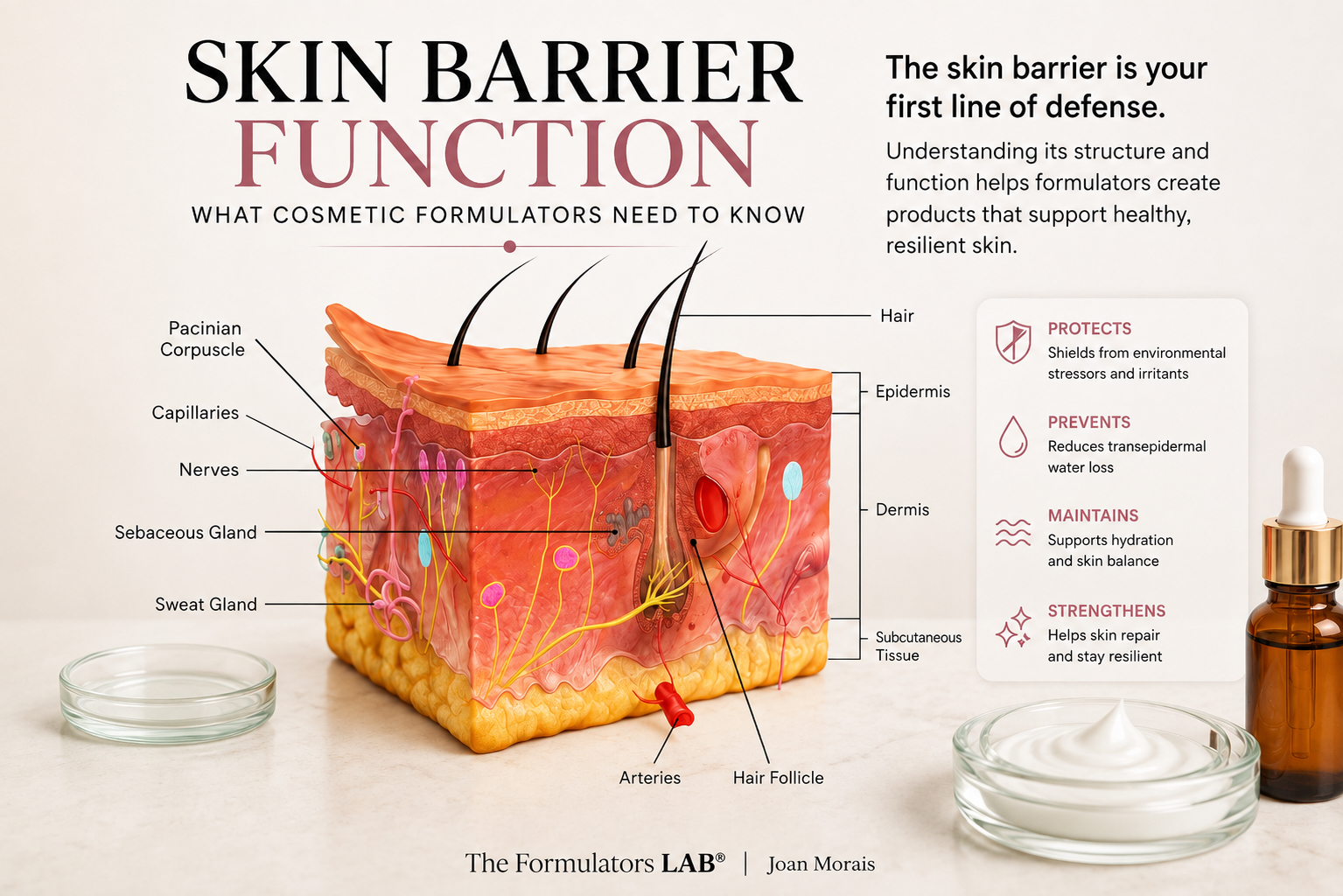
The skin is made up of several layers, each with important functions that help protect the body and maintain healthy skin. At the surface of the epidermis is the stratum corneum, which plays a major role in what we commonly call the skin barrier.
For cosmetic formulators, understanding the skin barrier is essential. The products we formulate and the ingredients we select can either support the skin’s natural barrier function or contribute to dryness, irritation, and barrier disruption.
A healthy skin barrier helps maintain hydration, retain important skin lipids, protect against environmental stressors, and limit the entry of irritating substances and microorganisms. It also helps regulate the continuous movement of water from within the skin to the surrounding environment.
How the Skin Barrier Works
The stratum corneum is often described as having a “brick-and-mortar” structure.
The “bricks” are flattened skin cells called corneocytes, while the surrounding “mortar” is a lipid-rich matrix containing primarily ceramides, cholesterol, and fatty acids.
Together, these components create a protective layer that helps:
- Reduce excessive water loss
- Maintain skin hydration
- Protect against environmental exposure
- Limit penetration of irritants and allergens
- Support the skin’s natural microbial environment
- Maintain smoothness, flexibility, and comfort
When this structure becomes disrupted, the skin may have greater difficulty retaining moisture and protecting itself from external stressors.
One of the most important measurements used to evaluate this function is transepidermal water loss, or TEWL.
Transepidermal Water Loss (TEWL)
Transepidermal water loss (TEWL) is the passive movement of water from within the body through the epidermis and stratum corneum, where it evaporates from the skin’s surface.
A certain amount of TEWL occurs naturally and continuously.
However, when the skin barrier is compromised, water can escape more readily. In general, higher TEWL is associated with reduced skin-barrier integrity, while a healthy, intact barrier is better able to regulate water loss.
Specialized instruments can measure water-vapor loss from the surface of the skin. TEWL testing is widely used in skin research and cosmetic product evaluation to help assess skin-barrier function and the effects of topical products.
Formulators Note: For a cosmetic formulator, TEWL is important because it helps explain why a product should do more than simply make the skin feel moisturized immediately after application. A well-designed formulation should also help the skin retain moisture and maintain its protective barrier.
Skin pH and the Skin Barrier
The surface of healthy skin is naturally mildly acidic. This acidic environment is sometimes referred to as the acid mantle and plays an important role in barrier function, skin-surface enzymes, and the skin’s microbial environment.
The pH of a cosmetic product can therefore be an important formulation consideration.
Repeated exposure to highly alkaline products, especially cleansers, can temporarily raise skin-surface pH and affect the structure and function of the stratum corneum. High-pH conditions have also been associated with stratum-corneum swelling and increased barrier disruption.
Formulators Note: This is one reason why formulators need to consider not only the ingredients in a product, but also the finished formulation’s pH, cleansing strength, frequency of use, and overall mildness.
How Skin Care Products Can Affect the Skin Barrier
Skin care products can either support the barrier or place additional stress on it.
Potential sources of barrier disruption include:
- Harsh or overly aggressive surfactants
- Excessive cleansing
- Highly alkaline products
- Overuse of exfoliating acids
- Aggressive physical exfoliation
- Frequent scrubbing
- Repeated exposure to irritating ingredients
- Formulations that do not provide adequate moisturization for the intended skin type
This does not mean cleansing or exfoliating ingredients should be avoided. Instead, they should be formulated thoughtfully and used at appropriate concentrations and frequencies.
The goal is to achieve the desired cosmetic effect without unnecessarily compromising the stratum corneum.
Other Factors That Can Affect the Skin Barrier
Skin-barrier function is influenced by many factors beyond cosmetic products, including:
- UV exposure
- Pollution and environmental exposure
- Low humidity and dry environments
- Extreme weather
- Repeated washing
- Chemical exposure
- Irritants and allergens
- Age
- Stress
- Certain skin conditions
Environmental conditions and pollution can also influence TEWL and skin-barrier function, although the effects of climate, humidity, season, and individual differences can vary considerably.
Signs of a Compromised Skin Barrier
Skin with a compromised barrier may appear or feel:
- Dry or dehydrated
- Rough or flaky
- Tight
- Itchy
- Sensitive
- Red or irritated
- Uncomfortable
- More reactive than usual
- Prone to stinging or burning when products are applied
These symptoms can have many causes, but they are important considerations when formulating products intended for dry, sensitive, or barrier-compromised skin.
Formulating to Support the Skin Barrier
A barrier-supportive formulation usually takes a multi-faceted approach.
Rather than relying on one “hero” ingredient, formulators can combine ingredients that help attract water, soften the skin, supplement surface lipids, and reduce moisture loss.
Humectants
Humectants help attract and retain water within the stratum corneum.
Examples include:
- Glycerin
- Sodium PCA
- Betaine
- Hyaluronic acid
- Sodium lactate
- Beta-glucan
- Propanediol
Emollients and Lipids
Emollients help soften and smooth the skin while improving the sensory quality of a formulation.
Depending on the formulation, these may include:
- Ceramides
- Squalane
- Jojoba oil
- Meadowfoam seed oil
- Marula oil
- Shea butter
- Other carefully selected plant oils and butters
Ceramides, cholesterol, and fatty acids are particularly important components of the skin’s natural lipid barrier.
Occlusives
Occlusive ingredients form a protective layer on the surface of the skin that helps slow evaporation of water.
Plant butters, waxes, certain oils, and other film-forming ingredients can provide varying degrees of occlusion depending on the formulation.
Formulator’s Note: A well-formulated moisturizer often combines humectants + emollients + occlusive ingredients rather than relying on only one approach.
Formulating With the Skin Barrier in Mind
Supporting the skin barrier begins long before choosing a trendy active ingredient.
A cosmetic formulator should consider the entire formulation:
Is the cleansing system appropriately mild?
Is the pH suitable for the product and its intended use?
Does the formulation provide enough hydration and emolliency?
Are potentially irritating ingredients being used appropriately?
Is the product designed for the needs of the intended skin type?
Could frequent use of the product cause unnecessary stripping or irritation?
These questions are especially important when developing products for dry, mature, sensitive, or easily irritated skin.
Free Formulators Guide
Skin Barrier Function: A Quick Formulators Guide to Supporting the Stratum Corneum
Download this free guide for a clear, practical reference you can use at your formulator bench.
Download the Free GuideThe Formulator’s Goal
The skin barrier is a complex and highly ef
fective protective system. Good skin care formulation should work with this natural system rather than against it.
For formulators, understanding the relationship between the stratum corneum, skin lipids, hydration, pH, cleansing, and transepidermal water loss provides a foundation for creating better products.
Ultimately, the goal is not simply to make the skin feel good immediately after application. It is to formulate products that help the skin remain comfortable, hydrated, resilient, and supported over time.
Continue Learning
Learn Professional Cosmetic Formulation
Would you like to understand how to properly develop skincare products supporting the skin barrier?
The Professional Natural Skin Care Formulation Course from Joan Morais Cosmetics School teaches you how to develop professional-quality, vegan, natural, and science-based skin care formulations. Learn how ingredients function, how to create stable emulsions, how to customize products for different skin types, and how to move from an idea to a properly developed cosmetic product.
Explore the Professional Skin Care CourseYou might also like