
Viscosity in Cosmetic Formulation: Understanding Texture and Flow
By Joan Morais | The Formulators LAB®
Have you made a shampoo that pours too quickly, a lotion that won’t pump, or a cream that feels thick in the jar but spreads easily? These are useful observations about how your formulation flows.
Viscosity is a measure of resistance to flow. Understanding it helps you choose ingredients, refine texture, compare batches, and select packaging that works with your product.
You don’t need to begin with expensive equipment. Start by observing one formulation carefully and keeping good notes. As you develop professional products, instrument testing gives you measurements you can use to set specifications and check consistency.
What Is Viscosity?
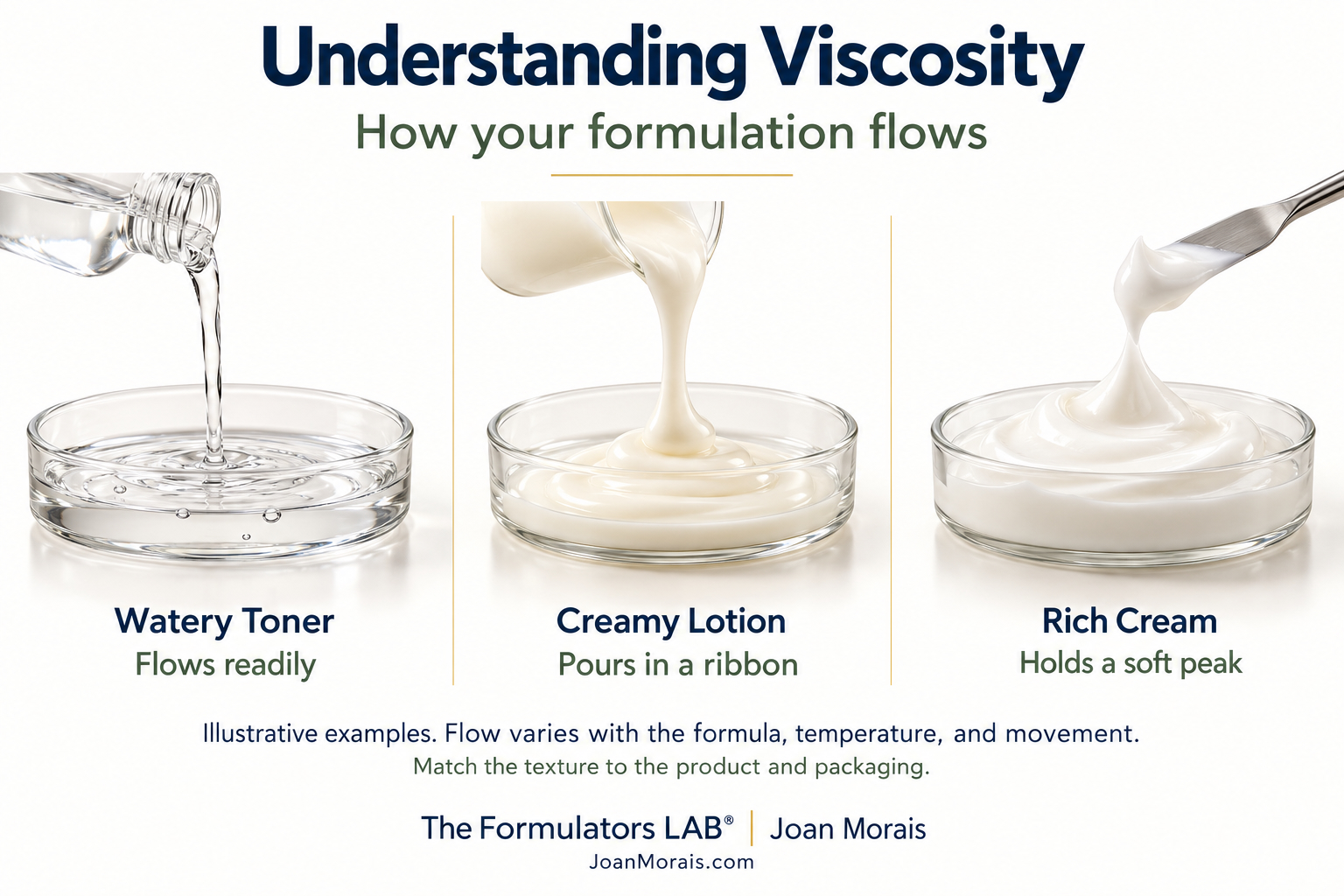
A low-viscosity liquid flows easily, like water or a watery toner. A higher-viscosity liquid resists flow more, like a creamy lotion.
We often describe products as thin or thick. Viscosity gives us a measurable way to describe their flow under specific testing conditions. It doesn’t tell us everything about texture. Slip, cushion, tackiness, elasticity, and firmness also shape how a product feels.
A balm or lip balm may be solid at room temperature. For these products, hardness, melting behavior, and structure can be more useful than a single viscosity reading.
Why Viscosity Matters
The right flow depends on the product you want to create.
- Application: A serum should spread as intended. A conditioner should distribute through the hair without unnecessary drag.
- Packaging: A lotion needs to dispense from its pump. A shampoo should pour with control.
- Consistency: Repeatable measurements help you compare batches and notice changes during storage.
- Manufacturing: Flow affects mixing, transferring, pumping, and filling, especially when you scale up.
- Physical stability: The right structure can help slow settling or droplet movement. Thickness alone does not prove a product is stable.
Formulator’s Note:
A thick product isn’t automatically better. Your goal is a texture that suits the formula, its intended use, and its packaging.
A thick product isn’t automatically better. Your goal is a texture that suits the formula, its intended use, and its packaging.
Simple Ways to Observe Flow
Use the same sample amount, temperature, container, and resting time when comparing batches.
Pour test: Pour a small sample between beakers. Does it run quickly, form a ribbon, or barely move?
Spatula test: Lift the product and watch how it falls. Does it drip, mound, or hold a soft peak?
Tilt test: Tilt a sample jar and observe how readily the product moves.
Spread test: Compare a measured amount on a clean glass plate. For appropriate finished samples, also assess application feel on skin or hair.
Packaging test: Try the product in the actual pump, bottle, tube, or jar you plan to use. Check dispensing after storage, too.
These observations help you learn your formulation. They do not provide a viscosity value in centipoise or replace stability and microbiological testing.
How Is Viscosity Measured?
A rotational viscometer measures the resistance as a spindle rotates in the sample. A rheometer can provide a broader picture of flow and structure under controlled conditions.
Dynamic viscosity is often reported in centipoise (cP) or millipascal-seconds (mPa·s). The values are equivalent: 1 cP = 1 mPa·s. The SI unit is Pa·s; 1 Pa·s equals 1,000 cP.
For many cosmetic products, the result is an apparent viscosity: a value that applies to the conditions used for that measurement. A number without a method is difficult to compare.
Record:
- Product, formula version, and batch number
- Test date and product age
- Instrument model, spindle or geometry, and speed or shear rate
- Sample temperature, container, sample amount, and immersion depth
- Sample preparation, mixing history, and resting time
- Reading time, viscosity value, and unit
- Torque within the instrument’s valid range, where applicable
- Appearance, bubbles, separation, and other observations
Follow the instrument instructions when choosing the spindle, speed, sample setup, and acceptable torque range. Establish a repeatable method for each product.
Temperature and Resting Time Matter
Many liquids become thinner as they warm. Emulsions, gels, and surfactant systems can respond in more complex ways, so test your own formula rather than assuming its behavior.
A common reference temperature is 25°C / 77°F. Use the temperature specified in your test method and allow the sample to reach that temperature before measuring.
Also give the product time to develop its texture. Gum hydration, cooling, and crystallization may continue after production. A useful development check is to compare the batch after 24–48 hours and again after one week, using the same method. These are observation points, not a universal testing schedule.
Why a Cream Can Be Thick but Spread Easily
Water is an example of a Newtonian liquid: at a fixed temperature, its viscosity stays essentially constant as shear rate changes.
Many cosmetic products are non-Newtonian. Their measured viscosity changes with the rate of movement, and sometimes with how long that movement continues.
Shear-thinning means viscosity decreases as shear rate increases. This can help a cream hold body in its jar while spreading more easily during application.
Thixotropy is time-dependent. Under sustained shear, the product becomes less viscous, then its structure recovers over time when the shear is reduced or stopped.
These behaviors can occur together, but they are different. A product thickening overnight does not, by itself, prove thixotropy; hydration or crystallization may also be involved.
What Affects Viscosity?
Lotions and Creams
The emulsifier system, oil phase, fatty alcohols, gums or polymers, pH, and manufacturing process all influence texture. Cooling and mixing can change the structure, even when the ingredient percentages stay the same.
Cetyl alcohol and cetearyl alcohol can add body in suitable systems. Xanthan gum, sclerotium gum, hydroxyethylcellulose, and other compatible thickeners can influence flow in different ways. Choose according to the complete formula and the supplier’s instructions.
Shampoos and Cleansers
The surfactant blend, active surfactant matter, pH, electrolytes, fragrance, essential oils, solubilizers, and preservative can all affect viscosity.
Salt does not thicken every surfactant system. In a salt-responsive blend, viscosity may increase to a peak and then decrease as more salt is added. Evaluate additions in small measured steps and keep a record; don’t assume more salt means a thicker shampoo.
Balms and Butters
For anhydrous products, evaluate firmness, glide, melting behavior, and crystal structure alongside flow. Wax and butter selection, ingredient ratios, and cooling rate all matter.
An oil that feels rich on the skin will not necessarily thicken an emulsion. Sensory feel and viscosity are related, but they are not interchangeable.
How to Adjust a Formula That Is Too Thin or Too Thick
Before changing the formula, check the temperature, pH, hydration, weighing, and processing. Compare the sample at the same age and under the same conditions as your reference batch.
Then make a small trial batch and change one variable at a time.
| If you notice | Review first | Possible development adjustment |
|---|---|---|
| Too thin | Hydration, pH, compatibility, processing | Adjust a compatible thickener or structural ingredient |
| Too thick | Thickener level, fatty alcohols, waxes, resting time | Reduce the relevant structuring ingredient in the next trial |
| Thinner during storage | pH drift, separation, heat exposure, contamination | Investigate the cause before trying to thicken it |
| Thicker during storage | Continued hydration, crystallization, water loss, temperature | Review the process, packaging, and storage conditions |
| Thick but drags or pills | Thickener choice, powder level, oil-phase balance | Refine the texture and slip rather than chasing thickness |
Keep each revised formula at 100%. If you change the water phase, recheck the concentrations of all ingredients, including the preservative. Repeat the appropriate stability, preservation, packaging, and performance testing after changes.
Do not try to rescue a potentially contaminated batch by adding thickener.
Begin with One Formulation
Choose one product and observe how it pours, spreads, and dispenses. Record what happens after resting and during storage. These simple habits help you connect ingredient choices and processing with the finished texture.
The aim is to understand why your formulation behaves the way it does, so you can adjust it thoughtfully and reproduce it consistently.
Free Formulator’s Guide
Viscosity in Cosmetic Formulation
Download this free guide for a quick reference, a practical troubleshooting checklist, and a visual viscosity batch-testing worksheet.
Learn to formulate — not simply follow recipes. Explore professional formulation courses and LAB classes at JoanMorais.com.
Technical References
AMETEK Brookfield: Viscosity and Rheology FAQs and Learn About Viscosity.
You might also like