
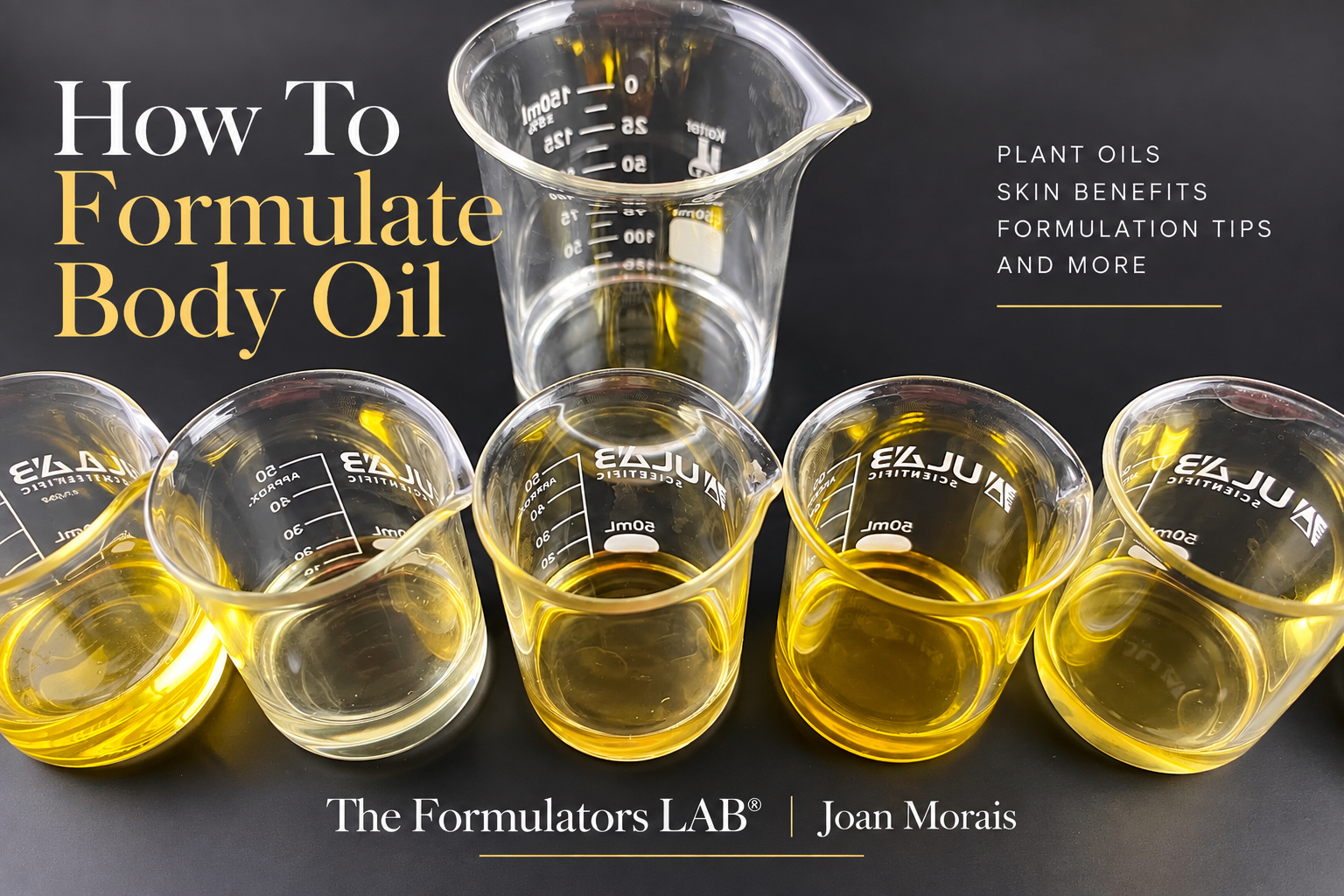
How to Formulate Body Oil
Body oil is one of the simplest types of cosmetic formulations to make, but creating a beautiful, professional body oil requires more than blending a few plant oils together.
A well-formulated body oil should spread easily, soften the skin, leave a beautiful glow, and absorb without feeling excessively greasy. The oils also need to work well together in terms of skin feel, oxidative stability, cost, and availability.
Because body oil is an anhydrous, or waterless, formulation, it does not require an emulsifier or water-phase thickener. A properly formulated waterless body oil also generally does not require a conventional antimicrobial preservative, although good manufacturing practices and protection from water contamination are still important.
What Does Body Oil Do?
Plant oils are emollients. They help soften, smooth, and condition the skin while reducing moisture loss.
Body oil does not add water to the skin, so technically it does not hydrate in the same way a water-based moisturizer does.
One of the best ways to use body oil is to apply it to slightly damp skin after bathing or showering. The oil helps seal in some of the moisture already present on the skin and leaves the skin feeling soft, supple, and conditioned.
Body oiling is a simple, time-honored practice that can help soften, smooth, and condition the skin while creating a comforting self-care ritual. In Ayurveda, body oiling, or abhyanga, has long been used as part of daily and seasonal care. This post explores the benefits of body oiling, why it can be especially helpful during cooler, drier months, and how different oils can be chosen for different skin needs and desired skin feel.
A good body oil can provide:
- Soft, smooth skin
- Improved skin suppleness
- Reduced moisture loss
- A beautiful healthy-looking glow
- A luxurious sensory experience
- An aromatic experience when essential oils are included
Start With Skin Type and the Desired Skin Feel
Before selecting your oils, decide who will be using the body oil and how you want the finished product to feel.
Do you want a:
- Lightweight dry body oil?
- Silky everyday body oil?
- Rich moisturizing body oil?
- Long-lasting glowing body oil?
- Premium luxury botanical oil?
Formulator’s Note:
There isn’t one body oil that is right for everyone. Different skin types and skin tones can have different needs and preferences. Some people prefer a lightweight, dry body oil that absorbs quickly, while others prefer a richer oil that remains on the skin longer and leaves a beautiful, lasting glow. The oils you select, and how much you use of each, will determine the final sensory profile.
There isn’t one body oil that is right for everyone. Different skin types and skin tones can have different needs and preferences. Some people prefer a lightweight, dry body oil that absorbs quickly, while others prefer a richer oil that remains on the skin longer and leaves a beautiful, lasting glow. The oils you select, and how much you use of each, will determine the final sensory profile.
Lightweight Base Oils
Lightweight oils and emollients are usually used as the foundation of a body oil.
Examples include:
- Coconut MCT / Caprylic/Capric Triglyceride
- High-Oleic Sunflower Oil
- High-Oleic Safflower Oil
These oils help the product spread easily and keep richer botanical oils from feeling too heavy.
Formulator’s Note:
High-oleic sunflower oil is especially useful when cost is important. It is generally economical, easy to source, light-to-medium in feel, and more oxidatively stable than conventional high-linoleic sunflower oil.
High-oleic sunflower oil is especially useful when cost is important. It is generally economical, easy to source, light-to-medium in feel, and more oxidatively stable than conventional high-linoleic sunflower oil.
Medium-Weight Conditioning Oils
Medium-weight oils provide additional softness, richness, and conditioning.
Examples include:
- Sweet Almond Oil
- Apricot Kernel Oil
- Rice Bran Oil
- Sesame Oil
Sweet almond oil is a classic body-oil ingredient because it has a soft, balanced skin feel.
Apricot kernel oil is a good alternative when you want something similar to almond oil.
Rice bran oil is slightly richer and more substantive and can help the glow remain on the skin longer.
Sesame oil adds richness and is particularly useful when you want a more conditioned, longer-lasting skin feel.
Richer and Premium Botanical Oils
Richer oils can be added at lower percentages to increase cushion, conditioning, and luxury.
Examples include:
- Avocado Oil
- Jojoba Oil
- Meadowfoam Seed Oil
- Baobab Oil
Premium botanical oils are higher-value plant-derived oils chosen for their skin feel, composition, formulation benefits, and premium positioning, and may also be included for their distinctive fatty-acid profiles, skin feel, and product story.
Examples include:
- Argan Oil
- Camellia Oil
- Abyssinian Oil
- Rosehip Seed Oil
- Cranberry Seed Oil
- Raspberry Seed Oil
- Evening Primrose Oil
- Borage Oil
You do not need a large number of expensive oils to create a beautiful product.
Formulator’s Note:
Often, the best strategy is to use stable, economical oils as the foundation and smaller percentages of premium oils where they add something meaningful to the formula.
Often, the best strategy is to use stable, economical oils as the foundation and smaller percentages of premium oils where they add something meaningful to the formula.
Silicone Alternatives for a Lighter Feel
Plant-derived sensory emollients can be used when you want a body oil to feel lighter, silkier, and less greasy.
Examples include:
- Coco-Caprylate/Caprate
- Isoamyl Laurate
- C13-15 Alkane / Hemisqualane
These are not traditional plant oils. They are performance ingredients selected primarily to improve:
- Slip
- Spreadability
- Dry-down
- Silkiness
- After-feel
Formulator’s Note:
These are especially useful when formulating a dry body oil or balancing richer plant oils.
These are especially useful when formulating a dry body oil or balancing richer plant oils.
Consider Oxidative Stability
Plant oils do not all have the same stability.
Highly unsaturated oils may oxidize more quickly and eventually develop undesirable changes in odor, color, and quality.
More oxidatively stable ingredients include:
- Coconut MCT Oil
- CCT Oil
- Jojoba Oil
- Meadowfoam Oil
- High-Oleic Sunflower Oil
- High-Oleic Safflower Oil
More oxidation-sensitive oils are often better used at lower percentages.
Examples include:
- Rosehip Seed Oil
- Borage Oil
- Evening Primrose Oil
- Chia Seed Oil
- Raspberry Seed Oil
Formulator’s Note:
Mixed tocopherols can be added to help slow oxidation of the oils in the formulation.
Mixed tocopherols can be added to help slow oxidation of the oils in the formulation.
Consider Cost and Availability
A great formula also needs to be practical.
Before choosing an oil, consider:
- Cost per pound or kilogram
- Minimum order quantity (MOQ)
- Availability from more than one supplier
- Shelf life
- Consistency of supply
- Whether an alternative is available if the ingredient becomes difficult to source
An expensive ingredient is not automatically a better ingredient.
Professional formulation is about choosing ingredients that work together to provide the desired performance, sensory feel, stability, availability, and cost.
Adding Essential Oils
Essential oils can transform a simple body oil into an aromatic body care experience.
They should be used at appropriate dermal levels and evaluated as a complete aromatic blend.
Essential oils can contribute:
- Floral notes
- Woody notes
- Balsamic notes
- Citrus notes
- Herbal notes
- Spicy notes
The goal is not simply to add essential oils for scent. The blend should be carefully designed so the aroma is balanced, pleasant, and appropriate for a leave-on body product.
Free Formulator’s Guide
How To Formulate Body Oil
Download this free guide for a clear, practical reference you can use at your formulator bench.
A Simple Approach to Building a Body Oil
When developing a body oil, think about combining:
Lightweight base oils
for spreadability
Medium-weight conditioning oils
for softness and skin feel
Richer or premium oils
for cushion and luxury
Sensory emollients
when a lighter or silkier finish is desired
Antioxidants
to help protect oxidation-sensitive oils
Essential oils
for the aromatic profile
Then make a small test batch and evaluate:
- Spreadability
- Absorption
- Greasiness
- Slip
- Glow
- Skin feel after 5 minutes
- Skin feel after 30 minutes
- Aroma
- Cost
- Stability
The best body oil is not necessarily the one with the longest ingredient list.
It is the one where each ingredient has a purpose.
Continue Learning
Learn How To Make an Aromatic Body Oil
Ready to make a body oil that’s already formulated for you? This complete formula includes a beautifully balanced essential oil blend and is simple to make from start to finish.
If you would like to go deeper into body-oil formulation and create the complete formula, take the Aromatic Body Oil Class. In this class, you will learn how to make a lightweight aromatic body oil using carefully selected essential oils and fast-absorbing plant oils to create a highly skin-softening, waterless body treatment.
Aromatic Body Oil Class Includes:
- 6 Training Videos
- Detailed Class Handout
- Complete Aromatic Body Oil Formula and Procedure
- Certificate Upon Completion
The class takes you through the formulation in more detail so you can understand the ingredients, how they work together, and how to make the finished body oil.
You might also like