
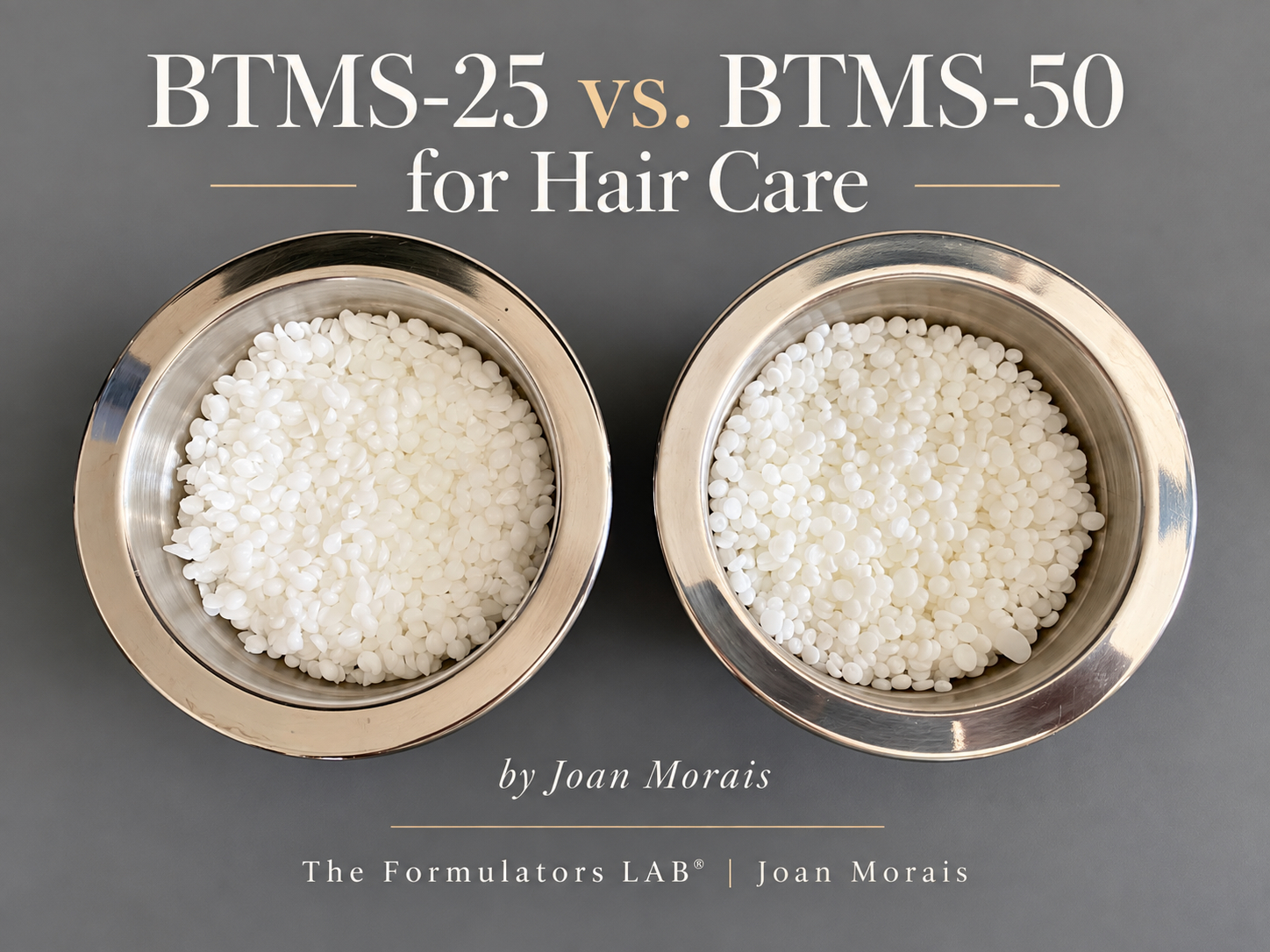
BTMS-25 vs. BTMS-50: What Cosmetic Formulators Need to Know
BTMS-25 and BTMS-50 are two of the most useful conditioning emulsifiers for professional hair care formulation. They can be used to create rinse-off conditioners, deep conditioning masks, leave-in conditioners, detanglers, co-washes, conditioning creams, and solid conditioner bars.
Although the names are similar, BTMS-25 and BTMS-50 do not perform exactly the same way in a formulation.
The primary difference is the amount of the conditioning active Behentrimonium Methosulfate contained in each raw material.
BTMS-25 contains approximately 25% Behentrimonium Methosulfate, while BTMS-50 contains approximately 50%. The remainder of the material consists primarily of fatty alcohols and, depending on the grade, other components.
This means BTMS-50 supplies approximately twice as much Behentrimonium Methosulfate at the same use level.
But this does not mean you should always choose BTMS-50.
The additional fatty alcohol present in BTMS-25 contributes significantly to the viscosity, structure, creaminess, slip, and overall sensory profile of the finished conditioner. BTMS-50 contains more conditioning active and less built-in fatty alcohol, which gives the formulator more control over how rich, thick, light, or conditioning the final product will be.
What Is Behentrimonium Methosulfate?
Behentrimonium Methosulfate is a cationic, positively charged conditioning ingredient. It is classified as a quaternary ammonium compound used for hair conditioning and emulsification. It is substantive to the hair and is particularly useful for improving detangling, wet combing, softness, and manageability.
Despite the word “methosulfate,” Behentrimonium Methosulfate is not a sulfate cleansing surfactant such as Sodium Lauryl Sulfate or Sodium Laureth Sulfate. It is used primarily as a conditioning agent and cationic emulsifier.
Hair fibers develop negatively charged areas, particularly when the hair is chemically treated, weathered, porous, or damaged. Cationic conditioning ingredients are attracted to these negatively charged areas and deposit onto the hair surface.
The result can be:
- improved wet and dry combing
- reduced friction between hair fibers
- easier detangling
- reduced static and flyaways
- smoother-feeling hair
- improved softness and manageability
- better slip during application and rinsing
- a more conditioned feel after the hair dries
BTMS-25 or BTMS
A common BTMS-25 grade contains approximately:
25% Behentrimonium Methosulfate
75% fatty alcohol
A common INCI is: Behentrimonium Methosulfate (and) Cetearyl Alcohol
Some suppliers instead declare the fatty alcohol components individually, such as Cetyl Alcohol and Stearyl Alcohol. Always formulate from the INCI and technical specifications supplied with the specific raw material you purchase rather than assuming every BTMS-25 is identical.
What BTMS-25 Does to a Formula
Because approximately three-quarters of the raw material consists of fatty alcohol, BTMS-25 contributes considerably more body and structure to a formulation.
A conditioner made with BTMS-25 can feel: creamy • substantial • soft • rich • cushioned • slightly more waxy
The higher fatty-alcohol portion can create a beautiful thick conditioner without requiring as much additional cetyl or cetearyl alcohol.
This makes BTMS-25 particularly useful when you want the emulsifier to contribute both conditioning and viscosity.
How BTMS-25 Feels on the Hair
At an appropriate use level, BTMS-25 generally produces hair that feels soft, smooth and conditioned with good body.
Because you usually need more BTMS-25 to obtain the same amount of conditioning active supplied by BTMS-50, you are simultaneously adding more fatty alcohol.
This can be beneficial for: dry hair, coarse hair, curly hair, highly textured hair, porous hair, chemically treated hair and formulations designed to have a rich conditioning feel.
However, very high levels can make fine or low-density hair feel heavier or more coated.
BTMS-50
BTMS-50 contains approximately 48–50% active conditioning material, depending upon the supplier. Generally, the INCI for BTMS-50 is INCI: Behentrimonium Methosulfate (and) Cetyl Alcohol (and) Butylene Glycol
Because BTMS-50 contains substantially more Behentrimonium Methosulfate and less fatty alcohol than BTMS-25, a formulator can achieve a significant conditioning effect while using less raw material.
BTMS-50 contain Butylene Glycol as part of the raw material, typically alongside Behentrimonium Methosulfate and Cetyl Alcohol. In BTMS-50, Butylene Glycol functions primarily as a glycol carrier/solvent and humectant, helping support the processing and delivery of the conditioning ingredient; it can also contribute some moisture retention.
The controversy around Butylene Glycol is largely connected to its synthetic or petrochemical origin and its exclusion from some “natural” or very strict clean-beauty ingredient philosophies, rather than strong evidence that it is unsafe at normal cosmetic use levels.
For formulators who want to avoid petrochemical-derived ingredients altogether, BTMS-25 may better fit that formulation philosophy, but always check the exact INCI from your supplier because BTMS grades can vary.
Today, formulators also have access to bio-based Butylene Glycol made from renewable plant sugars rather than petroleum. One example is Brontide® natural Butylene Glycol, which is produced through fermentation of plant-derived sugars and has the same INCI name, Butylene Glycol, as conventional material.
What BTMS-50 Does to a Formula
BTMS-50 gives the formulator greater control over the relationship between: conditioning strength → fatty alcohol → viscosity → final sensory profile
Instead of obtaining a large amount of fatty alcohol automatically from BTMS-25, you can use a lower percentage of BTMS-50 and then separately determine how much cetyl alcohol, cetearyl alcohol, stearyl alcohol or another structuring material you want. This is extremely useful when developing professional formulations.
BTMS-50 can create a conditioner that feels: silky • highly conditioning • slippery • elegant • smooth • less structurally heavy when properly formulated
It can also produce a very rich conditioner if it is combined with additional fatty alcohols, oils and butters.
It is described as providing excellent detangling and wet-combing performance and identifies applications including rinse-off conditioners, detanglers, styling products and other hair care formulations.
BTMS-25 vs. BTMS-50 at the Same Percentage
This is where the difference becomes easier to understand.
| Use Level | Approx. Active from BTMS-25 | Approx. Active from BTMS-50 |
|---|---|---|
| 1% | 0.25% | 0.50% |
| 2% | 0.50% | 1.00% |
| 3% | 0.75% | 1.50% |
| 4% | 1.00% | 2.00% |
| 5% | 1.25% | 2.50% |
| 6% | 1.50% | 3.00% |
| 8% | 2.00% | 4.00% |
For example: 4% BTMS-25 provides approximately 1% Behentrimonium Methosulfate active.
To obtain approximately the same theoretical amount of active using BTMS-50, you would need around: 2% BTMS-50.
But the two formulas will not necessarily have the same viscosity or sensory profile.
The 4% BTMS-25 formula introduces considerably more fatty alcohol into the formulation. Therefore, it will generally contribute more body and creaminess than 2% BTMS-50.
This is why substituting BTMS-25 for BTMS-50, or vice versa, should not simply be done gram for gram.
Recommended Starting Percentages
Supplier recommendations vary. Always look at the supplier recommendations.
For formulation development, I would use the following as practical starting ranges, and then adjust according to the hair type, desired texture, oil phase and other conditioning ingredients.
| Product | BTMS-25 | BTMS-50 | Expected Result |
|---|---|---|---|
| Light leave-in conditioner | 1–2% | 0.5–1% | Light conditioning, softness, minimal weight |
| Cream leave-in conditioner | 2–4% | 1–2.5% | More slip, softness and control |
| Detangling cream | 2–4% | 1–2% | Improved wet combing and detangling |
| Daily rinse-off conditioner | 3–6% | 2–4% | Medium conditioning with good softness |
| Rich rinse-off conditioner | 5–8% | 3–5% | Richer slip and stronger conditioning |
| Deep conditioning mask | 5–10% | 3–6% | Substantial conditioning for dry or damaged hair |
| Co-wash | 2–5% | 1–3% | Conditioning cleansing system; surfactant compatibility must be considered |
These are formulation-development ranges rather than universal rules. Always check the technical data and maximum recommended usage for your specific supplier grade.
Which One Is Better for Fine Hair?
For fine hair, the goal is usually to provide detangling and softness without significantly reducing volume or movement.
BTMS-50 can be especially useful because a relatively low percentage can provide noticeable conditioning without automatically introducing a large amount of fatty alcohol.
A light conditioner might begin around 1–2% BTMS-50, with additional fatty alcohol added only if more viscosity is required.
BTMS-25 can also be used successfully, but because it contains much more fatty alcohol, increasing it to obtain more conditioning simultaneously increases the structural and potentially heavier components of the formula.
Formulator’s Note:
For very fine hair, I would usually start lower and evaluate the hair after it is completely dry rather than judging the conditioner only by how slippery the wet hair feels.
For very fine hair, I would usually start lower and evaluate the hair after it is completely dry rather than judging the conditioner only by how slippery the wet hair feels.
Which One Is Better for Curly, Coarse or Textured Hair?
For curly, coarse, highly textured, dry or porous hair, more conditioning deposition and a richer cream structure may be desirable.
BTMS-25 at approximately 5–8% can create a beautiful, substantial conditioner because the fatty alcohol content contributes creaminess, body and emolliency.
BTMS-50 at approximately 3–5% can produce stronger conditioning while allowing you to customize the supporting fatty alcohol system.
For example, rather than relying entirely on the fatty alcohol contained in BTMS-25, a formulator could use BTMS-50 with a separately selected level of cetyl alcohol or cetearyl alcohol.
This provides much greater control over the finished product.
Which One Is Better for Damaged or Chemically Treated Hair?
BTMS-50 is particularly useful when the primary goal is strong conditioning, detangling and improved combability.
Damaged hair generally has more irregular and negatively charged areas on the fiber surface, giving cationic conditioners useful sites for deposition. However, adding more BTMS is not always better.
The objective should be to find the lowest level that produces the desired conditioning effect without leaving the hair overly coated, heavy or limp.
Other components of the formulation, including fatty alcohols, oils, proteins, polymers, silicones or silicone alternatives, will also influence the finished performance.
Using BTMS in a Co-Wash
BTMS can be very useful in a co-wash because it provides the soft, slippery, conditioned feel consumers expect from a conditioning cleanser. There is an important compatibility issue, however.
BTMS is cationic. Many traditional cleansing surfactants are anionic.
Cationic and anionic materials can interact and form complexes, potentially changing viscosity, clarity, cleansing performance and conditioning performance.
For this reason, I prefer to formulate BTMS-based co-washes primarily around compatible amphoteric and nonionic surfactants.
BTMS in Solid Conditioner Bars
Solid conditioner bars are different from conventional water-based emulsions.
BTMS may make up a very large percentage of a solid bar because it functions as both a conditioning material and part of the structural system.
When developing a conditioner bar, the percentage must therefore be considered in the context of the entire solid system rather than using the same guidelines as an emulsified rinse-off conditioner.
BTMS-25 can be particularly useful when additional hardness and fatty-alcohol structure are desirable.
BTMS-50 is useful when stronger conditioning is desired and the formulator wants to build the remainder of the bar structure with separately selected fatty alcohols and emollients.
Processing BTMS-25 and BTMS-50
BTMS materials require heat to melt and properly incorporate. Generally recommended for BTMS materials is processing the heated phases in approximately the range of 158°F – 176°F / 70°C – 80°C.
In a traditional conditioner emulsion, I generally recommend heating the water phase and BTMS-containing phase separately, bringing them to similar temperatures, combining them while hot, and mixing appropriately as the emulsion forms.
Do not judge the final viscosity immediately.
BTMS-based conditioners frequently continue to develop viscosity and structure as they cool and may continue setting for many hours after production.
Heat-sensitive ingredients, fragrance and the preservative should be incorporated according to their individual temperature requirements.
pH of a BTMS Conditioner
The final pH should be selected for the entire formulation, not for BTMS alone.
For many conventional hair conditioners, I generally like a finished pH around:
pH 4.5–5.5
A mildly acidic conditioner can complement the conditioning system and is appropriate for many hair care applications.
Can You Substitute BTMS-25 for BTMS-50?
Yes, but they should not automatically be substituted at the same percentage.
If a formula contains: 4% BTMS-25, the approximate Behentrimonium Methosulfate active is: 1%.
An approximate active-equivalent starting point would therefore be: 2% BTMS-50.
However, the 2% BTMS-50 formula will contain less fatty alcohol.
You may need to add additional cetyl alcohol, cetearyl alcohol or another structuring material if you want to reproduce the viscosity and creaminess of the original BTMS-25 formulation.
The reverse is also true.
If you replace BTMS-50 with BTMS-25, simply doubling the BTMS-25 may theoretically bring the conditioning active closer, but it also adds a much larger quantity of fatty alcohol and can make the finished product substantially thicker and heavier.
This is why professional substitution requires evaluating both: conditioning active AND formulation structure.
BTMS-25 vs. BTMS-50: The Main Difference
| BTMS-25 | BTMS-50 | |
|---|---|---|
| Behentrimonium Methosulfate | Approx. 25% | Approx. 48–50% |
| Conditioning strength per gram | Moderate | Higher |
| Fatty alcohol content | Higher | Lower |
| Natural viscosity contribution | Higher | Lower/more adjustable |
| Typical feel | Creamy, substantial, cushioned | Silky, strongly conditioning, customizable |
| Best advantage | Conditioning + structure together | Greater control of conditioning vs. structure |
| Fine hair | Use conservatively | Excellent at lower levels |
| Dry/coarse/textured hair | Excellent for rich creams | Excellent for strong conditioning |
| Deep conditioners | Excellent | Excellent |
| Conditioner bars | Excellent structural option | Excellent conditioning option |
| Formula flexibility | Moderate | High |
Free Formulator’s Guide
BTMS-25 vs. BTMS-50 for Hair Care
Download this free guide for a clear, practical reference you can use at your formulator bench.
Formulator’s Notes
I don’t consider BTMS-50 automatically “better” than BTMS-25. I select them according to what I want the finished formulation to do and if the brand is clean beauty and doesn’t allow petroleum-based butylene glycol.
If I want a thick, creamy conditioner and I also want the BTMS material itself to contribute a significant amount of fatty-alcohol structure, BTMS-25 is an excellent choice.
If I want greater conditioning strength while having more precise control over the fatty alcohol, viscosity and overall sensory profile, BTMS-50 gives me more formulation flexibility.
This becomes especially important when developing products for different hair types.
Fine hair may benefit from strong conditioning delivered through a lower amount of BTMS-50 without excessive structural material.
Coarse, curly, textured or very dry hair may benefit from the additional creaminess created with BTMS-25, or from a BTMS-50 system in which the formulator deliberately builds a richer fatty alcohol and emollient phase.
The important lesson is that the percentage of BTMS alone does not tell you how a conditioner will perform.
You need to consider the percentage of active Behentrimonium Methosulfate, the fatty alcohol supplied with it, any additional fatty alcohols, the oil phase, other conditioning ingredients, the hair type, and whether the product is rinse-off or leave-in.
That is the difference between simply following a formula and truly formulating a hair conditioner.
Continue Learning
Learn Professional Hair Care Cosmetic Formulation
Would you like to learn how to select the right conditioning agents and use levels for different hair types, and formulate a conditioner specifically designed for their needs?
The Professional Natural Hair Care Formulation Course from Joan Morais Cosmetics School teaches you how to develop professional-quality, vegan, natural, and science-based hair care formulations. Learn how ingredients function, how to create stable emulsions, how to customize products for different hair types, and how to move from an idea to a properly developed cosmetic product.
Explore the Professional Natural Hair Care Formulation Course
You might also like