
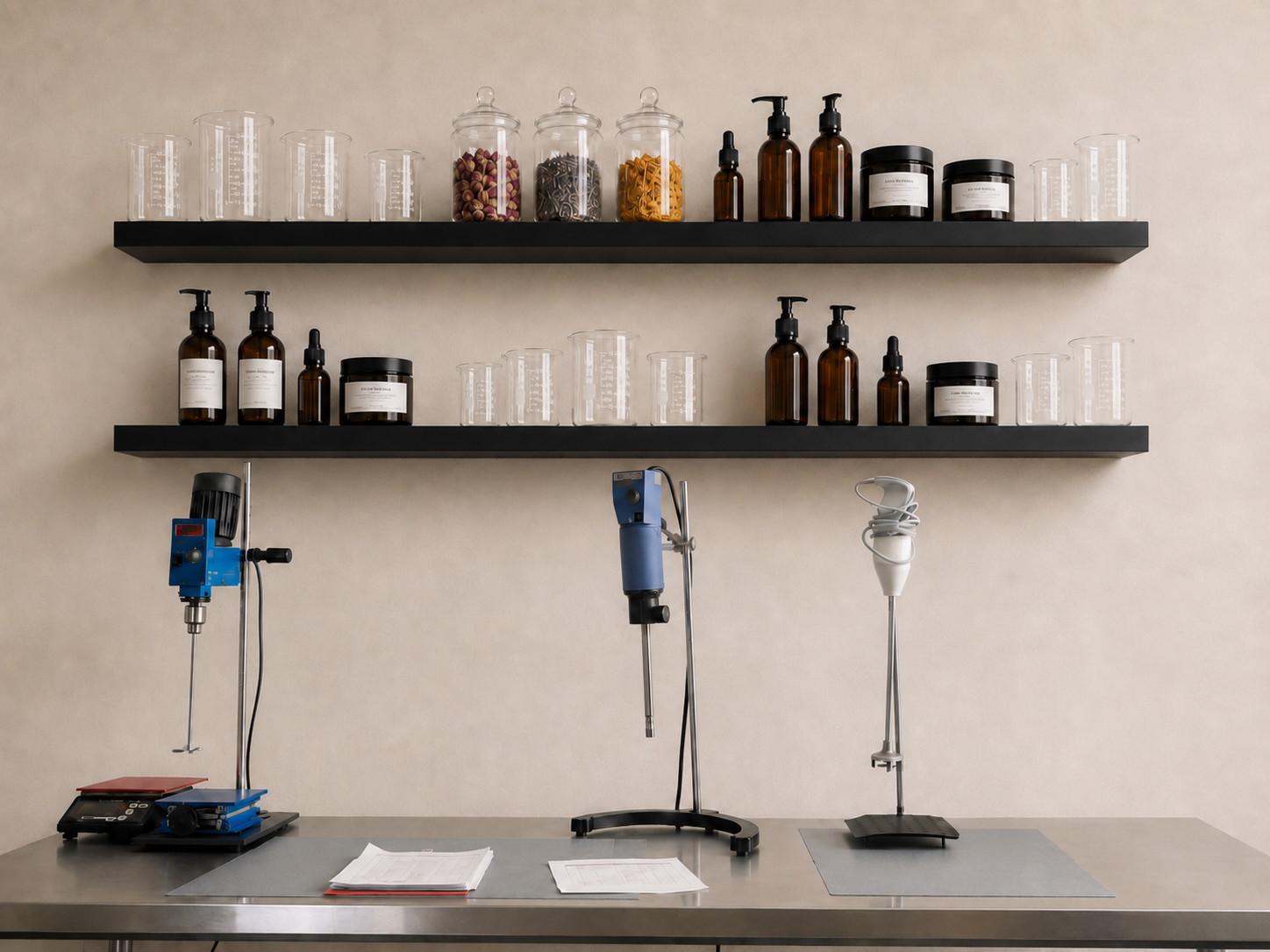
Homogenizer vs. Overhead Mixer vs. Immersion Blender for Cosmetic Emulsions
When making cosmetic formulations, the type of mixing equipment you use can influence the texture, appearance, viscosity, stability, and consistency of the finished product.
Two pieces of equipment commonly used in cosmetic laboratories are:
- A homogenizer
- An overhead stirring mixer
Although both machines mix ingredients, they do not work in the same way. A homogenizer applies concentrated high shear to reduce oil droplets, particles, and agglomerates (clumps) into smaller sizes. An overhead stirring mixer moves the entire batch through the vessel to blend ingredients and maintain uniformity.
For many emulsions, these two pieces of equipment are not competitors. They perform different jobs and may be used at different stages of the same formulation.
What Does Homogeneous Mean?
The word homogeneous means uniform throughout.
A homogeneous cosmetic formulation should have a consistent:
- Appearance
- Color
- Texture
- Ingredient distribution
- Viscosity
- Product performance
However, a homogeneous emulsion is not the same as a true solution.
In a true solution, one material is dissolved at the molecular level in another material. In an emulsion, tiny droplets of one liquid are dispersed throughout another liquid. For example, an oil-in-water emulsion contains small droplets of oil distributed throughout a continuous water phase.
When we describe an emulsion as homogeneous, we mean that the oil droplets and other ingredients are distributed evenly enough that one portion of the product is substantially consistent with another.
A cream may look completely smooth to the eye while still containing millions of microscopic oil droplets.
What Is a Homogenizer?
In a cosmetic laboratory, the word homogenizer usually refers to a rotor-stator high-shear mixer.
A rotor-stator homogenizer contains two primary components:
- A rapidly rotating internal rotor
- A stationary outer stator
The rotor spins at high speed inside the stator. The formulation is drawn into the mixing head, exposed to intense mechanical forces, and pushed through the small openings or gaps in the stator.
This creates a concentrated shearing action that can:
- Break larger oil droplets into smaller droplets
- Break apart powder agglomerates (clumps)
- Disperse pigments
- Improve the distribution of insoluble materials
- Create finer emulsions
- Improve smoothness and uniformity
IKA describes its laboratory homogenizers as rotor-stator systems in which a fast-moving rotor is surrounded by a stationary stator. As the sample passes through the rotor-stator head, it experiences intense shear that can produce very small droplets or particles.
Laboratory rotor-stator homogenizers should not be confused with high-pressure homogenizers. High-pressure homogenizers use pressure to force a product through a very small opening. They are different machines typically used for specialized processing or larger industrial applications.
How Does a Homogenizer Affect an Emulsion?
When the oil and water phases of an emulsion are first combined, the oil may initially exist as relatively large droplets.
The emulsifier begins positioning itself at the interface between the oil and water phases, but mechanical mixing is still needed to distribute the oil throughout the water or the water throughout the oil.
A homogenizer breaks the larger droplets into smaller droplets.
This can produce an emulsion that is:
- Finer
- Smoother
- More uniform
- Less grainy
- More elegant in appearance
- More consistent from batch to batch
- Potentially more resistant to creaming or separation
Silverson reports that high-shear rotor-stator mixers can produce fine, uniform emulsions and that its equipment commonly achieves droplets in the low-micron range, although the actual result depends on the formulation, equipment, processing conditions, and required outcome.
Smaller droplets can contribute to improved physical stability because they generally move and separate more slowly than very large droplets. However, smaller droplet size does not automatically guarantee that an emulsion will be stable.
Emulsion stability also depends on:
- The emulsifier system
- Emulsifier usage rate
- Oil-phase composition
- Oil-phase percentage
- Thickener system
- Processing temperature
- Phase-addition method
- Cooling procedure
- Final pH
- Electrolytes
- Packaging
- Storage conditions
Formulator’s Note:
A poorly designed emulsion cannot always be rescued by using more speed or homogenizing it for a longer period.
A poorly designed emulsion cannot always be rescued by using more speed or homogenizing it for a longer period.
What Is an Overhead Stirring Mixer?
An overhead stirring mixer has a motor positioned above the mixing vessel. A shaft extends down from the motor into the formulation, with a mixing blade or impeller attached to the end.
Depending on the formulation, the mixing attachment may be a:
- Propeller
- Paddle
- Turbine
- Anchor
- Sweep blade
- Blade with a vessel-wall scraper
An overhead mixer produces movement throughout the vessel. This is often called bulk mixing or macro-mixing.
Its main functions are to:
- Circulate the batch
- Combine ingredients
- Maintain an even temperature
- Keep ingredients uniformly suspended
- Prevent localized concentrations
- Support controlled cooling
- Mix medium- and high-viscosity products
- Incorporate heat-sensitive cool-down ingredients gently
IKA describes overhead mixing as a motor-driven shaft and impeller positioned in the material being mixed. Different impellers allow the mixer to handle low- through high-viscosity materials and provide anything from gentle stirring to more intensive mixing.
Unlike a rotor-stator homogenizer, a standard overhead stirring blade does not normally force the entire formulation through a narrow high-shear gap. Its primary job is circulation rather than extreme droplet-size reduction.
How an Overhead Mixer Affects an Emulsion
An overhead mixer helps combine the oil and water phases and moves the forming emulsion throughout the vessel.
It can:
- Pull material from the top toward the bottom
- Move material from the bottom toward the top
- Move the product outward toward the vessel walls
- Bring material from the vessel walls back toward the center
- Maintain consistent mixing while the emulsion thickens and cools
The exact flow pattern depends on the impeller.
For example, a propeller commonly creates axial flow, moving material primarily upward or downward through the vessel. IKA notes that its propeller-style stirring elements generate axial flow and are generally used at medium to high stirring speeds.
An anchor blade moves closer to the vessel wall and is often selected for thicker products. It is normally used at lower speeds and can help move creams, masks, conditioners, and other viscous products that may no longer circulate effectively with a small propeller.
An overhead mixer may successfully produce certain emulsions without a separate homogenizing step, especially when:
- The batch is small
- The emulsion is relatively fluid
- The emulsifier forms emulsions easily
- A very fine droplet size is not required
- The impeller produces sufficient shear
- The desired product is not expected to have an exceptionally refined texture
However, a standard overhead mixer may not produce the same fine droplet size or droplet-size distribution as a rotor-stator homogenizer.
Homogenizer vs. Overhead Mixer
| Feature | Homogenizer | Overhead stirring mixer |
|---|---|---|
| Main action | High-shear droplet and particle reduction | Bulk circulation and blending |
| Typical mixing head | Rotor-stator | Propeller, paddle, turbine or anchor |
| Primary purpose | Create a fine dispersion or emulsion | Keep the entire batch moving uniformly |
| Effect on droplets | Breaks larger droplets into smaller droplets | Distributes droplets throughout the batch |
| Typical speed | High | Low to moderately high, depending on impeller |
| Best processing stage | Emulsion formation or dispersion | Phase preparation, phase combination and cooling |
| Viscosity handling | Depends on model, head and batch movement | Can handle low to high viscosity with the correct impeller and torque |
| Air incorporation risk | Possible if the head is too close to the surface | Possible if the speed creates a deep vortex |
| Repeatability | Usually high when speed, time and geometry are controlled | High when speed, impeller and vessel geometry are controlled |
| Cooling-stage use | Usually limited or brief | Very useful |
| Main concern | Overprocessing, heat and aeration | Insufficient circulation or excessive vortexing |
When Should You Use a Homogenizer on an Emulsion?
A homogenizer is normally used around the time the oil and water phases are combined.
For a typical hot-process oil-in-water emulsion, the general sequence may be:
- Prepare the water phase.
- Prepare the oil phase.
- Heat the phases as required by the emulsifier system.
- Begin mixing the receiving phase.
- Combine the phases according to the formulation procedure.
- Apply controlled homogenization.
- Stop the homogenizer after the emulsion has formed and the required level of refinement has been achieved.
- Continue cooling with an overhead mixer or another gentler mixing method.
- Add heat-sensitive cool-down ingredients at their appropriate temperatures.
- Reduce mixing speed as needed while the product thickens and cools.
The exact order of addition depends on whether you are making an oil-in-water or water-in-oil emulsion and on the requirements of the emulsifier.
High shear is often most useful immediately after the phases are combined because this is when larger droplets are being formed and distributed. The homogenizer can reduce those droplets before the structure of the emulsion fully develops.
Formulator’s Note:
You generally do not need to operate the homogenizer continuously throughout the entire cooling process.
You generally do not need to operate the homogenizer continuously throughout the entire cooling process.
How Long Should You Homogenize?
Longer homogenizing is not always better.
A homogenizer may create a refined emulsion within a relatively short processing period. The required time depends on:
- Batch size
- Homogenizer head diameter
- Rotor-stator gap
- Speed
- Vessel shape
- Position of the homogenizer
- Product viscosity
- Oil-phase percentage
- Emulsifier system
- Desired droplet size
Once the required droplet or particle reduction has been reached, continued processing may provide little additional benefit.
IKA notes that rotor-stator systems eventually reach a point at which additional processing no longer reduces particle size and instead primarily transfers frictional heat into the product.
For cosmetic formulation, it is best to establish a controlled process and give details in the procedure in addition to “homogenize until smooth.”
A more reproducible procedure records:
- Homogenizer model
- Mixing-head size
- Batch size
- Vessel dimensions
- Speed
- Processing time
- Processing temperature
- Position of the mixing head
- Appearance before and after homogenizing
Understanding Mixing Speed
RPM means revolutions per minute. It tells you how many times the shaft or rotor turns each minute.
However, RPM alone does not tell you how much shear a formulation receives.
Two machines operating at the same RPM can produce very different results because of differences in:
- Blade diameter
- Rotor diameter
- Stator design
- Rotor-stator gap
- Impeller shape
- Motor torque
- Batch size
- Vessel dimensions
- Product viscosity
For this reason, a procedure should not be transferred to a different machine based only on RPM.
For example, some small laboratory rotor-stator homogenizers may operate at speeds extending into tens of thousands of RPM, while an overhead stirring mixer may operate at much lower speeds. This does not mean one machine is always better. They are designed to perform different types of mixing. IKA laboratory dispersers, for example, offer equipment with maximum operating speeds as high as 25,000 RPM, while overhead impellers are commonly rated for substantially lower operating speeds.
When to Increase the Speed
Begin at a lower speed and increase gradually.
You may need to increase mixing speed when:
- The phases are not distributing evenly
- Oil remains on the surface
- Powder remains in clumps
- The entire batch is not circulating
- Material is stationary near the bottom or vessel walls
- The product can tolerate more shear
- The viscosity has increased but the motor has sufficient torque
- A finer emulsion or dispersion is required
With an overhead mixer, increase the speed until you have effective circulation throughout the vessel.
With a homogenizer, increase speed only after the rotor-stator head is properly submerged. Increasing the speed gradually gives you more control and reduces the chance of splashing, air incorporation, or pulling the product surface down into the mixing head.
The goal is not to create the deepest possible vortex. The goal is to create efficient mixing without drawing excessive air into the formulation.
When to Decrease the Speed
Decrease the speed when:
- The emulsion has formed
- The required texture has been achieved
- The product is cooling
- The viscosity is increasing
- A large vortex begins pulling in air
- Foam is forming
- The product is splashing
- The batch is climbing the shaft
- Heat-sensitive ingredients have been added
- Fragrance or essential oils are being incorporated
- Encapsulated or shear-sensitive ingredients are present
- The product contains beads or suspended decorative materials
As an emulsion cools, fatty alcohols, emulsifiers, waxes, and other structuring ingredients may begin building the final viscosity and internal structure.
Aggressive high-shear processing during this stage may not be necessary. In some formulations, it can interfere with the development of the desired structure.
The cooling stage usually requires enough mixing to keep the batch uniform, but not so much that the emulsion is continually exposed to unnecessary shear.
Avoid Pulling Air into the Emulsion
Both homogenizers and overhead mixers can incorporate air.
Air may enter the product when:
- The homogenizer head is too close to the surface
- The liquid level falls below part of the rotor-stator head
- An overhead mixer creates a deep vortex
- The mixer speed is too high for the batch size
- The vessel is too wide
- The mixing blade is poorly positioned
- The product becomes too thick to circulate properly
Entrapped air may cause:
- A whipped or mousse-like texture
- Inaccurate fill weights
- Visible bubbles in transparent packaging
- Oxidation concerns
- Uneven viscosity measurements
- Difficulty evaluating the true emulsion texture
Keep a rotor-stator head below the product surface and avoid operating it dry. Position the mixing head so that the product circulates effectively without creating excessive surface turbulence.
Cosmetic Formulations Commonly Made with a Homogenizer
A laboratory homogenizer may be used for:
- Facial moisturizers
- Body lotions
- Facial creams
- Body creams
- Cream cleansers
- Cream masks
- Hair conditioners
- Leave-in conditioners
- Co-washes
- Emulsified hair masks
- Emulsified scalp treatments
- Sunscreen prototypes where permitted filters and appropriate testing are used
- Pigmented complexion products
- Tinted moisturizers
- Liquid foundations
- Emulsified makeup
- Powder dispersions
- Clay dispersions
- Gum and polymer dispersions
Rotor-stator equipment is also commonly used to disperse pigments and break apart pigment agglomerates. IKA explains that high shear can break up pigment clusters and support a more homogeneous distribution of color.
A homogenizer may also help disperse gums and thickeners. However, the correct method depends on the thickener. Some polymers have specific hydration, neutralization, or shear requirements. More shear is not always appropriate after the polymer has fully hydrated.
Cosmetic Formulations Commonly Made with an Overhead Mixer
An overhead stirring mixer may be used for:
- Lotions and creams
- Hair conditioners
- Hair masks
- Shampoo
- Body wash
- Facial cleansers
- Micellar cleansers
- Toners
- Liquid serums
- Gel serums
- Styling gels
- Edge gels
- Cream masks
- Clay masks
- Body scrubs
- Scalp scrubs
- Anhydrous body butters
- Lip products
- Suspensions
- Larger pilot batches
The correct attachment is important.
A small propeller may work well for a thin shampoo or water phase but may become ineffective after a cream thickens. A paddle or anchor-style impeller may be more appropriate for thick creams, masks, conditioners, and butters.
Foaming surfactant products should generally be mixed gently enough to avoid creating excessive foam. A homogenizer is usually unnecessary for a standard shampoo or body wash unless there is a specific dispersion problem that requires controlled high shear.
Can You Use an Immersion Blender Instead of a Laboratory Homogenizer?
For a small cosmetic formulation laboratory, an immersion blender can serve as an affordable substitute for a laboratory homogenizer.
An immersion blender is also called a:
- Stick blender
- Hand blender
- Wand blender
It contains a rapidly rotating blade located inside a protective bell-shaped housing. The blade draws product into the head, cuts and circulates it, and pushes it back into the vessel.
Immersion blenders are capable of making emulsions. They are commonly used in food processing to produce emulsified products such as mayonnaise and dressings.
For early formulation work, an immersion blender may be suitable for:
- Small lotion batches
- Small cream batches
- Hair conditioners
- Cream masks
- Cream cleansers
- Initial formulation prototypes
- Student laboratory work
- Evaluating whether an emulsion system will form
However, an immersion blender and a laboratory rotor-stator homogenizer are not identical.
Immersion Blender vs. Laboratory Homogenizer
| Feature | Immersion blender | Laboratory homogenizer |
| Mixing mechanism | Rotating blade in a protective housing | Rotor spinning inside a close-fitting stator |
| Shear control | Limited | More precise |
| Speed control | May have only a few settings | Often adjustable over a defined range |
| Displayed RPM | Usually unavailable | Often available |
| Droplet reduction | Moderate and variable | More concentrated and efficient |
| Droplet uniformity | Often broader and less predictable | Usually finer and more uniform |
| Repeatability | Depends heavily on operator technique | Easier to standardize |
| Batch documentation | More difficult | Easier |
| Head options | Usually limited | Multiple heads may be available |
| Air incorporation | Can be significant | Can be controlled with correct positioning |
| Cleaning | Relatively easy but household designs may contain crevices | Designed for disassembly and laboratory cleaning |
| Cost | Lower | Higher |
| Best use | Early prototypes and small batches | Professional development, testing and repeatable laboratory work |
How Does an Immersion Blender Perform on an Emulsion?
An immersion blender can create a smooth and apparently stable emulsion, especially when:
- The emulsifier is easy to process
- The batch is small
- The viscosity is moderate
- The phases are at the correct temperature
- The blade remains submerged
- The formulator uses consistent technique
However, the emulsion may have a larger and less uniform droplet-size distribution than one made with a laboratory homogenizer.
That does not mean the immersion-blended emulsion will automatically fail. It means the result may be less refined or less reproducible.
Possible differences include:
- Slightly heavier skin feel
- Less elegant texture
- More visible air
- Greater variation between batches
- Longer processing time
- More operator dependence
- Less predictable scale-up
A laboratory homogenizer generally gives the formulator more control over processing speed, time, head position, and shear intensity. This becomes increasingly important when comparing prototypes, troubleshooting stability, documenting procedures, or preparing a formulation for manufacturing.
How to Get Better Results with an Immersion Blender
When using an immersion blender for cosmetic emulsions:
- Use a tall, narrow vessel rather than a very wide bowl.
- Make sure the blender head is fully covered by the formulation.
- Begin at a lower speed when possible.
- Keep the head below the surface.
- Avoid pumping the blender rapidly up and down.
- Tilt the head only slightly if needed to improve circulation.
- Avoid creating a deep vortex.
- Use short, controlled mixing periods.
- Stop periodically to inspect the emulsion.
- Transition to gentler stirring during cooling.
- Record the blender model, setting and processing time.
- Dedicate the blender to cosmetic laboratory use.
Do not move a kitchen immersion blender back and forth between cosmetic manufacturing and food preparation. Cosmetic laboratory equipment should be dedicated to that purpose and cleaned and sanitized according to an appropriate laboratory procedure.
Want a quick reference to keep in your formulation lab?
Free Formulator’s Guide
Cosmetic Emulsion Mixing: Homogenizer vs. Overhead Mixer vs. Immersion Blender
Download this free guide for a clear, practical reference you can use at your formulator bench.
Why Scale-Up Can Change the Result
A formula made successfully with an immersion blender may behave differently when transferred to a laboratory homogenizer or production mixer.
Scale-up is not as simple as maintaining the same RPM.
A larger batch changes:
- The distance the product must travel
- The vessel geometry
- The mixing-head-to-vessel ratio
- The amount of bulk circulation
- The rate of heat loss
- The cooling time
- The amount of shear received by each part of the batch
- The likelihood of air incorporation
For this reason, formulation procedures should document equipment and processing conditions as carefully as ingredient percentages.
A formula is more than a list of ingredients. The manufacturing procedure is part of the formula.
Can Too Much Homogenizing Damage an Emulsion?
Yes. Excessive homogenization can cause problems.
Potential signs of overprocessing include:
- Unexpected loss of viscosity
- Excessive heat
- Air incorporation
- Foam
- Changes in texture
- Changes in color
- Damage to suspended beads or capsules
- Breakdown of shear-sensitive thickeners
- An emulsion that becomes thinner instead of thicker
High shear produces friction, and friction produces heat. Heat-sensitive ingredients may be damaged if the product temperature is not monitored. IKA specifically cautions that prolonged high-speed dispersion may generate heat and affect heat-sensitive materials.
The correct endpoint is the point at which the required emulsion or dispersion has been achieved, not necessarily the maximum speed or longest processing time the equipment can provide.
Which Mixer Should a Cosmetic Formulator Buy First?
The best choice depends on the types of products you make.
An overhead mixer may be the most versatile first professional mixer if you regularly make:
- Shampoo
- Conditioner
- Gel
- Cream
- Lotion
- Masks
- Scrubs
- Medium-size laboratory batches
It can be used during phase preparation, emulsification, cool-down and final mixing. With different impellers, it can accommodate a wide range of viscosities.
A homogenizer may be the better priority if your work focuses heavily on:
- Fine facial emulsions
- Luxury creams
- Pigmented products
- Difficult powder dispersions
- Very smooth conditioners
- Reproducible emulsion development
- Research and development
- Preparing formulas for scale-up
Many professional cosmetic laboratories use both.
The homogenizer performs the short, high-shear processing step. The overhead mixer provides controlled circulation before and after that step.
Key Points
A homogenizer and an overhead stirring mixer perform different functions in cosmetic formulation.
The homogenizer:
- Applies concentrated high shear
- Reduces droplet and particle size
- Creates finer emulsions and dispersions
- Is generally used for a controlled period during emulsion formation
The overhead stirring mixer:
- Circulates the entire batch
- Blends ingredients uniformly
- Maintains movement during heating and cooling
- Can accommodate different viscosities through different impellers
- Is useful throughout more stages of the manufacturing process
An immersion blender can be an effective starting substitute for a laboratory homogenizer, particularly for small prototypes and formulation training. However, it generally offers less control, less repeatability, and less predictable droplet reduction than a professional rotor-stator homogenizer.
Regardless of the equipment used, the goal is not to mix at the highest possible speed. The goal is to use the correct amount of mixing and shear at the correct stage of the process.
For consistent cosmetic formulations, document the equipment, speed, time, temperature, vessel, attachment, batch size and order of processing. These manufacturing details can be just as important as the ingredients themselves.
Have questions about our cosmetic formulation training? We’re happy to help!
Email us, we’ll be glad to answer your questions.
You might also like