
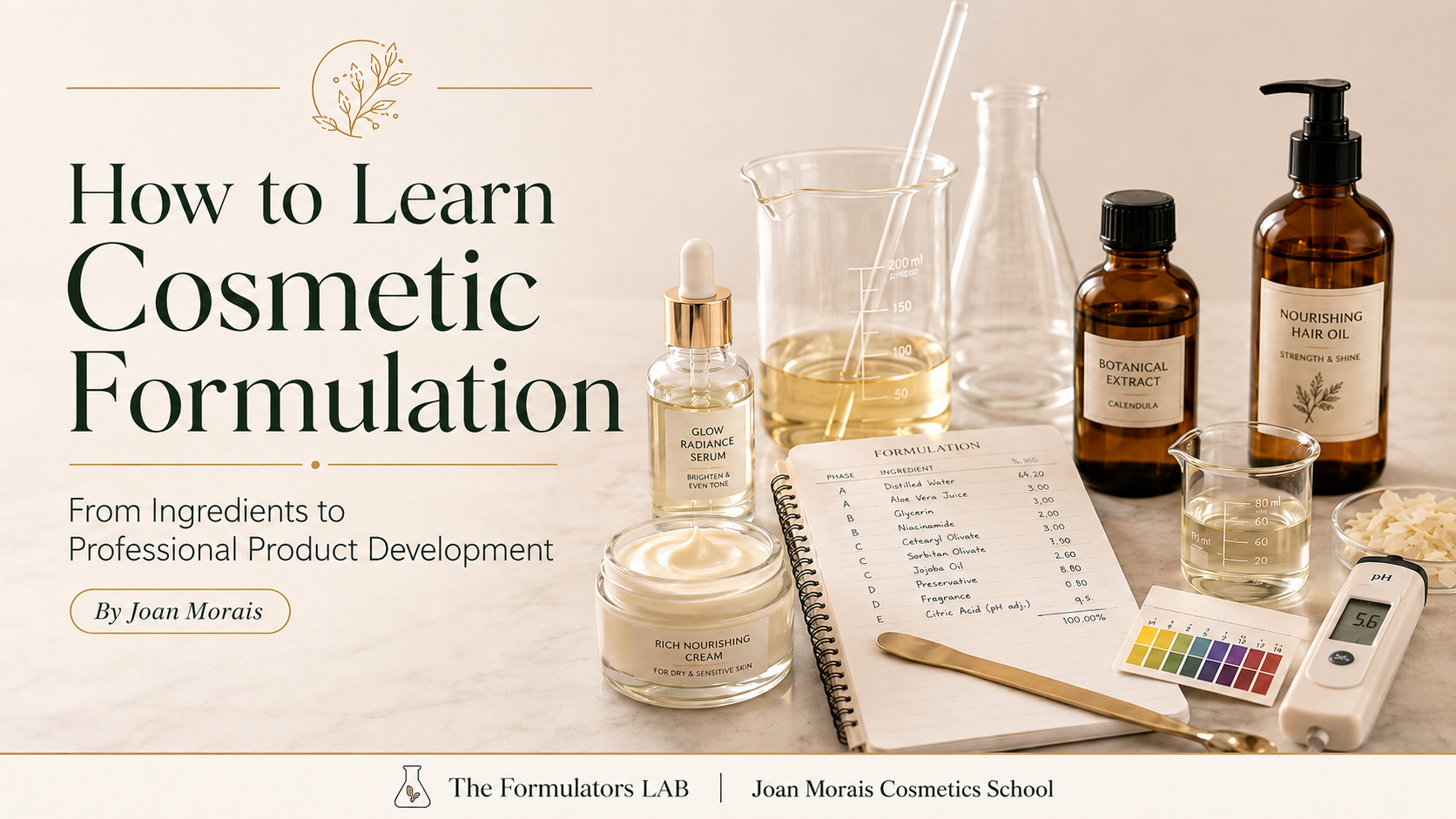
How to Learn Cosmetic Formulation: From Ingredients to Professional Product Development
If you love skin care or hair care and have ever wondered how professional products are actually created, cosmetic formulation is where it all begins.
Cosmetic formulation is much more than following a recipe or combining ingredients that sound appealing. It is the process of designing a product by understanding what each ingredient does, how ingredients interact, how the product should be manufactured, how it will perform, and whether it will remain stable and properly preserved over time.
Whether your goal is to formulate products for yourself, start a skin care or hair care business, improve an existing product line, or develop professional skills as a cosmetic formulator, learning the fundamentals gives you the knowledge to create products with purpose.
At Joan Morais Cosmetics School, I have taught cosmetic formulation online since 2003, with a focus on natural, plant-based, vegan formulations combined with sound formulation science.
What Is Cosmetic Formulation?
Cosmetic formulation is the process of developing a cosmetic product by selecting ingredients according to their:
- Function
- Compatibility
- Safety
- Stability
- Usage level
- Processing requirements
- Sensory characteristics
- Intended performance
A professional formulator doesn’t simply ask:
“What ingredients should I put in this product?”
Instead, we ask:
What do I want this product to accomplish, and what ingredients and formulation system will help me achieve that goal?
That distinction is important.
A recipe may tell you what to combine.
Professional formulation teaches you why ingredients are being used, how much to use, how to process them, how to troubleshoot the formula, and how to evaluate the finished product.
A professional cosmetic formula also needs to consider percentages, preservation, pH, manufacturing procedures, packaging, stability, and testing.
What Does a Cosmetic Formulator Actually Do?
A cosmetic formulator can be involved in every stage of product development.
That may include:
- Defining the purpose of the product
- Identifying the target user
- Selecting ingredients
- Developing formulas in percentages
- Creating manufacturing procedures
- Determining processing temperatures
- Selecting mixing methods
- Adjusting pH
- Adjusting viscosity
- Evaluating texture and sensory feel
- Selecting a preservative system
- Troubleshooting separation or instability
- Conducting or arranging product testing
- Selecting suitable packaging
- Scaling a formula for larger production
- Working with ingredient suppliers
- Communicating with laboratories and contract manufacturers
Formulators may work for cosmetic companies, formulate for their own brand, work independently, compound products in production, consult, teach, or collaborate with contract manufacturers.
Do You Need to Be a Chemist to Learn Cosmetic Formulation?
No.
A chemistry degree can certainly be valuable for particular laboratory, research, and corporate careers, but you do not need to begin as a chemist to learn professional cosmetic formulation.
What you do need is structured training in subjects such as:
- Ingredient science
- Ingredient functions
- Formulation math
- Emulsions
- Surfactants
- Preservation
- pH
- Stability
- Testing
- Good Manufacturing Practices
- Product development
You also need a willingness to practice.
Formulation is a skill.
You study the principles, make products, observe what happens, document your results, make adjustments, test again, and continue building your knowledge.
You do not need to know everything before you begin.
Who Can Learn Cosmetic Formulation?
One of the things I love most about this field is that people come to formulation from many different backgrounds.
Beginners
A beginner can learn formulation from the ground up without relying on disconnected recipes from the internet.
Structured education helps you understand the foundation before moving into more advanced formulation.
Beauty Brand Founders
If you want to launch your own skin care or hair care company, understanding formulation can make you a much more knowledgeable business owner.
Even if you eventually hire a cosmetic laboratory or contract manufacturer, you will be better prepared to communicate what you want and evaluate what they develop for you.
Product Makers
Maybe you already make lotions, creams, shampoos, body butters, oils, conditioners, or other products.
Formulation education can help you understand why your product behaves the way it does and improve its:
- Stability
- Preservation
- Consistency
- Performance
- Texture
- Manufacturing process
Hair and Skin Care Professionals
Hairstylists, trichologists, estheticians, spa professionals, salon professionals, and other practitioners can also benefit from understanding the products they use every day.
Experienced Formulators
Experienced formulators may want to develop new product categories, work with newer ingredients, or strengthen their understanding of natural, sustainable, and vegan cosmetic formulation.
Understanding Cosmetic Ingredients
Learning ingredients is one of the foundations of formulation.
It is not enough to know that an ingredient is “good for skin” or “good for hair.”
You need to understand its function within the formula.
Important ingredient categories include:
- Emollients
- Humectants
- Emulsifiers
- Surfactants
- Conditioning agents
- Thickeners
- Gelling agents
- Solubilizers
- Antioxidants
- Chelating agents
- Preservatives
- Botanical extracts
- Active ingredients
- Fragrance ingredients
- Essential oils
Once you understand functions, ingredient substitution becomes much easier.
Instead of asking:
“What can I substitute for this ingredient?”
you can ask:
“What function is this ingredient providing, and what other ingredient could provide a similar function in this particular formula?”
That is how you begin thinking like a formulator.
Why Professional Formulas Are Written in Percentages
Professional cosmetic formulas are written in percentages because percentages make formulas scalable.
A complete formula totals 100%.
You can then calculate that same formula for different batch sizes, such as:
- 100 grams
- 500 grams
- 1 kilogram
- 5 kilograms
- Larger manufacturing batches
Learning percentage-based formulation is one of the most important skills you can develop as a cosmetic formulator.
Product Development Starts With a Goal
Before reaching for ingredients, first decide what you are trying to create.
Ask:
What type of product am I making?
Cream? Serum? Shampoo? Conditioner? Gel? Balm? Mist?
Who is the product for?
What are their skin, hair, or scalp needs?
What should the product feel like?
Light? Rich? Silky? Creamy? Fluid? Gel-like?
How should it perform?
What benefit is the consumer expecting?
How will it be packaged?
Jar? Pump? Tube? Bottle? Airless container?
The answers influence almost every decision you make afterward.
Skin Care Formulation Requires Understanding the Skin
Skin is not the same from one person to another.
Skin can vary tremendously in type, sensitivity, hydration level, oil production, barrier condition, environmental exposure, and individual needs.
A formulator needs to take those differences into consideration when developing skin care products.
Areas of study may include:
- Skin structure and function
- Skin types and conditions
- Hydration
- Moisturization
- Sensitive skin
- Active ingredients
- Product texture
- Sensory characteristics
- Emulsion systems
- Skin barrier support
Why the Skin Barrier Matters
One of the most important considerations in skin care formulation is supporting the skin’s natural protective barrier.
Keeping the skin barrier intact is essential because it helps the skin retain moisture, protect against environmental stressors and irritants, and maintain healthy, balanced skin.
When developing moisturizers, cleansers, serums, and other products, the goal should not simply be to make the skin temporarily feel soft.
We also want to consider the long-term health and function of the skin.
Professional skin care formulation can include products such as:
- Facial cleansers
- Cream cleansers
- Gel cleansers
- Micellar products
- Toners
- Facial mists
- Serums
- Gel creams
- Lotions
- Creams
- Water-in-oil emulsions
- Facial oils
- Balms
- Masks
- Exfoliating products
- Body moisturizers
- Body oils
- Lip products
Hair Care Formulation Requires Understanding Hair and Scalp
Hair care is equally complex.
Hair can vary tremendously in texture, curl pattern, porosity, density, styling practices, and individual needs.
A product that performs beautifully on one person’s hair may feel completely different on another.
Hair care formulators need to understand areas such as:
- Hair structure
- Hair types and textures
- Porosity
- Scalp care
- Surfactant systems
- Conditioning systems
- Slip
- Detangling
- Frizz control
- Styling
- Hold
- Buildup
- Flaking
Products may include:
- Shampoos
- Sulfate-free cleansers
- Conditioners
- Conditioner bars
- Deep conditioners
- Hair masks
- Leave-in conditioners
- Detanglers
- Hair mists
- Curl creams
- Styling gels
- Hair mousse
- Edge gels
- Edge control
- Hair serums
- Scalp oils
- Hair growth support products
- Products for waves, curls, coils, textured hair, and locs
Hair care formulation requires understanding both the hair fiber and the scalp rather than treating all hair the same.
Manufacturing Procedure Matters
Having the correct ingredients does not guarantee that a formula will work.
How you make it matters.
Ingredient order, temperature, mixing speed, mixing time, shear, hydration, and cooling can dramatically affect a finished product.
For example, an emulsion can have the correct ingredients and percentages and still fail because of the processing method.
A professional formula therefore needs a detailed manufacturing procedure.
The procedure should tell you:
- When ingredients are added
- Which ingredients are heated
- Appropriate temperatures
- How phases are combined
- What type of mixing is required
- When heat-sensitive ingredients are added
- When preservatives are added
- When pH is checked
- How the batch is cooled and finished
Preservation Is Part of Formulation
Preservation should never be an afterthought.
When a cosmetic product contains water, the formulation must be developed with microbial protection in mind.
Preservative selection can depend on:
- Product type
- pH
- Ingredients
- Water content
- Packaging
- Intended use
- Preservative compatibility
- Recommended usage rate
There is no single preservative that is automatically appropriate for every cosmetic formula.
This is why preservative education is an essential part of professional cosmetic formulation.
Why pH Matters
pH can influence many aspects of a cosmetic product.
Depending on the formula, pH can affect:
- Skin compatibility
- Hair performance
- Scalp compatibility
- Preservative effectiveness
- Ingredient stability
- Viscosity
- Surfactants
- Active ingredients
Learning how to measure, monitor, and adjust pH is an important laboratory skill.
A Beautiful Product Still Needs Testing
Making a beautiful cream, serum, shampoo, or conditioner on the first day does not mean the formula is finished.
We need to know what happens over time.
Product evaluation and testing may include:
- Heat stability
- Cold stability
- Freeze-thaw testing
- Emulsion stability
- Packaging compatibility
- pH monitoring
- Product observation
- Microbiological testing
- Preservative efficacy or challenge testing
A formula may look perfect when freshly made and behave very differently several weeks or months later.
Testing provides information that helps us refine products before they reach customers.
Good Manufacturing Practices Matter Too
A wonderful formula can still be compromised by poor manufacturing practices.
Good Manufacturing Practices—or GMP—include areas such as:
- Cleaning and sanitation
- Raw material handling
- Accurate weighing
- Lot tracking
- Batch records
- Equipment cleaning
- Documentation
- Production procedures
- Repeatability
The goal is to be able to produce a product consistently and responsibly from one batch to the next.
Natural Formulation Still Requires Science
I believe strongly in natural, plant-based, and vegan cosmetic formulation.
But natural does not mean avoiding science.
Natural products still need to be:
- Properly formulated
- Appropriately preserved
- Stable
- Tested
- Manufactured correctly
- Suitable for their intended use
Our formulation approach includes:
- Plant-based and vegan ingredients
- Green chemistry principles
- Sustainable ingredient considerations
- Renewable ingredient considerations
- Ingredient performance
- Ingredient safety
- Appropriate preservation
- Responsible essential oil use
- Evidence-based product development
- No animal-derived ingredients
Nature and science work beautifully together.
A natural cosmetic product should meet professional formulation standards just as any other cosmetic product should.
From an Idea to a Finished Cosmetic Product
Professional cosmetic product development usually follows a progression.
1. Define your product concept.
What do you want to make?
2. Identify your target customer.
Who is the product for?
3. Choose your product format.
Cream, serum, shampoo, conditioner, mist, balm, gel, oil, or another format?
4. Research ingredient functions.
Choose ingredients based on what the formula needs.
5. Draft your formula in percentages.
Determine the purpose and percentage of every ingredient.
6. Develop the manufacturing procedure.
Determine ingredient order, phases, temperatures, and mixing.
7. Make your laboratory batch.
Document exactly what you do.
8. Evaluate your product.
Look at appearance, texture, aroma, pH, application, and performance.
9. Revise your formula.
Improve the areas that need adjustment.
10. Conduct stability and microbiological testing.
Determine how the product performs over time.
11. Select packaging.
Make sure the packaging is compatible with the formula.
12. Scale your formula.
Move from your laboratory batch toward larger production.
13. Prepare for manufacturing.
Finalize the formula, procedures, testing, documentation, and production requirements.
Should You Learn Formulation If You Plan to Use a Contract Manufacturer?
Yes—it can be extremely valuable.
You do not have to personally manufacture your products forever to benefit from learning formulation.
When you understand product development, you can communicate much more effectively with a contract manufacturer.
You can better:
- Define your product
- Identify preferred ingredients
- Identify excluded ingredients
- Communicate your desired texture
- Evaluate prototypes
- Understand ingredient choices
- Ask informed questions
- Understand product testing
- Review manufacturing requirements
- Discuss costs and minimum order quantities
Instead of telling a manufacturer:
“I want a really good natural moisturizer.”
you can develop a detailed product brief explaining what you actually want.
That knowledge can make you a much stronger brand owner.
Cosmetic Recipes vs. Professional Formulation
There is nothing wrong with beginning with recipes.
Recipes can be an enjoyable introduction to cosmetic making.
But there is a difference between a recipe and professional formulation.
| Cosmetic Recipe | Professional Formula |
|---|---|
| May use cups, teaspoons, or drops | Written in percentages |
| Often made for one batch size | Can be accurately scaled |
| May not explain ingredient functions | Ingredients have defined functions |
| Preservation may not be addressed | Preservation is deliberately selected |
| Limited testing information | Stability and testing are considered |
| Simplified instructions | Manufacturing procedures are documented |
| Often copied directly | Developed for a defined product goal |
Recipes teach you what to make.
Formulation teaches you how to develop products.
How Long Does It Take to Learn Cosmetic Formulation?
There is no single answer.
You can begin making products relatively quickly, but becoming a confident formulator takes practice.
Your skills grow through:
Study → Make → Observe → Document → Test → Refine → Repeat
Each formulation teaches you something.
Sometimes your unsuccessful batches will teach you even more than your successful ones.
This is also why having lifetime access to your formulation education can be valuable. You can return to subjects as your experience grows rather than trying to master everything at once.
What Equipment Do You Need to Begin?
You do not need a fully equipped commercial cosmetic laboratory to start learning.
Basic equipment may include:
- Digital scale
- Heat-safe beakers
- Mixing vessels
- Thermometer
- Mini mixer
- Laboratory homogenizer or appropriate mixer
- Spatulas
- Pipettes
- pH meter or quality pH strips
- Sanitizing supplies
- Gloves
- Labels
- Formulation or batch notebook
Start with what you need for the formulations you are learning.
Your equipment can grow along with your skills.
How to Choose a Cosmetic Formulation Course
If you are considering professional cosmetic formulation education, look beyond the number of formulas included.
Ask whether the training teaches you:
- Ingredient functions
- Percentage-based formulation
- Complete manufacturing procedures
- Preservation
- pH
- Emulsions
- Surfactants
- Stability
- Microbiological testing
- GMP
- Troubleshooting
- Scaling
- Supplier guidance
- Hands-on product development
Also investigate the instructor.
Who created the program?
How much formulation experience do they have?
Can you clearly see what the curriculum includes before purchasing?
Does the program teach you the reasoning behind formulations or simply give you recipes to follow?
Does it provide ongoing access so you can return to your education as your skills grow?
Begin With the Products You Want to Formulate
You do not have to learn every area of cosmetic formulation at once.
If you want to develop professional skin and body products, begin with comprehensive skin care formulation training.
If your passion is shampoos, conditioners, styling products, scalp products, curls, coils, textured hair, and locs, begin with hair care formulation training.
If you want to focus on one particular product, an individual formulation class may be the right place to begin.
The important thing is to build a solid foundation and then continue expanding your knowledge.
At Joan Morais Cosmetics School, students can choose from:
Professional Natural Skin Care Formulation Course
Comprehensive professional education in skin and body care formulation.
Explore the Skin Care Formulation Course
Professional Natural Hair Care Formulation Course
Comprehensive professional education in hair and scalp formulation.
Explore the Hair Care Formulation Course
Individual Formulation LAB Classes
Focused classes for learning specific product formulations.
Explore Formulation LAB Classes
Compare our Courses and Classes
You Can Learn Cosmetic Formulation
You don’t need to begin as a chemist.
You don’t need an elaborate laboratory.
And you don’t need to know how to formulate every product before you start.
Begin with the fundamentals.
Learn your ingredients.
Understand percentages.
Learn proper procedures.
Make your products.
Observe them.
Document your work.
Test them.
Make changes.
Then do it again.
With education and hands-on practice, you begin moving from simply making cosmetic products to understanding how to formulate them.
And that is where the real creativity begins.
You might also like