
Peptides vs. Ceramides in Haircare: What Works, Where, and Why
Part 3 of 3 • Peptides and Ceramides Educational Series
Part 1: Peptides in Skincare is here.
Part 2: Ceramides in Skincare is here.
by Joan Morais
Hair and scalp are two different formulation targets
The hair shaft is a nonliving keratinized fiber. The scalp is living skin with follicles. A product that makes the hair fiber smoother or easier to comb is not necessarily a product that stimulates growth. Separating hair-fiber claims from scalp and follicle claims is the most important first step in choosing peptides or ceramides.
What do ceramides do in hair?
Hair contains a cell membrane complex (CMC) with lipid components that help organize and connect structural regions of the fiber. Ceramides are among the lipids associated with hair structure. Chemical treatments and weathering can change fiber lipids. Adding a compatible ceramide system to a conditioner or leave-in is a plausible conditioning strategy, but deposition and measurable improvement depend on the entire formula.
What do peptides do in haircare?
“Peptide” is not one performance category. Hydrolyzed proteins contain mixtures of peptides and amino acids; depending on molecular size and charge, they may form films, condition the surface, or interact with damaged hair. Specialty peptides such as Biotinoyl Tripeptide-1 and Copper Tripeptide-1 are marketed for scalp or follicle applications. Their hair-growth evidence should not be confused with studies of hydrolyzed proteins (protein hydrolysates) on hair-fiber breakage.
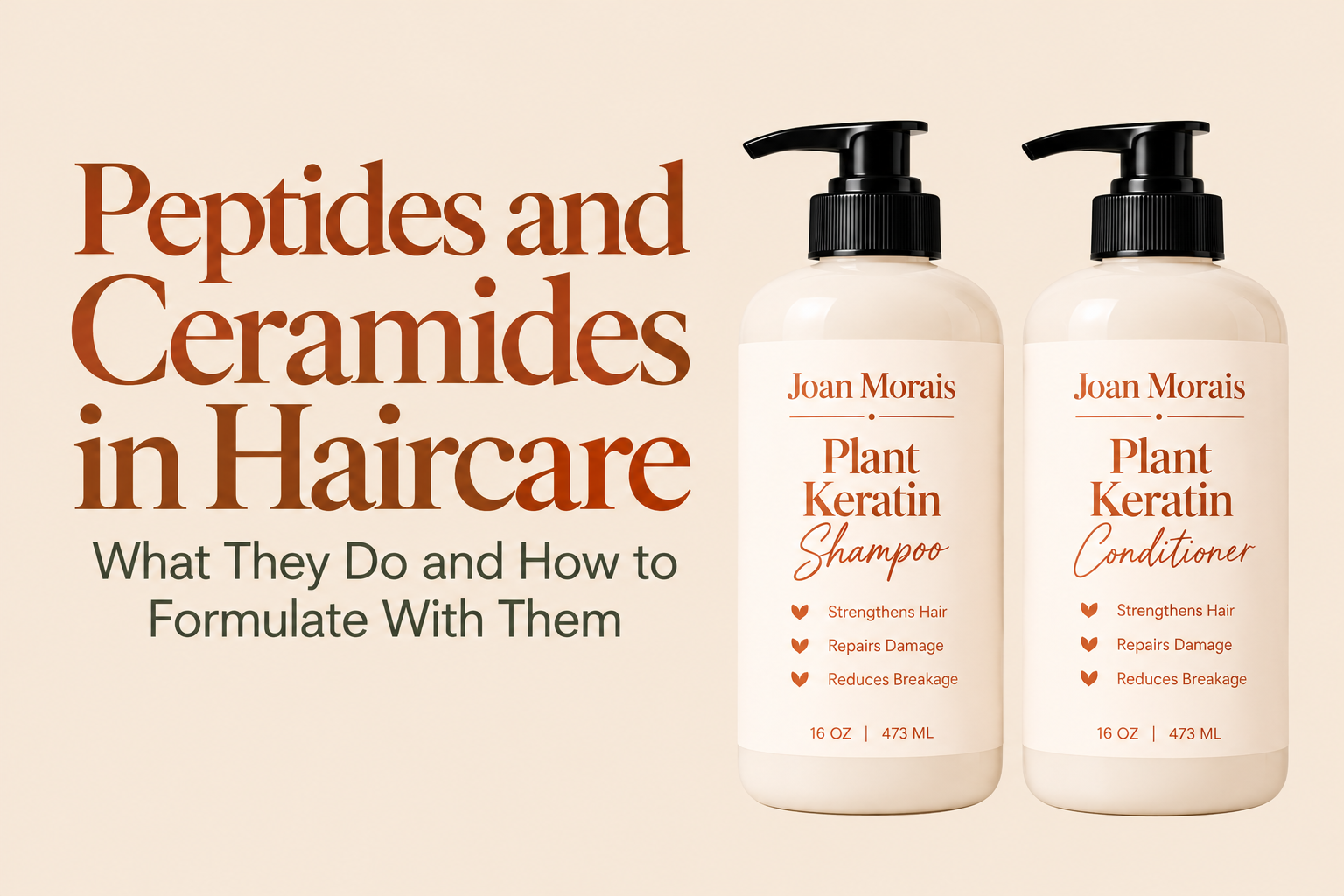
Learn about the Plant Keratin Shampoo and Conditioner Formulation in the Pro Hair Course
Where did the science come from?
Hair fiber science grew from research into keratin, the cuticle, cortex, and cell membrane complex. Separately, peptide chemistry and follicle biology led to investigations of signaling molecules in scalp products. Modern marketing often combines these distinct lines of research, so formulators need to trace every claim back to the exact ingredient, application, and test endpoint.
Peptides and ceramides for hair: comparison chart
| Ingredient | What it may contribute | Best format | Evidence caution | Vegan status | How it is derived |
|---|---|---|---|---|---|
| Ceramide NP / Ceramide Complexes | Hair fiber lipid conditioning; scalp barrier support | Masks, leave-ins, conditioners, scalp care | Hair-specific evidence depends on the grade and finished product | Commonly vegan; verify complete complex | Chemically synthesized or produced through fermentation. Some complexes contain additional lipids, including cholesterol, which may be animal-derived. |
| Hydrolyzed Rice / Pea / Quinoa Protein | Film formation and conditioning; some grades may reduce breakage | Conditioners, leave-ins, treatments | Performance depends on molecular-weight distribution and testing methods | Vegan when sourced from the stated plants | Proteins extracted from rice, peas, or quinoa are broken into smaller peptides and amino acids through enzymatic or chemical hydrolysis. |
| Hydrolyzed Plant Keratin | Hair fiber affinity and conditioning; may improve damaged hair properties | Repair masks, conditioners | Ingredient- and grade-specific hair fiber testing | Vegan; verify complete complex | Plant keratin is vegan. Traditional keratin is extracted from animal-derived materials such as wool, feathers, or hair, then hydrolyzed. |
| Biotinoyl Tripeptide-1 | Marketed for fuller-looking hair and scalp care | Leave-on scalp serum | Primarily supplier-supported evidence; hair-regrowth claims require stronger clinical support | Commonly vegan | Chemically synthesized tripeptide modified with a biotin group. |
| Copper Tripeptide-1 | Investigated for follicle biology and scalp conditioning | Scalp serum | Limited human clinical evidence for hair growth | Commonly vegan | Chemically synthesized tripeptide (GHK) complexed with copper ions. |
| Acetyl Tetrapeptide-3 | Marketed in hair-density and scalp treatment complexes | Scalp serum | Primarily supplier-led evidence; evaluate the complete commercial blend | Commonly vegan | Chemically synthesized tetrapeptide modified with an acetyl group. |
Which is better for damaged hair?
For a rinse-off conditioner or mask, start with the conditioning system: cationic surfactant, fatty alcohols, suitable emollients, pH, and deposition. A well-chosen hydrolyzed protein can add film-forming and conditioning effects. A ceramide complex can support a lipid-replenishment concept, especially in leave-ons and masks, but neither ingredient should be assumed to permanently repair split ends or reverse severe chemical damage.
Which is better for scalp care or fuller-looking hair?
For a dry, uncomfortable scalp, barrier-supporting ingredients and gentle cleansing are more relevant than a fashionable hair-growth peptide. For fuller-looking hair or reduced visible shedding, a supplier-supported specialty peptide may be considered, but distinguish cosmetic appearance claims from medical hair-regrowth claims.
Formulator’s Note:
Human studies of the exact finished treatment are much more persuasive than cell-culture data alone.
Human studies of the exact finished treatment are much more persuasive than cell-culture data alone.
Joan’s Formulation Tip
When selecting peptides or ceramides for hair care, consider whether your primary goal is to improve the hair fiber or support scalp health.
-
For damaged hair: Consider ceramide complexes and hydrolyzed plant proteins in conditioners, masks, and leave-in treatments.
-
For scalp treatments: Investigate specialty peptides such as Biotinoyl Tripeptide-1, Copper Tripeptide-1, and Acetyl Tetrapeptide-3.
-
For vegan formulations: Choose supplier-verified vegan ingredients and check all components of commercial peptide and ceramide blends.
Remember: A peptide or ceramide with promising laboratory results does not necessarily produce measurable benefits in a finished hair care product. Look for hair-specific testing, appropriate use levels, and evidence supporting the exact commercial ingredient.
Supplier studies versus independent studies
Ask whether a study measured combing force, tensile strength, breakage, shine, scalp hydration, hair counts, or participant impressions. These are different endpoints. Supplier-funded tests can be rigorous but may use small samples, proprietary blends, or comparisons against a weak control. Independent replication, blinded assessment, adequate sample size, and a clearly identified formulation increase confidence. Do not transfer results from one peptide complex to another peptide with a similar-sounding name.
What to consider for vegan formulas
Hydrolyzed keratin is commonly animal-derived. Vegan alternatives include hydrolyzed rice, pea, quinoa, or other plant proteins, but their amino-acid profiles, molecular-weight distributions, and deposition behavior differ. Obtain source and vegan declarations from the supplier. Many commercial ceramide systems are synthetic or biotechnology-derived, but verify each grade and its carriers.
Formulation and preservation considerations
Ceramide complexes can contain emulsifiers, lipids, and solvents that affect viscosity and stability. Protein hydrolysates may contribute odor, color, electrolytes, or microbial burden. Specialty peptide solutions may have pH and heat limitations. Follow supplier guidance, check active concentration, and conduct stability, preservative challenge testing for water-containing products, and packaging compatibility testing. Do not assume a preservative present in the raw material preserves the finished formula.
How to decide whether the cost is justified
Make a control formula without the specialty active and a matched version with it. Test wet/dry combing, breakage, softness, shine, and consumer perception for hair-fiber products. For scalp products, choose appropriate ways to evaluate their effectiveness, such as improvements in scalp comfort, hydration, dryness, flaking, and overall appearance. Compare performance with the added cost, manufacturing complexity, and label claim requirements. Premium ingredients should earn their place through a meaningful improvement.
What Formulators Should Know
Ceramides are especially beneficial in hair care products designed to support the hair’s natural lipid layer and in scalp care products that help maintain a healthy skin barrier and reduce moisture loss. Hydrolyzed protein peptides can be useful hair-fiber conditioners. Specialty peptides are a separate category for scalp-targeted products with more variable clinical support. Choose by product goal and evidence, not by whether the ingredient is trendy.
Free Formulator’s Guide
Peptides and Ceramides in Haircare
Download this free guide for a clear, practical reference you can use at your formulator bench.
Series links: Part 1—Peptides in Skincare; Part 2—Ceramides in Skincare; Part 3—Peptides and Ceramides in Haircare
Resources
- Robbins CR. Chemical and Physical Behavior of Human Hair. 5th ed. Springer; 2012.
- Dias MFRG. Hair cosmetics: an overview. Int J Trichology. 2015;7(1):2–15.
- Gavazzoni Dias MFR et al. The shampoo pH can affect the hair: myth or reality? Int J Trichology. 2014;6(3):95–99.
You might also like